
CountryHouse at Granite Bay
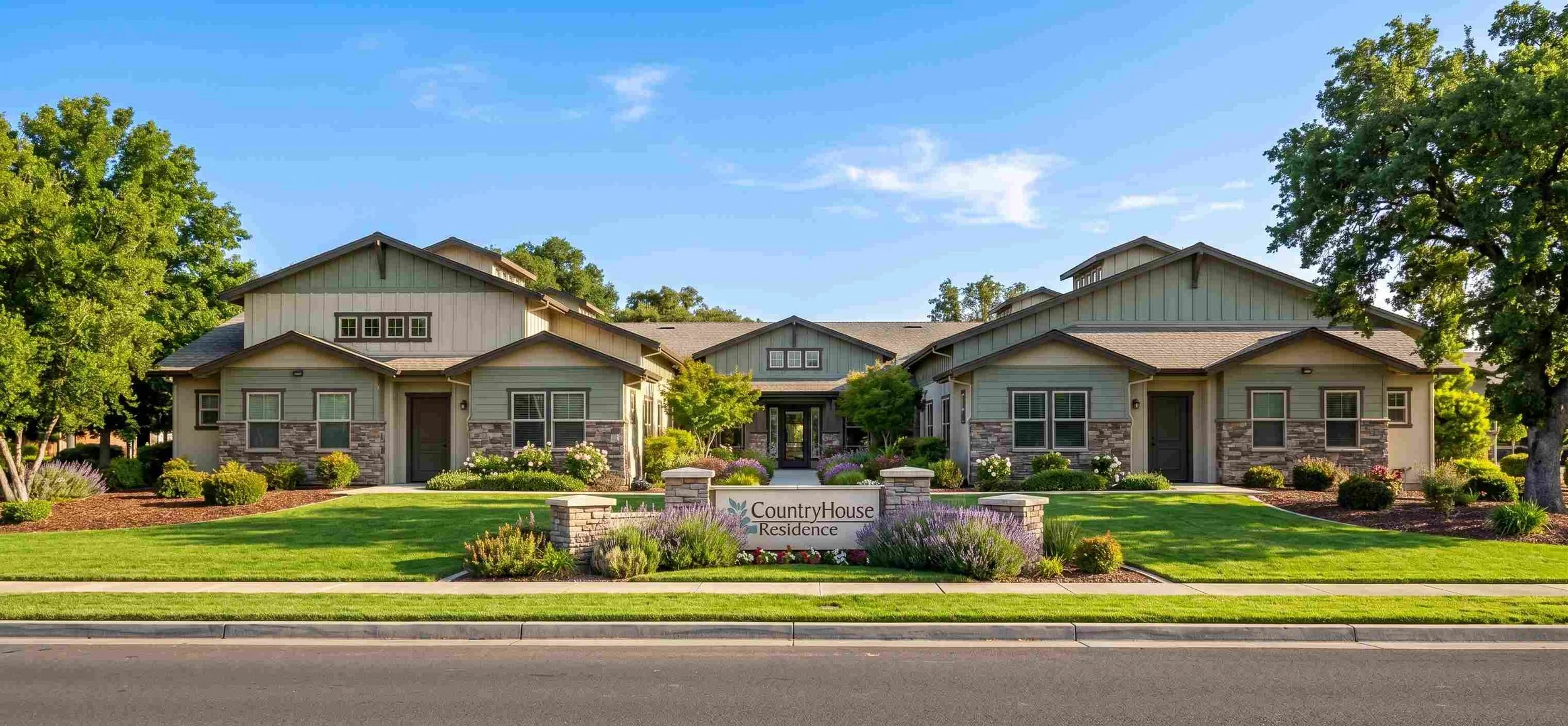
Assisted living Roseville families tour usually means a general community with a memory care wing. CountryHouse at Granite Bay is the other shape: a single dementia-focused house at 8485 Barton Rd, licensed by the state as Granite Bay Countryhouse LLC, license number 312700033. That difference changes almost everything about how a day there feels.
The community has been open since 2015 and is part of the Agemark family of senior living communities. State records list a licensed capacity of 49, and the community itself says up to 45 residents live there at a time. It sits about 25 miles from Sacramento, near the north shore of Folsom Lake.
What the Community Looks Like Day to Day
It is built to feel like a house rather than a floor of a building, which is the point of the design. The grounds are secured but open, so a resident can go outside without anyone unlocking a door for them.
The community describes an outdoor area with a circulating creek, a large shady oak, a lawn for outdoor games, a strolling path and a furnished patio. Inside there is a living room with a fireplace, a resident kitchen used for baking and cooking activities, a sun room, and a full-service salon and spa with a whirlpool tub.
Rooms and What They Cost
Five room types are offered: companion rooms, private and deluxe private rooms, and private and deluxe rooms on the second floor, called Granite Heights. Every room has a private bathroom, shared in companion rooms, with individually controlled heating and air conditioning and utilities included in the monthly rate.
The published starting rates put a companion room from $5,595 a month and a private room from $6,695. Respite stays start at $300 for a 24-hour period, and the community does not offer day stays. A one-time community fee applies, and annual increases happen.
How Care Levels Are Priced
Base rent covers the room, meals and snacks, housekeeping, activities, transportation and utilities. Hands-on help such as medication delivery, bathing or dressing assistance is charged separately, and the wellness director assesses each person before move-in to decide which services are needed.
There are four care levels, priced by the minutes a service takes and the training of the staff member providing it. Level one starts at $950 a month, and care beyond level four is billed by minutes and points. Ask what level the assessment produced and what would push someone to the next one, because that number moves.
What Memory Care Adds to Assisted Living
Memory care is assisted living with a locked perimeter, dementia-trained staff and a day built around routine. Knowing the distinction helps you compare CountryHouse with the general communities nearby.
The National Institute on Aging describes assisted living as care for people who need help with daily tasks but not around-the-clock nursing, with residents in their own rooms and access to meals, help with personal care and medications, housekeeping, 24-hour supervision and activities. Some assisted living facilities also run special Alzheimer’s units with staff who check on and care for people with dementia.
The same guidance is blunt about money: most people pay assisted living costs themselves, Medicare does not pay for it, Medicaid coverage depends on the state and eligibility, and some long-term care insurance policies cover part of it. Plan around that before you fall in love with a room.
If you are still working out whether the need is memory care or general assisted living, a clinician’s assessment is more useful than a family debate. Screening tools such as the clock drawing test are one small part of how that picture gets built.
How Medical Care Works Once Someone Moves In
A residential care facility is a home, not a clinic, so routine medical care still comes from outside. That is the piece families most often discover late.
Staff can remind and deliver medications, watch for changes and call you. They do not diagnose, adjust prescriptions or order tests. Those decisions stay with the resident’s own physician, and appointments mean transport, a waiting room and a long afternoon for someone with dementia.
Many families solve this by arranging a physician who visits residents where they live, which keeps routine reviews, follow-ups and the occasional urgent question inside the building. Ask the community which visiting providers already come to the house, since an established relationship makes scheduling far easier.
Ask two more questions while you are there: how often a nurse or wellness director reviews each resident, and what the community does at night when something changes. The answers tell you how much of the medical coordination will land on you.
What to Look For When You Tour
Visit more than once, at different times of day, and watch the staff rather than the furniture. A quiet Tuesday morning and a late afternoon are two different communities.
Watch the Room, Not the Brochure
The National Institute on Aging suggests asking yourself how the staff care for residents, whether the place feels comfortable, whether the people living there look clean and well cared for, whether mealtimes feel relaxed, and whether staff speak to residents with patience and respect.
Those observations are worth more than the amenities list. Late afternoon is often the hardest stretch of the day for someone with dementia, which makes it the most informative hour to be standing in the room.
Questions Worth Asking the Staff
NIA also suggests asking what activities are planned, how many staff are on duty and how many are trained for medical care, how many residents have Alzheimer’s, whether a doctor checks on residents regularly, what a typical day looks like, whether there is a safe outdoor space, and what is included in the fee versus what costs extra.
Add one more about leaving. Ask what would cause the community to say it can no longer meet someone’s needs, because that answer defines how long this move lasts. The guidance on finding long-term care for a person with Alzheimer’s also advises talking with other families at the facility before you sign anything.
The contract deserves the same attention as the tour. Questions to ask before signing an assisted living agreement covers the clauses that matter most, and a step-by-step way to compare homes helps when three places start to blur.
Living in Granite Bay and the Roseville Area
Granite Bay is a quiet, leafy community in Placer County, just east of Roseville and close to the north shore of Folsom Lake. For families, the appeal is that it is unhurried without being remote.
Roseville sits a short drive west with its hospitals, shops and restaurants, and Sacramento is roughly 25 miles away. Folsom is close enough that families often tour both CountryHouse houses, since the company runs a sister residence there.
Practically, the location matters most for visiting. A community you can reach in fifteen minutes gets visited on a weekday evening. One that takes an hour gets visited on Sundays, and residents feel that difference more than any amenity.
Address, License and Contact Details
CountryHouse at Granite Bay is at 8485 Barton Rd, Granite Bay, CA 95746, in Placer County. The telephone number is (916) 899-6565.
The facility is licensed by the California Department of Social Services as Granite Bay Countryhouse LLC, license number 312700033, with a licensed capacity of 49 and a first license date of 24 October 2016. The licensee is listed together with Agemark Mgmt LLC.
Room details, current rates and tour requests are on the community’s own pages, and staff can confirm availability, which changes week to week. Verify anything in this overview directly with them before you make a decision.
If You Are Deciding Right Now
Do three things this week: book a tour for a late afternoon, ask for the current rate sheet in writing, and start the physician’s report. Those three move in parallel rather than in sequence.
If you are comparing several communities across Roseville, Granite Bay and Folsom and the details have started running together, a placement specialist can narrow the list to the ones that actually accept your situation. Placement agencies in the network do this locally, and how placement specialists work explains what to expect from one.
Whatever you decide, keep the paperwork moving. Assessments expire, rooms get taken, and the families who find this easiest are usually the ones who started the forms before they had settled on an answer.
Sources Used
Alzheimer’s Caregiving: Finding Long-Term Care – National Institute on Aging (2024)
Clock Drawing Test: What It Means for Memory – Doctor2me
Doctor2me Provider Network: Primary Care & Medical Specialists – Doctor2me
Doctor2me Provider Network: Placement Agencies – Doctor2me
How Placement Specialists Match Older Adults with the Right Senior Living Community – Doctor2me
How to Choose the Right Assisted Living Home: A Step-by-Step Guide – Doctor2me
Long-Term Care Facilities: Assisted Living, Nursing Homes, and Other Residential Care – National Institute on Aging (2023)
Questions to Ask Before Signing an Assisted Living Agreement – Doctor2me
Request Form LIC602 – Doctor2me

Written by Sofiia Puhach
September 26, 2026
Explore More Assisted Living Communities

Address: 4075 54th Street, San Diego, CA 92105