
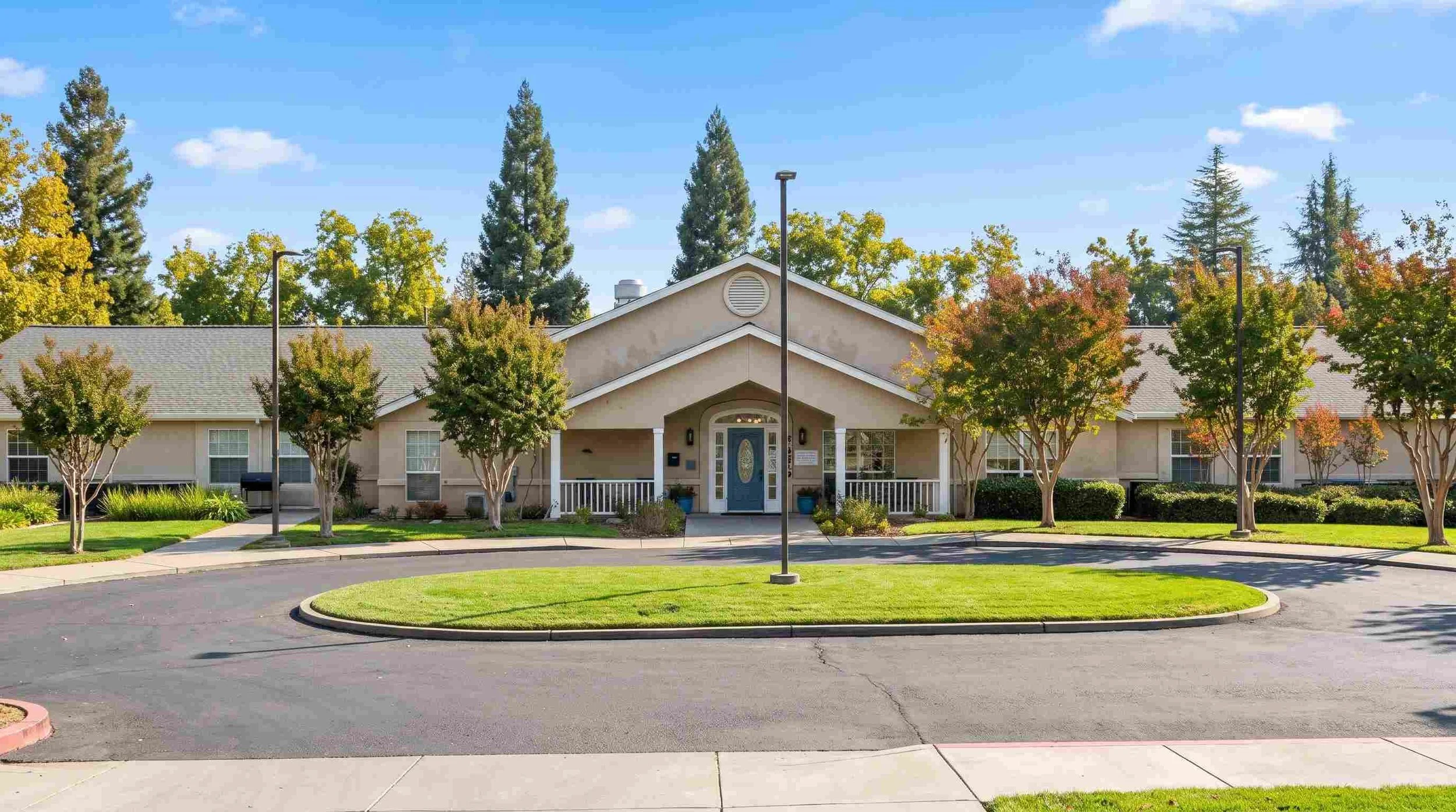
Brookdale Sylvan Ranch sits at 7375 Stock Ranch Road, Citrus Heights, CA 95621, and holds California license number 347003712 with a licensed capacity of 56 residents. Among the options for memory care in Citrus Heights, this one stands out for a simple reason: it does memory care and nothing else.
That matters more than it sounds. Many communities in the Sacramento suburbs run an assisted living wing with a smaller locked memory care wing attached, so staffing, activities and the daily rhythm are shared between two very different groups of residents. Here the whole building, the programming and the training are pointed at one thing.
What Brookdale Sylvan Ranch Offers
Memory care is the only level of care listed. The community describes a person-centered approach built on gentle routines and familiar experiences, with six structured programs through the day and a trained staff member available around the clock to respond if something happens at three in the morning.
The building itself is set up for people who wander and for people who get restless indoors. Published features include secured entrances, an enclosed courtyard, a greenhouse, a hair salon, an art studio and a game room, plus personalized living spaces where residents can bring their own furnishings, keepsakes and, in some cases, a pet.
The Daily Programming
Brookdale runs its dementia programming under the name Clare Bridge, which it describes as a daily path of gentle, structured activities, including sensory experiences, brain games, dancing and cooking. The stated aim is a routine that supports whatever abilities a person still has rather than filling hours.
Consistent Care Partners
One detail worth asking about on a tour is consistency of staffing. The community says it aims to assign the same dementia care partners to a resident so relationships build over time, which for someone who no longer remembers new faces is often the difference between a calm morning and a frightening one.
What Memory Care Means in a Licensed California Community
Memory care is a specialized setting inside the assisted living world rather than a separate kind of license. The National Institute on Aging explains that facility-based long-term care runs from assisted living through group homes to nursing homes, and that many assisted living communities add special units with staff who check on and care for people with dementia.
The practical differences show up in three places: the doors, the staffing ratio and the programming. A memory care setting is built so a resident cannot leave unnoticed, has more staff per resident than general assisted living, and runs a day structured around cueing and routine rather than independence.
What it is not is skilled nursing. A residential care community in California provides supervision, personal care and help with daily tasks, while ongoing medical treatment comes from outside providers who visit, or from a hospital when something acute happens. Families sometimes learn this distinction at an awkward moment, so it is worth being clear about it up front.
The Changes That Usually Bring Families to This Point
Most families arrive after a slow accumulation rather than one dramatic event. The CDC lists ten warning signs that separate ordinary aging from something more: memory loss that disrupts daily life, trouble with planning or problem solving, difficulty with familiar tasks, confusion about time or place, problems understanding visual images and spatial relations.
The list continues with new problems with words in speaking or writing, misplacing things and being unable to retrace steps, poor judgment, withdrawal from work or social activities, and changes in mood or personality. Memory is only one item among ten, which is why families often miss the pattern for a while.
The CDC also makes a point that applies to timing. Early diagnosis gives people a chance to identify the cause of the changes and to plan, which includes looking at communities before a crisis forces a decision in a weekend. Touring while nothing is urgent is a very different experience.
Medical Care Once Someone Lives Here
A residential community provides care and supervision, while medical treatment comes from outside. Day-to-day medical needs stay with the resident's own doctors, which in practice means someone has to coordinate the visits, the prescriptions and the paperwork the community keeps asking for. For a family spread across several cities, that coordination is the real work.
Home visits solve most of the friction. A physician who sees patients where they live can handle routine reviews, the forms the community needs on file, and the first look when staff notice a change, without the strain of loading someone with dementia into a car and sitting in a waiting room.
Ask the community how it handles a change of condition: who calls the doctor, who calls you, and at what point someone goes to the emergency room. The answer tells you a great deal about how the place runs when it is short-staffed on a Sunday.
The Citrus Heights Neighborhood Around Stock Ranch Road
Stock Ranch Road sits in the eastern part of Citrus Heights, in Sacramento County, a few minutes from Sunrise Boulevard and the shops and restaurants clustered around it. The surrounding streets are quiet, flat and residential, which makes short walks with a visiting family member realistic.
Location matters here for an unglamorous reason: visit frequency. Families who live in Roseville, Orangevale, Fair Oaks or Antelope can reach this part of Citrus Heights in fifteen to twenty-five minutes outside rush hour, and the people who visit most often are the ones for whom the trip is short enough to do on a weekday evening.
If you are comparing options in the same city, another Citrus Heights community offering both assisted living and memory care is worth seeing on the same day. Touring two places within a few hours of each other makes the differences in atmosphere much easier to notice than a tour a week apart.
Questions Worth Asking Before You Choose
The National Institute on Aging suggests visiting a few places, asking friends, relatives, social workers or health care providers for suggestions, and visiting at different times of day. Its questions are deliberately plain: how does the staff care for residents, is the staff friendly, does the place feel comfortable, do the residents look clean and well cared for, are mealtimes comfortable.
Add a few that matter specifically for memory care. What is the ratio of care staff to residents on the overnight shift, how much dementia-specific training do new hires get, what happens when a resident becomes agitated in the evening, and what behaviors would mean the community could no longer keep someone.
Watch the Small Signals
The atmosphere tells you things a brochure cannot. Listen for how staff speak to residents who are confused, look at whether people are sitting alone with the television on, and notice whether the courtyard is actually being used. A guide to the red flags that show up on tours is useful to read before you go, while you can still be objective.
Compare Against a Known Standard
It helps to have seen more than one memory care community before deciding. Reading through a detailed overview of another memory care community gives you a reference point for what the licensing details, the staffing answers and the daily programming usually look like, so the tour is not your only frame.
Contact and the Next Step
Brookdale Sylvan Ranch is at 7375 Stock Ranch Road, Citrus Heights, CA 95621, and the phone number published on its own page is 279-277-6420. Licensing records list the facility under license number 347003712 with a capacity of 56 and a first licensing date in May 2007, which makes it a long-established address rather than a new operation.
Pricing, availability and floor plans change often, so those are worth asking about directly through the community's own page rather than relying on a listing site. Ask for the current monthly rate, what the care-level add-ons cost, and what triggers a rate increase.
If the search is wider than one community, a placement advisor shortens it considerably. An agency that places families in senior housing already knows which communities in the Citrus Heights and Roseville area have openings, which accept a given level of need, and which have recent licensing issues worth knowing about.
Whatever you decide, start the physician's report early. The form has to be completed and signed before a move-in, and a doctor's visit arranged at the last minute is the single most common reason a planned move slips by a week or two.
Sources Used
Alzheimer's Caregiving: Finding Long-Term Care – National Institute on Aging (2024)
Brookdale Sylvan Ranch – Brookdale Senior Living
Signs and Symptoms of Alzheimer's – Centers for Disease Control and Prevention (2024)

Written by Sofiia Puhach
November 10, 2026
Explore More Assisted Living Communities

Address: 7375 Stock Ranch Road, Citrus Heights, CA 95621