
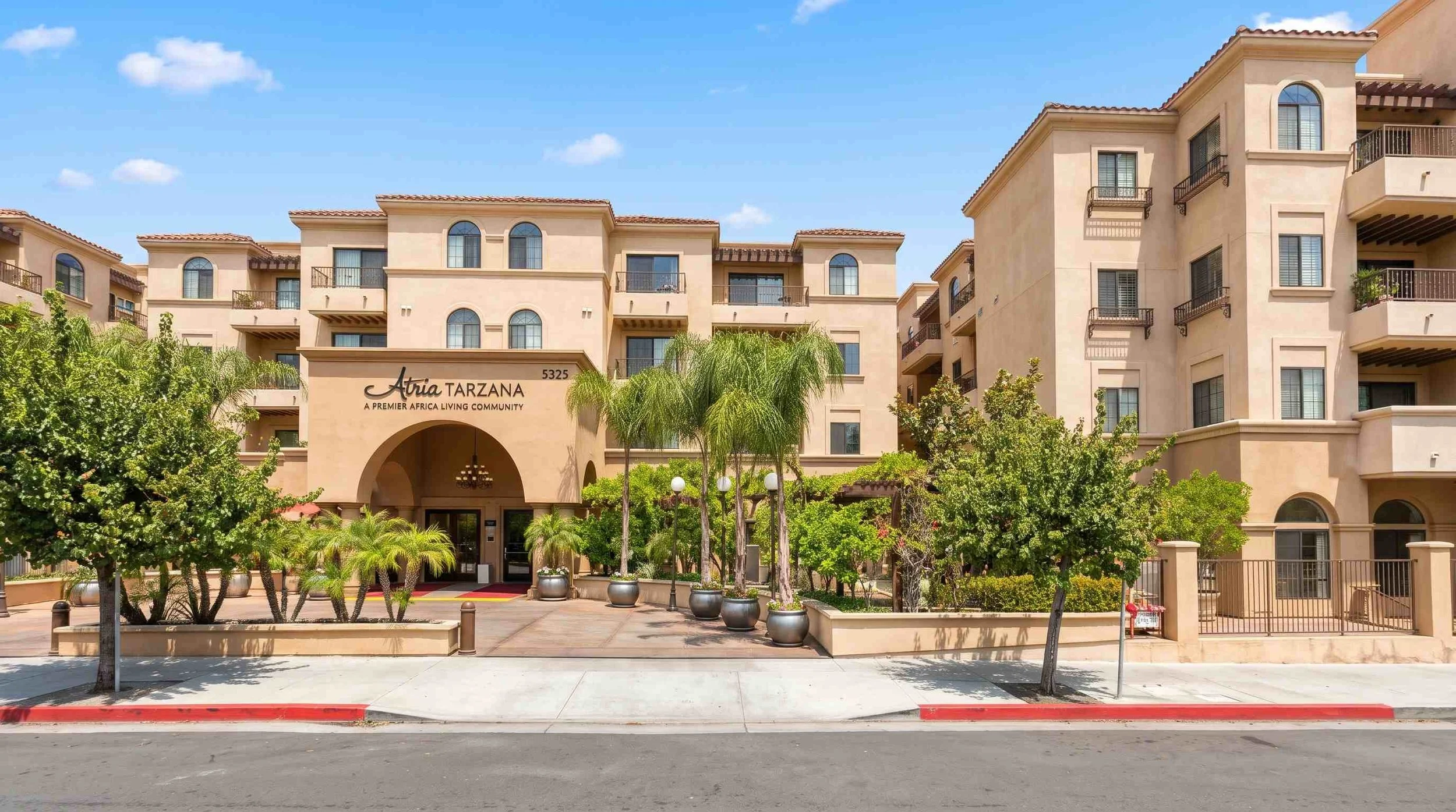
For families looking at assisted living in Tarzana, this is one of the larger options in the area. Atria Tarzana is at 5325 Etiwanda Ave, Tarzana, CA 91356, licensed by the state under number 197610142, with a licensed capacity of 136.
What Atria Tarzana Is, and What It Is Not
It is a full-service retirement community rather than a small care home. The community's own pages describe both independent living and assisted living under one roof, which is the model that lets a resident move from one level of support to another without changing address.
State records list the first license date as August 20, 2021, with WG Tarzana, LP and Atria Management Company, LLC as the licensee and Irma Arteaga as the facility administrator. The licensed capacity is 136 and the community's published phone number is (818) 344-4164, which is the one to use rather than the corporate line.
About Memory Care
The community's own pages describe independent living and assisted living and do not set out a memory care program, while an internal note in the state file mentions memory care. That gap is worth resolving in a phone call rather than assuming either way, especially if dementia is already part of the picture.
Why Size Changes the Experience
At 136 licensed beds this is a busy building, with several dining venues and a full events calendar. Residents who want company, activity and a choice of where to eat tend to do well in that setting. Someone who is easily overwhelmed by noise and movement may find a smaller home a better fit.
What Assisted Living Includes Here
The community describes assisted living as help with daily activities delivered in a resident's own apartment. Listed support includes assistance getting out of bed, personal grooming and dressing, help with bathing, grooming and incontinence, escorts to and from meals and events, and assistance with administering medication.
Care levels are set by assessment rather than by request. A licensed on-site nurse carries out what the community calls a thorough care assessment for each resident, and that assessment is used to match the person with the right level of care and staffing.
Medication Oversight
The published service list includes medication reviews and consultations with physicians, which is the part families most often overlook when comparing communities. A resident arriving from hospital with eight new prescriptions needs that review in the first week, not at the next annual visit.
Staffing Around the Clock
The community states that it has 24-hour staff and a team of employees on site at all times, along with telehealth access for residents. On a tour, the useful follow-up is how many of those staff are awake and assigned to care during the overnight hours, and how many residents each one covers.
What Daily Life and Services Look Like
The services list reads closer to a hotel than a care home, which is part of the appeal and part of the price. Chef-prepared meals, housekeeping, basic utilities, community and grounds maintenance, and scheduled local transportation are described as included.
The amenities named for the community include a landscaped courtyard with a heated spa, several dining venues including a restaurant and a coffee bar, a fitness center, and a library. There is also valet parking and an underground garage, which matters more than it sounds for visiting relatives in the Valley.
Concierge and Transportation
A 24-hour concierge service is described as covering grocery, drug store and dry cleaning delivery, restaurant reservations and salon services, with daily transportation available. For a resident who has just stopped driving, the transportation schedule is often the single most important detail on the whole list.
The Events Calendar
The community advertises a full calendar of daily events and outings. Ask to see an actual printed calendar for the current month rather than a sample, and ask what share of residents typically join the main daily activity, since a long calendar and a well-attended one are not the same thing.
What Assisted Living Covers, and What It Does Not
Assisted living is housing with daily support, not a medical facility. MedlinePlus describes assisted living as a setting for people who need help with daily activities such as bathing, dressing and medication reminders, with meals, housekeeping and social activities included, and without the round-the-clock medical care a nursing home provides.
That boundary is where placements tend to fail. Continuous nursing, complex wound care, two-person transfers and tube feeding all sit outside what an assisted living license covers, however willing the staff are. A community that accepts a resident beyond its licensed scope is doing nobody a favor, least of all the resident.
Where It Sits Among the Options
The National Institute on Aging sets out the full range of long-term care settings, from board and care homes through assisted living to nursing homes and continuing care retirement communities. Knowing which rung a community sits on prevents a second move within the year.
Reading the Agreement
In a community with levels of care, the monthly figure in the brochure is a starting point and the care charges are added on top. The level-of-care triggers and the discharge terms are the two sections to read twice, and this walk-through of the questions to ask before signing an assisted living agreement sets out the wording to look for.
Falls Are the Safety Question Worth Asking About
In any assisted living building, falls are the event that most often changes a resident's trajectory. According to the Centers for Disease Control and Prevention, more than one out of four older people falls each year, fewer than half of them tell their doctor, and falling once doubles the chance of falling again.
The same source lists lower body weakness, walking and balance difficulties, vision problems, foot pain or poor footwear, certain medicines, and home hazards among the modifiable risk factors. Almost all of those are things a community can influence, which is why the answers you get are informative.
What to Ask About Falls
Questions on the Tour
Ask how falls are documented and who tells the family. Ask whether residents are reassessed after a fall and what changes as a result. Ask how long a call for help typically takes to answer at three in the morning, and whether bathrooms have grab bars and the lighting is adjustable at night.
Medical Care and Home Health in the Building
A resident still needs a physician, and getting to appointments is the part that quietly becomes exhausting. A visiting doctor who sees patients in care communities and at home keeps the exam, the medication review and any required paperwork in the building, including the LIC 602A at move-in or renewal.
Some residents also need skilled care on top of the community's own support, usually after a hospital stay. XL Care Home Health Agency covers Los Angeles County from a Burbank office with skilled nursing, physical, occupational and speech therapy, medical social services and home health aides, which is the kind of short-term layer that can prevent a readmission.
Coordinating Outside Providers
Worth clarifying before a move: whether the community allows outside home health providers in the apartment, whether there are set visiting hours for them, and who coordinates between the community's nurse and the outside agency. The answers vary more than families expect.
The Neighborhood: Etiwanda Avenue and the San Fernando Valley
Etiwanda Avenue sits in the middle of Tarzana, which puts the community within a short drive of most of the central Valley. For relatives working in Los Angeles proper, that generally means a manageable evening visit rather than a weekend expedition.
The community's own neighborhood page names The Japanese Garden, the Sepulveda Basin Recreation Area and Lake Balboa among the nearby open spaces, with Village Walk and Westfield Topanga for shopping, Woodley Lakes Golf Course and El Caballero Country Club for golf, and Mort's Deli and Bea's Bakery among the local places it mentions by name.
Why That List Is Useful
A list of nearby places is not marketing filler if you read it as a list of possible outings. Ask which of them the community actually visits on its transportation schedule, how often, and whether a resident who uses a walker can join. That is where a neighborhood becomes part of daily life rather than a view.
Getting There
Tarzana is central enough that both Valley and Westside relatives can reach it, and the underground garage removes the usual street-parking problem. If visitors are coming from further out, ask about guest parking at peak visiting times and whether the private dining room can be reserved for a family meal.
A Reasonable Next Step
Published pages describe the plan. A visit tells you how it runs. The National Institute on Aging suggests asking how many care providers serve each resident, what training they have, how often key staff turn over, and whether a doctor checks on residents regularly, then coming back a second time without calling ahead.
Help Comparing Communities
Families weighing several communities across the San Fernando Valley often start with a senior placement agency, which assesses the care level first and then shortlists homes licensed for it. How that process works in practice is described in this piece on how placement specialists match older adults with the right community.
Contact details: Atria Tarzana, 5325 Etiwanda Ave, Tarzana, CA 91356, phone (818) 344-4164, license number 197610142, Los Angeles County.
Sources Used
Assisted Living – MedlinePlus, U.S. National Library of Medicine (2023)
Facts About Older Adult Falls – Centers for Disease Control and Prevention (2026)
How To Choose a Nursing Home or Other Long-Term Care Facility – National Institute on Aging (2023)
Long-Term Care Facilities: Assisted Living, Nursing Homes, and Other Residential Care – National Institute on Aging (2023)

Written by Sofiia Puhach
November 9, 2026
Explore More Assisted Living Communities

Address: 5325 Etiwanda Ave, Tarzana, CA 91356 (Los Angeles County)