
Poway Gardens Senior Living – Mountain Vistas
Start it before you fall in love with a place. Your parent's own doctor can complete the form, and the community then assesses whether it can meet the care level the form describes. A tuberculosis clearance goes alongside it. Families who begin the paperwork during the touring stage move in weeks earlier than families who wait until a decision is made.
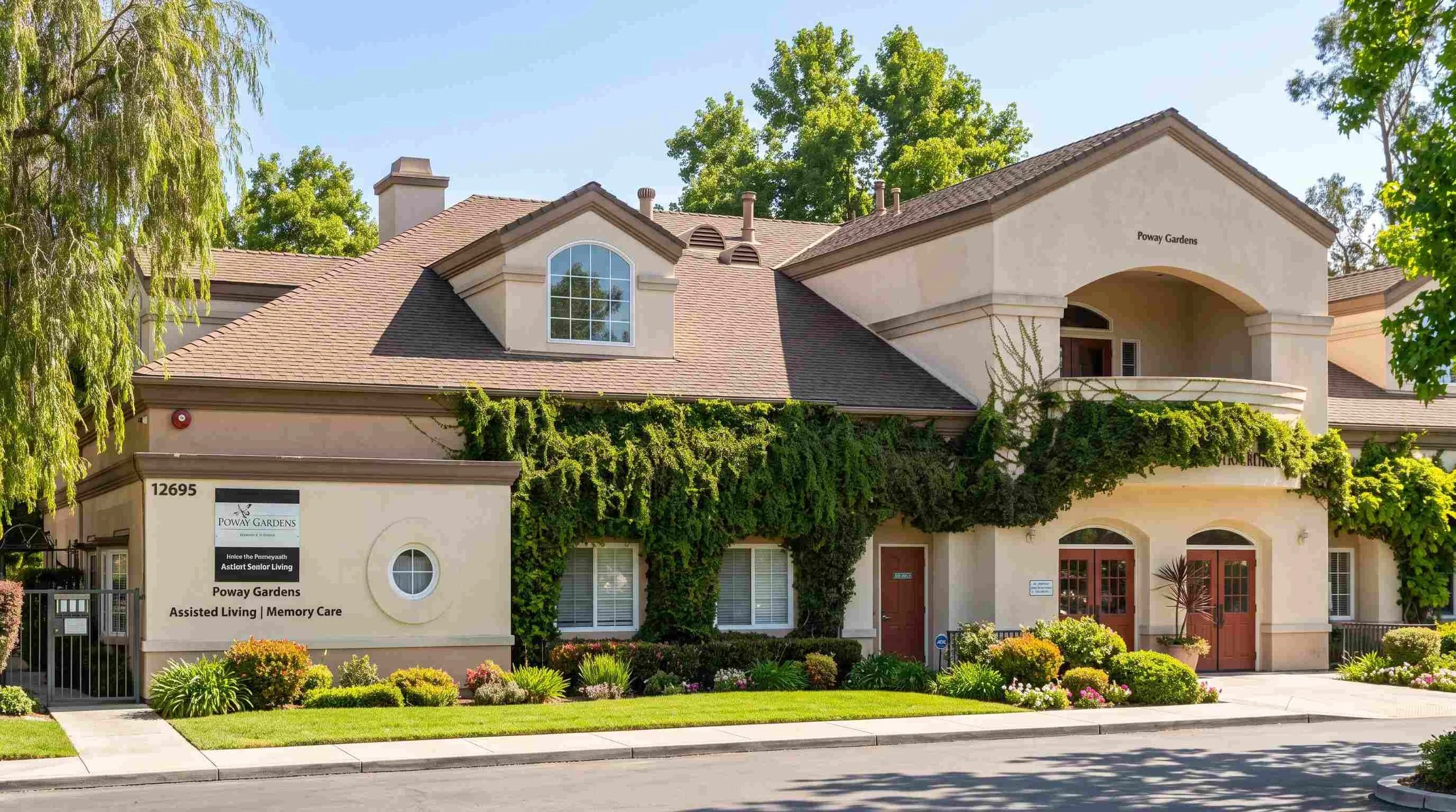
Mountain Vistas is at 12695 Monte Vista Road in Poway, licensed by California as a Residential Care Facility for the Elderly under number 374604633. It has been licensed since May 2024 and is approved for 32 residents.
Which Building Is Mountain Vistas?
It is the largest of seven separately licensed homes that sit along the same stretch of Monte Vista Road, which is the detail most families miss.
Poway Gardens is a campus rather than a single building. State licensing records list Mountain Vistas at 32 beds and The Palms at 24, plus five small six-bed homes: the Magnolias, the Maples, the Oaks, the Sycamores and the Pines. Each has its own license number and its own address on Monte Vista Road.
That structure explains a lot about how a tour goes. You may be shown the grounds, the greenhouse and a dining room, and come away without knowing which licensed home your parents would actually live in. The answer changes the staffing ratio, the size of the group at dinner and the room options.
So ask directly which building has the opening, what its license number is, and how many residents live there now. A six-bed house and a 32-bed building are different experiences, and the campus brochure covers both.
The Horticultural Campus and What Residents Actually Do
The programming is built around growing food, which is unusual enough to be the real reason to look at this place.
The community's lifestyle page describes an on-site greenhouse, organic farmland and fruit orchards, with residents eating what they grow in what the operator calls a seed-to-table approach. A horticultural therapy program sits at the centre of the activity calendar.
The same page lists five garden villas among the residences, alongside the main buildings, and describes social, creative and wellness programming plus music, movement and sensory stimulation for residents with memory loss.
Gardening is not a gimmick for this population. It gives people a reason to go outside, a task with a visible result, and something to talk about that is not their health. For a resident who spent fifty years tending a yard, that continuity does more than another bingo afternoon.
The honest question on a tour is participation. Ask how many residents were in the greenhouse last week, who takes them out there, and what happens on a hot August afternoon when nobody wants to move.
What Memory Care Means on This Campus
The operator presents Poway Gardens as a memory care community, so the whole campus is designed around cognitive decline rather than retrofitted for it.
That has an upside and a limit. The upside is that staff, layout and programming all assume memory loss, which usually means fewer of the frictions that appear when someone with dementia lives in a general assisted living building.
The limit is fit. A parent who is physically frail but cognitively sharp may find a memory care setting mismatched, and a parent with advanced dementia and complex behaviours may exceed what any residential facility can take. Both ends of that range need an honest conversation before a deposit.
Two questions sort most of it out. What specifically would cause the community to ask a resident to move, and how is the building secured at night. The answers vary widely between facilities that use the same words in their marketing.
Medical Care, Medications and Who Visits
An RCFE is housing with care, not a medical facility, so the doctor still comes from outside.
Staff in a licensed residential care facility help with medications, personal care and daily routines, and they coordinate with physicians. Diagnosis, prescribing and changes to a treatment plan stay with the resident's own clinician.
Keeping that clinician involved is easier when the visit happens in the building. Physicians who see patients in assisted living handle routine follow-up, chronic condition management and the small problems that otherwise turn into emergency room trips, without moving a frail resident into a car.
For families in the San Diego area who want a doctor covering both the resident and the wider household, Allen Jahroumi, M.D. provides at-home family medicine and urgent care across San Diego and south Orange County, including management of long-term conditions such as high blood pressure and diabetes.
How Assisted Living and Memory Care Differ From a Nursing Home
Assisted living is for people who need help with daily care without the medical intensity a nursing home provides.
Long-Term Care Facilities: Assisted Living, Nursing Homes, and Other Residential Care, reviewed by the National Institute on Aging in 2023, sets out what assisted living normally includes: a private room or apartment, shared common areas, up to three meals a day, help with personal care and medications, housekeeping, laundry, 24-hour supervision and an activity programme.
Nursing homes do something else. They provide skilled nursing, 24-hour medical supervision and rehabilitation services such as physical, occupational and speech therapy. A resident who comes to need that level of care usually has to move.
The NIA also notes that these communities typically offer several levels of care and charge more as a resident needs more. On a campus with seven licensed homes, it is worth asking whether moving up a level means moving buildings, and whether that is treated as an internal transfer or a new admission.
What It Costs and Who Pays
Families pay privately in most cases, because Medicare does not cover assisted living or memory care.
The National Institute on Aging states it without hedging: Medicare does not pay for assisted living. Medicaid may cover some aspects depending on the state and the person's eligibility, and some long-term care insurance policies cover part of the cost. California's Medicaid programme is Medi-Cal, and what it contributes depends on the specific programme and the resident's circumstances.
Memory care generally costs more than standard assisted living in the same building, because the staffing is heavier. North inland San Diego County sits at the higher end of California pricing, and the campus quotes its own current rates.
Ask for the all-in monthly figure at your parent's assessed care level rather than a starting price. Then ask what triggers a move to the next level, how much that adds, and how much notice the community gives before a rate change.
The Monte Vista Road Neighborhood
Quiet south Poway, close to Pomerado Road and a hospital with an emergency department minutes away.
Monte Vista Road runs through a low-density part of Poway with large lots and open land, which is what makes orchards and farmland possible on a senior living campus at all. It is residential and quiet rather than walkable to shops.
For urgent care, Palomar UC San Diego Health Poway is at 15615 Pomerado Road in Poway with a full emergency department, and the same system runs outpatient and lab sites further along Pomerado Road. Having a hospital inside the city rather than down the freeway shortens the trip when a fall happens at night.
For visiting, the location works well from Rancho Bernardo, Scripps Ranch, Escondido and much of north inland San Diego. Driving up from central San Diego or the coast takes longer, which is worth weighing honestly against how often family expects to come.
Address, License and Contact Details
The licensing details for this specific building are below.
Facility name: Poway Gardens Senior Living – Mountain Vistas
Address: 12695 Monte Vista Road, Poway, CA 92064
License number: 374604633
Licensee: Sabra West Coast Operations I, LLC; SH1 Red Alder
Administrator: Shannon Hundley
Licensed capacity: 32 residents
Licensed since: May 2024
County: San Diego
Operated as: Cadence at Poway Gardens
The campus website carries the tour request form and current contact number. Because seven licensed homes share this campus, confirm the phone number and the licence number for the specific building you are being offered. Licensing status, capacity and citation history are public records held by California's Community Care Licensing Division and worth checking yourself.
Your Next Step
Tour the actual building with the opening, not just the gardens, and get the physician's report started this week.
A campus tour sells the greenhouse. What decides the next three years is the room, the hallway, the staff on that building's evening shift and the other residents at that dining table. Ask to spend twenty minutes in the home your parents would live in, at a mealtime if possible.
If you are weighing several San Diego County communities and have limited time, a placement agency can narrow the list to places that accept your parent's care level and budget. Most are paid by facilities rather than families, so ask how a given agency earns its fee before leaning on its recommendation.
Whatever you choose, the LIC 602 is the item with the longest lead time and no downside. Getting it signed keeps every option on your list open.
Sources Used
Emergency Services – Palomar UC San Diego Health (2026)
Long-Term Care Facilities: Assisted Living, Nursing Homes, and Other Residential Care – National Institute on Aging (2023)
Tour — Poway Gardens

Written by Sofiia Puhach
Ocotober 9, 2026
Explore More Assisted Living Communities

Address: 2456 Geary Boulevard, San Francisco, CA 94115