California's New Hospital Cost Penalties
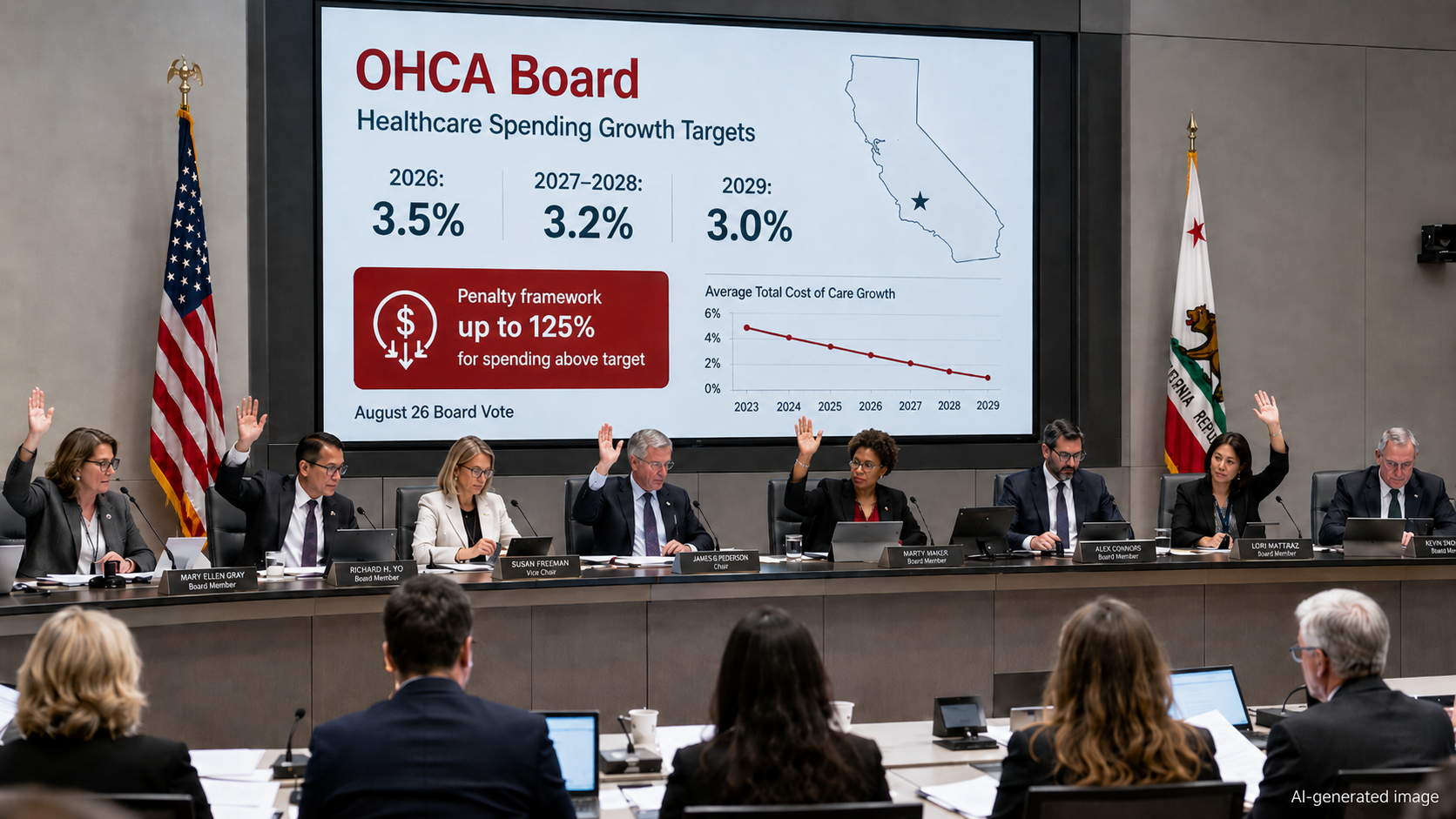
On August 26, a state board most Californians have never heard of may vote on something unusual financial penalties for hospitals, medical groups, and insurers whose spending grows faster than the state says it should.
The board belongs to California's Office of Health Care Affordability (OHCA), created by state law to slow the growth of healthcare spending. As first reported by KFF Health News and the Los Angeles Times, the penalties under consideration could reach 125% of whatever a healthcare entity spends above the state's annual growth target. The board is also weighing procedural fines, according to its June 2026 board presentation: up to $10,000 a day for repeated failures to file an acceptable performance-improvement plan or provide required information, and a separate penalty of up to $500,000 per violation for failing to actually implement one.
The target
California set a statewide per-person spending-growth target of 3.5% for 2025 and 2026, stepping down to 3.2% in 2027 and 2028 and 3% in 2029. A target is not a hard cap — spending above it isn't prohibited; it starts an enforcement process. Seven hospitals the state considers particularly expensive got tighter targets: 1.8% in 2026, dropping to 1.6% by 2029.
Why hospitals specifically? Nationally, hospitals accounted for 40% of the growth in U.S. health spending between 2022 and 2024, compared with 11% from retail prescription drugs, according to KFF.
The stakes for patients are not abstract. The California Health Care Foundation's 2026 policy survey found that 4 in 10 Californians carry medical debt, and 59% said they or a family member skipped or delayed care in the past year because of cost.
The catch: the radar gun doesn't work yet
Here is the detail that matters most if you're the one holding the bill.
Even if the board adopts penalties this week, how entities performed against the 2026 targets isn't expected to be publicly reported until 2028, because of the data-collection lag, per the Department of Health Care Access and Information. The 2025 targets aren't enforceable at all.
And the enforcement road is long by design: technical assistance first, then public explanations, then performance improvement plans, and only then fines. That's why OHCA's own August 2026 materials put the earliest possible spending-target penalty at 2030 — and more likely 2031. Meanwhile, the California Hospital Association is suing to challenge the spending limits as unreasonable, and hospitals have warned they may cut services — emergency rooms, obstetrics, behavioral health — if the targets stick.
The industry's core defense is worth reading twice: hospitals say they can't reliably control how fast their own costs grow — pointing to minimum wage increases, earthquake retrofits, and expensive new drugs. Some of that is fair. But researchers estimate almost 25% of U.S. healthcare spending is wasteful — administrative overhead, duplicative tests, and prices untethered from cost.
What this means for you, here in Greater LA
California is one of at least eight states with healthcare spending targets, and none has actually applied a financial penalty yet. So the honest summary is this: the state built an office, a board, a data system, and a 125% penalty — all to slow the growth rate of what you pay. Not to lower it. And, on the state's own timeline, likely not before 2031.
Your medical bills are due now
That's why it's worth knowing that a simpler structure already exists alongside the regulated one. In direct-pay medicine, a physician — an MD or DO — quotes a price before care, you pay it, and no enforcement mechanism is required to keep it honest. The price doesn't need a growth target because you saw it before you said yes. House calls and telehealth visits work this way today across Los Angeles and Southern California.
Regulation may eventually slow the treadmill. Until then, patients still have the option to step off it for the everyday care where a clear price is possible.
Skip the insurance maze — book a same-day house call or virtual visit with a Doctor2me physician, and see how direct-pay pricing works.
This article is general information, not medical advice. For real emergencies, call 911.