Hospitals Are Asking for the Money First. Here's What That Actually Means
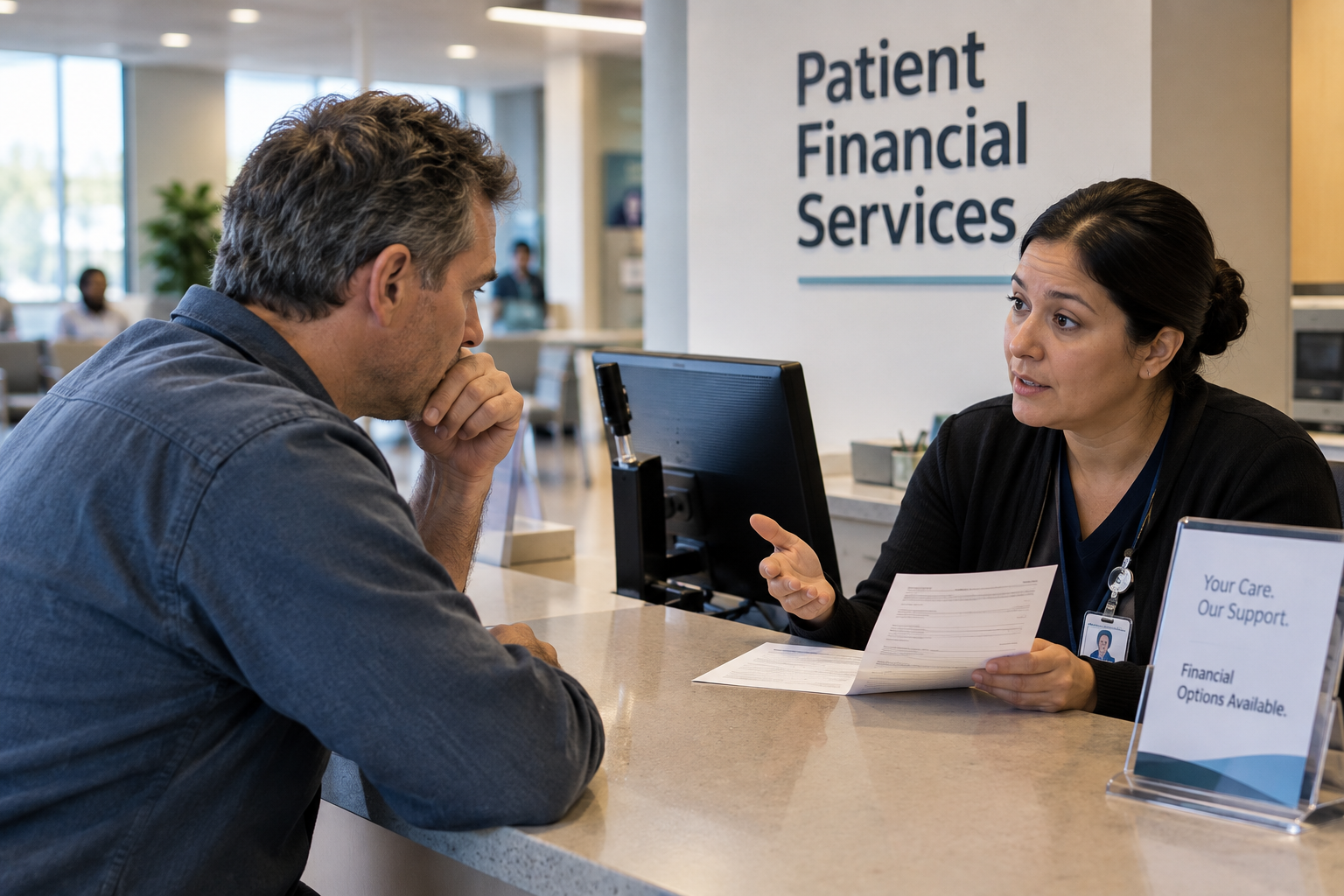
In April 2024, Thomas Zordani flew from Denver to Phoenix to see a Mayo Clinic neurosurgeon about debilitating headaches. He says he'd been told when booking that the clinic was in his insurer's network. When he arrived, he was sent to the financial office and told he owed a $5,000 pre-service deposit — Mayo had since determined it was not contracted with his insurer, and designated him “self-pay” even though his plan had out-of-network benefits. Days earlier, an estimate in his insurer's portal had said $565.
He refused. The appointment was canceled. He flew home.
The story didn't end there. Zordani filed a complaint in Arizona civil court, and in September 2025 an arbitrator awarded him $47,500 in economic damages and attorney fees, finding Mayo violated a state consumer fraud law by failing to tell him before he traveled that his plan wasn't in-network. Mayo told KFF Health News it regretted that his “experience did not meet the high standard of communication we strive to provide”; its statement did not address the award.
That story, reported by KFF Health News and CBS News on August 12, is an extreme version of something ordinary. Hospitals and clinics are increasingly asking patients for money before care, not after.
The shift, in one number
Hospitals now collect roughly a quarter of what they expect a patient to owe before the service happens, according to Matt Szaflarski of Kodiak Solutions, a revenue-cycle firm that pulls data from more than 2,300 hospitals. His example: on a scan, an insurer will reimburse $1,000; the hospital asks the patient for about $250 up front. “That used to be closer to $150.”
Some health systems say so openly. Johns Hopkins Medicine states that for non-emergency care, “it is our policy to collect all amounts owed before services are rendered.” MD Anderson tells self-pay patients they'll be asked for an initial deposit set by the care center. Mayo Clinic lists the situations in which it requires pre-service deposits.
None of this is hidden. Most patients have never had a reason to read the billing page.
Worth being precise about what the Zordani case does and doesn't illustrate. Because Mayo designated him self-pay, his $5,000 wasn't strictly a deposit against an insurance claim — there may have been no claim to adjudicate. The broader pattern the Kodiak data describes is the quieter one: insured patients asked to pay before their claim has been adjudicated, on an amount calculated in ways they have no practical means to audit.
Why now
Because deductibles grew large enough that hospitals stopped assuming they'd be paid later. Average Affordable Care Act marketplace deductibles rose 37% this year to a record $3,786, and the average deductible in employer family coverage is $3,762 per person. Patients are, as one hospital-finance executive told KFF, “basically being asked to self-insure.”
It isn't working especially well for hospitals either. Kodiak's June 2026 report found uncollected patient debt rising even as upfront collections climb — higher deductibles and more complex cost-sharing raise what patients nominally owe without improving the odds anyone actually pays it.
Where the protections are, and where they aren't
There is one bright line. Under EMTALA, a hospital that participates in Medicare cannot demand payment before screening and stabilizing someone with an emergency medical condition. If you are having an emergency, go to the ER or call 911. That is not the situation this article is about.
Outside the ER, the ground is softer. Matthew Fiedler of the Brookings Institution told KFF that for out-of-network care, he isn't aware of any barrier stopping a hospital or clinic from requiring a deposit. In-network patients may have some protection buried in their insurer's contract — which means reading fine print most people never see.
How the deposit amount gets calculated is largely up to the organization asking. Patricia Kelmar of PIRG put it bluntly: a hospital could name $1,500, and you'd have no way to know whether that's your remaining deductible, a percentage of the expected charge, or something else. If you booked three months out, the hospital doesn't know your remaining deductible either.
And refunds, when you overpay, are their own maze. Only a small number of states directly address how quickly the money must come back. Florida now requires medical providers — the statute's term, covering facilities and practitioners alike — to reimburse within 30 days of determining an overpayment, and Maryland prohibits certain hospitals from requiring prepayment as a way around offering financial assistance. Arizona's attorney general sued an imaging chain this year over upfront billing practices after allegations that some patients waited more than a year to receive refunds; the settlement set an average 60-day refund window. In most states, no specific rule sets a clock.
The California wrinkle
Szaflarski told KFF that California and Texas are among the states where hospitals collect more up front — his read from the data, not a published statistic, but worth knowing if you live here.
California does give patients real footing on the back end. The Hospital Fair Pricing Act, expanded by AB 1020 and updated again in 2025, requires hospitals to notify patients about charity care and discounted payment policies at defined points in the billing cycle, and raised the financial-assistance income threshold to 400% of the federal poverty level. If someone in Greater LA asks you for a deposit, asking about financial assistance is a fair and legal question.
The part worth sitting with
If a hospital asks you for money before it treats you, the transaction has already become a cash transaction. You're handing over funds in advance, in exchange for care whose final cost nobody has committed to.
The one thing missing is the thing cash usually buys you: a price.
That's the honest reframe. This isn't an argument that insurance is worthless — for a hospitalization, a surgery, a course of cancer treatment, it very much is not. It's an argument that “I have insurance” no longer reliably means “I don't need to ask what this costs.”
And the Zordani arbitration adds a practical footnote: the paper trail mattered. The portal estimate, the booking communications, the timing of Mayo's notice — those documents are what turned a canceled appointment into a $47,500 award. Keep yours.
What to ask before you pay a deposit
Ask for the amount in writing, with an explanation of how it was calculated.
Ask whether it's your remaining deductible, a percentage of the estimate, or a flat policy figure.
Call your insurer and ask whether your plan has any rules about pre-service collection.
Ask what happens if you overpay, and how long a refund takes.
Ask about financial assistance — in California, hospitals are required to tell you it exists.
Save everything: the estimate, the booking confirmation, the deposit request. If a dispute comes later, the documents are the case.
For anything non-urgent, compare the total against your alternatives: telehealth, a house call from an MD or DO, or an urgent care that posts cash prices. Many will give you the number before you commit — ask for it.
Not because the insurance pathway is always the wrong one. Because it's no longer automatically the cheaper one, and it increasingly asks for the money first anyway.
General information, not medical advice. For medical emergencies, call 911. Doctor2me is a technology platform; independent physicians provide medical services. Before you default to the insurance pathway for a non-urgent visit, it's worth exploring your alternatives — including a virtual consultation or a house call.
Sources
Sen. Roger Marshall, "Patients Deserve Price Tags Act Passes Senate HELP Committee" (July 22, 2026)
H.R.9393 — Lower Costs, More Transparency Act of 2026 (E&C markup July 20–21, forwarded 45–0)
HFMA, "Healthcare price transparency legislation gains momentum in Congress" (July 24, 2026)
American Hospital Association comments on the Senate bill (July 2026)