The ER Line Is About to Get Longer for Everyone. LA Has Seen This Before
Is About to Remove 1.6 Million People From Medi-Cal. Your Insurance Card Won't Shield You From What Happens Next.
Los Angeles has run this experiment before.
In 2007, Martin Luther King Jr.-Harbor Hospital closed. Neighboring hospitals reported emergency department waits longer than 11 hours, more trauma cases, and more uninsured patients. The people stuck in those waiting rooms weren't just former King-Harbor patients — they were privately insured Angelenos whose hospitals suddenly had to absorb everyone else. Researchers later tied the closure to worse outcomes across the region.
California is now setting up a much larger version of that experiment. If you have insurance and think this isn't your problem, the numbers say otherwise.
The numbers, all sourced
Federal law (H.R. 1, passed July 2025) and California's own budget decisions are cutting deep into Medi-Cal — the program that covers nearly 15 million Californians. State officials estimate Medi-Cal could lose roughly $30 billion a year.
The state's nonpartisan Legislative Analyst's Office projects that the new federal eligibility rules alone — an 80-hour-per-month work requirement and eligibility checks every 6 months instead of 12 — will remove about 1.6 million people from Medi-Cal by 2029-30. Total enrollment is projected to fall from nearly 15 million to about 12 million.
UC Berkeley's Labor Center projects 2.2 million Californians will lose coverage by 2030 — roughly doubling the state's uninsured rate.
One detail worth sitting with: research compiled by KFF shows work requirements mostly remove people who are actually eligible. They get tripped up by paperwork, not by the rules themselves.
What a business does when losses double
Our founder is a CPA, not a physician. And here's what reading financial statements for a living teaches you: when a business's losses double, it cuts.
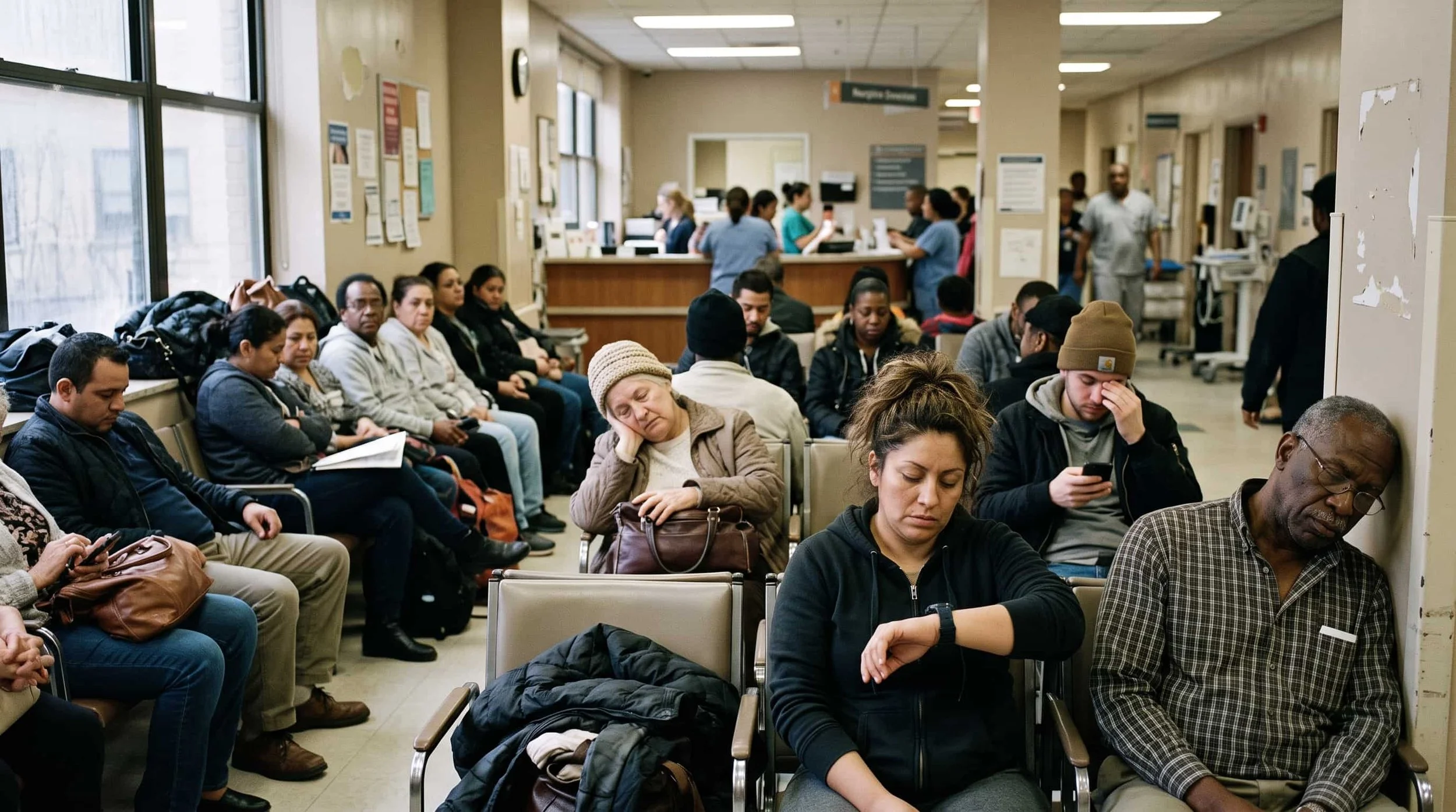
Hospitals can't turn anyone away from an emergency room — that's federal law. So when millions lose coverage, they don't stop getting sick. They wait, get sicker, and walk through the one door that legally can't close: the ER.
The California Hospital Association expects uncompensated care to double, from $2 billion to $4 billion a year, while reporting that more than half of California's hospitals already operate at a loss. In anticipation of the cuts, California hospitals have already laid off more than 3,000 workers.
When hospitals absorb losses, they respond the way any business does: fewer nurses, closed maternity wards, closed ERs — or closed hospitals. None of those cuts check your insurance card. A longer ER wait is a longer ER wait for everyone in line.
Will your premium rise too? Economists disagree on how much cost-shifting actually happens — that's a real debate, not a settled fact. Emory health policy professor Kenneth Thorpe puts the estimate at roughly 1% to 2%, about $500 a year for an average family, from the federal cuts alone. Separately, commercial insurers say California's new health plan tax to backfill Medi-Cal will add about $100 per person per year.
Maybe the problem is the default
So can we pause and question the structure?
When 2.2 million people lose coverage, who pays? Everyone in the building — and everyone in line behind them. Maybe the problem isn't that hospitals are failing. Maybe it's that we route everything through them by default.
Most ER visits aren't emergencies. They're the Sunday infection. The midnight fever. The flare-up your primary care office can't see for three weeks. Those are exactly the visits about to get slower and more crowded — and they're the visits that never needed a hospital in the first place.
Before you default to the insurance pathway
Here's the part you control. Before you head to the ER or join the in-network queue for a non-emergency, spend ten minutes exploring your alternatives:
A virtual visit with an MD or DO, often available the same day. A house call — a physician who comes to you, anywhere in Greater LA. An urgent care that posts its cash prices. Whatever you choose, ask what it costs before you go. You may be surprised in both directions.
Every non-emergency handled outside the hospital is faster care for you — and one less person in a queue that's about to get much longer. In a system this stretched, staying out of the line is both self-interest and a small public service.
For real emergencies, call 911. Full stop.
The cuts are coming on Sacramento's and Washington's timeline, not yours. How you get routine and urgent care is still yours to decide.
This article is general information, not medical advice. Doctor2me is a technology platform, not a medical provider — all visits are delivered by independent physician practices.
Sources
CalMatters, "Medicaid cuts stand to hit everyone (yes, even you). Here's why" (Aug. 7, 2026)
CalMatters, "California healthcare tax may raise private insurance premiums" (June 2026)
Annals of Emergency Medicine, ED crowding after the King-Harbor closure (2007)
Orange County Register, "California hospitals laying off thousands" (March 22, 2026)