
Table of Content
In adults, an ear infection usually means ear pain or pressure, muffled hearing, and sometimes fluid draining out. Most clear up on their own.
Mayo Clinic, in a page dated April 2025, lists three common adult symptoms: ear pain or pressure, fluid coming from the ear that can come from a torn eardrum, and trouble hearing. The adult version is shorter than the children's list, which is part of why it gets dismissed as nothing.
Do Adults Really Get Ear Infections?
Yes, and the mechanism is identical to a child's. Cleveland Clinic states the causes are the same in children and adults: bacteria or viruses growing in fluid trapped behind the eardrum.
Children get them more often because their eustachian tubes, the narrow tubes that drain the middle ear, work less well and their immune systems are still learning. Adult tubes drain better, so adult infections are less frequent rather than impossible.
Cleveland Clinic names the two situations that tip an adult over: eustachian tubes that are blocked, and a weakened immune system, which can come from a health condition, a procedure or even a medicine you take. An infection that follows a bad cold is the ordinary story.
What Are the Symptoms of an Ear Infection in Adults?
Pain or pressure in one ear, hearing that sounds muffled on that side, and sometimes discharge. Symptoms usually arrive fast, often a few days into a cold.
Cleveland Clinic's symptom list for an ear infection runs: ear pain, fullness or pressure in the ear, trouble hearing in the blocked ear, and yellow, brown or white drainage, which is a sign the eardrum has torn. Fever is common but not guaranteed in an adult.
The CDC adds the signals that mean the problem has moved past ordinary: a fever of 102.2 F (39 C) or higher, pus or fluid coming from the ear, symptoms that are getting worse, symptoms of a middle ear infection lasting more than two to three days, and hearing loss.
Middle Ear or Outer Ear: How the Pain Tells You
Tug gently on the outside of your ear. MedlinePlus describes swimmer's ear, the outer-ear infection known as otitis externa, as ear pain that gets worse when you pull on the outer ear, along with itching, hearing loss, and yellow, green or foul-smelling drainage.
A middle ear infection sits behind the eardrum, so pulling the ear does not usually change it. On exam, MedlinePlus notes the outer-ear version shows a red and swollen canal, and touching or moving the outer ear makes the pain worse, which is the fastest clue a clinician has.
Pain that spikes when you tug the ear or chew: more likely the outer ear canal
Deep ache plus a blocked, muffled feeling: more likely the middle ear
Itching with scaly skin in the canal: points to the outer ear
Sudden relief followed by discharge: the eardrum may have torn
Ear Infection Types, Side by Side
The phrase "ear infection" covers several different problems, and they are treated differently. The CDC separates them by where the problem sits and whether an infection is present at all.
|
What it is |
Where it sits |
What it feels like |
|---|---|---|
|
Middle ear infection (acute otitis media) |
Behind the eardrum |
Ear pain or pressure, muffled hearing, sometimes fever and drainage |
|
Fluid in the ear (otitis media with effusion) |
Behind the eardrum, no infection |
Fullness and dulled hearing, with no fever, ear pain or pus |
|
Swimmer's ear (otitis externa) |
The outer ear canal |
Pain that worsens when the ear is pulled, itching, drainage |
That middle row is the one people misread. Fluid can sit behind the eardrum after an infection has already cleared, so the muffled hearing outlasts the illness by weeks without anything being infected.
Can an Ear Infection Go Away on Its Own?
Usually, yes. Cleveland Clinic says most ear infections clear on their own within about three days, which is why a clinician may watch rather than treat immediately.
The CDC puts the same idea in plainer terms: the body's immune system can often fight off a middle ear infection without help, and sometimes antibiotics are not needed at all. Rest and extra fluids do real work in those first few days.
The exceptions are specific. The CDC says a severe middle ear infection, or one lasting longer than two to three days, needs antibiotics right away. That is the line between waiting sensibly and waiting too long.
Watchful Waiting and Delayed Prescribing
These are two named strategies, not a brush-off. In watchful waiting, the provider suggests watching for two to three days to see whether antibiotics are needed, giving the immune system time to work.
In delayed prescribing, the CDC explains, the provider writes the prescription but suggests waiting two to three days before filling it. You recover on your own in many cases, and the prescription is there if you do not. Ask which of the two you are on, so you know what to do on day three.
The Pain Is Severe: Wait It Out or Get Seen Today?
Severe pain is itself a reason to be seen, not a reason to wait. Watchful waiting is for mild symptoms, and the CDC pairs it with mild cases only.
While you are arranging it, the ordinary measures still apply. Rest, extra water or other fluids, and something warm held against the ear, which MedlinePlus notes may reduce pain. Over-the-counter pain relief is worth asking a pharmacist or clinician about rather than guessing.
Feeling wiped out all over is normal with any viral illness that comes with an ear infection, and our piece on body aches and what causes them covers why the whole body joins in. The ear is only the loudest part of it.
Urgent Care or Straight to the ER?
Most ear infections are not emergency material. An ear that hurts, drains and muffles sound is urgent-care or same-day-clinic territory, not an emergency department.
Signs That Mean Emergency Care
The reason to move faster is a sign the infection is spreading. Mayo Clinic notes that untreated or poorly responding infections can spread to nearby tissue, rarely reaching the bone behind the ear, called mastoiditis, and that serious middle ear infections can rarely spread to the membranes around the brain.
MedlinePlus flags its own version of that for the outer ear: contact a provider if you get new symptoms such as fever, or pain and redness of the skull behind the ear. Pain and swelling behind the ear, high fever, a stiff neck or confusion all mean emergency care rather than a clinic appointment.
If you are weighing the options at ten at night, our breakdown of urgent care, the ER and a house-call doctor sorts out which symptoms belong where.
Ear Blocked and Hearing Down: Will It Come Back?
Almost always, yes. Mayo Clinic says mild hearing loss is common with an ear infection and hearing usually gets better once the infection clears.
When the muffling outlasts the infection, fluid is the usual reason. Cleveland Clinic describes thick fluid filling the middle ear, known as otitis media with effusion, where hearing loss is the main symptom alongside tinnitus, pressure, and a popping sensation when swallowing. It usually resolves on its own within three months.
The part worth taking seriously is repetition. Mayo Clinic notes that infections which keep coming back, or constant fluid in the middle ear, can cause worse hearing loss, and that if the eardrum or other middle-ear parts are lastingly damaged, hearing might not fully return.
When the Eardrum Tears
A torn eardrum often announces itself as relief. Mayo Clinic lists ear pain that may go away fast, then mucus, pus-filled or bloody fluid coming out, hearing loss, ringing, and a spinning sensation.
Most heal without treatment. Mayo Clinic says a ruptured eardrum most often heals in a few weeks, though it might need a patch or surgical repair, and that hearing loss is usually short-term, lasting only until the eardrum heals. Cleveland Clinic adds that tears can take weeks to months.
Complications are uncommon and show up when a hole does not close. Mayo Clinic flags problems if the eardrum has not healed after three to six months, including repeated infections, ongoing fluid leaks, and a middle ear cyst called a cholesteatoma. That is the reason for the follow-up visit people skip.
What Could Be Mistaken for an Ear Infection?
Several things, which is why a look inside the ear settles it. Cleveland Clinic notes providers diagnose most ear infections from symptoms plus an exam, using a lighted otoscope to see whether the eardrum is swollen.
Earwax is the first impostor. Cleveland Clinic is explicit that earwax buildup does not cause fluid behind the eardrum, and that water getting in while showering or swimming does not either. Our piece on what a smelly ear and odd-smelling earwax actually mean covers that side of it.
Earwax, Jaw Pain and Fluid Without Infection
Pain felt in the ear does not always start there, and a jaw or tooth problem can be felt as earache, so an exam that finds a normal eardrum is useful information rather than a wasted visit. If the eardrum looks normal and there is no fluid, the search moves elsewhere.
Fluids without infection are another common mix-up. The CDC points out that otitis media with effusion does not cause fever, ear pain or pus in the middle ear, so a blocked ear with none of those is probably not an infection that antibiotics would touch.
Getting an Ear Looked At Without Leaving Home
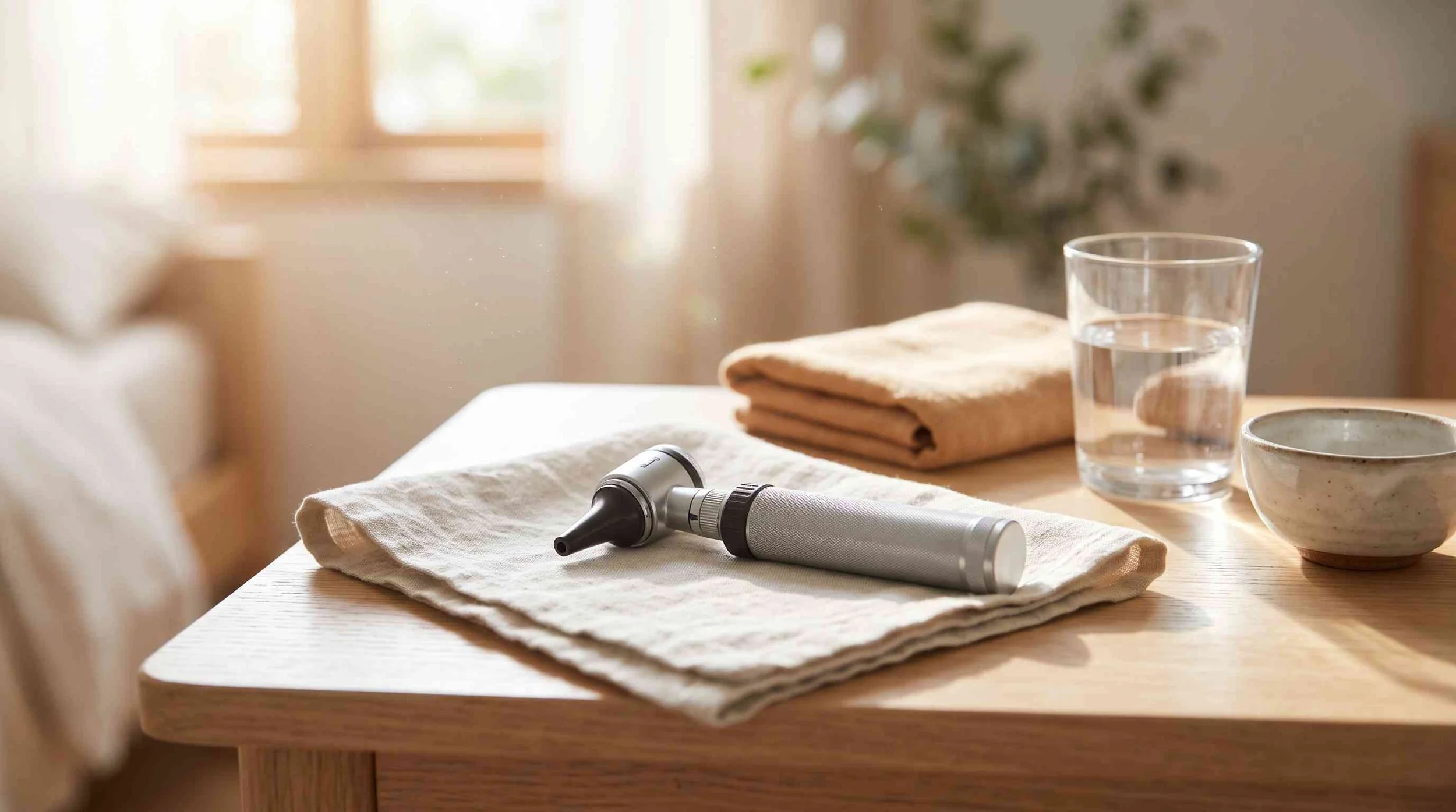
An ear exam needs equipment, not a clinic building. An otoscope is portable, which makes this one of the problems that can be settled at a kitchen table.
That matters when the pain is bad, when driving feels unsafe, or when a cold has already flattened you for three days. A clinician who can come to the house and look in the ear can also check whether the eardrum is swollen or torn, which is the piece a phone call cannot do.
In Pasadena and the San Gabriel Valley, family medicine physicians including Cleo Tsolakoglou-Williams, M.D. see adults for this kind of problem. Whichever route you take, the aim is the same: get the eardrum looked at before day three turns into week two.
Going Back Out After the Illness
Timing also matters because ear symptoms often sit on top of another infection. If the ear trouble started during a respiratory illness, our explainer on how long people stay contagious with Covid covers the part about going back out in public.
FAQ
-
Cleveland Clinic says air travel or a trip to the mountains is safe with an ear infection, though you may feel temporary pain during takeoff and landing. Swallowing fluids or chewing gum during descent helps. Mayo Clinic separately advises against flying with a stuffed-up cold if you can avoid it.
-
Cleveland Clinic says swimming is fine as long as there is no tear in the eardrum and no drainage from the ear. For the outer-ear kind, MedlinePlus recommends keeping ears clean and dry, using earplugs when swimming, and drying the ear well after it gets wet.
-
No. Cleveland Clinic states you should never use ear candles, that there is no evidence they work, and that using them can cause injuries including burns. Nothing you light on fire belongs near an ear canal.
-
The infection itself is not, but Cleveland Clinic points out that the germs causing it are. Many of the bacteria and viruses involved are the same ones behind colds and flu, so the cold spreads and the ear infection follows in whoever is susceptible.
-
Cleveland Clinic names blocked eustachian tubes and a weakened immune system, which can come from a condition, a procedure or a medicine. Mayo Clinic adds seasonal risk, with ear infections most common in fall and winter, plus tobacco smoke, air pollution and seasonal allergies.
-
Rarely. MedlinePlus notes the infection can spread to areas around the ear, including the skull bone, and that in older adults or people with diabetes or a weakened immune system it can become severe, a condition called malignant otitis externa that is treated in hospital.
Sources Used
Ear Infection – Cleveland Clinic (2026)
Ear Infection Basics – Centers for Disease Control and Prevention (2024)
Ear infection (middle ear) – Mayo Clinic (2025)
Glue Ear – Cleveland Clinic (2025)
Ruptured eardrum (perforated eardrum) – Mayo Clinic (2025)
Swimmer's ear – MedlinePlus, National Library of Medicine (2024)
Otitis media with effusion – MedlinePlus (2024)
Watchful Waiting for Children With Acute Otitis Media: Frequency of Use and Outcomes in Clinical Practice – PMC (2025)

Written by Sofiia Puhach
November 3, 2026
You May Also Like



Pain high on the right after a fatty meal is usually a gallstone blocking a bile duct.