
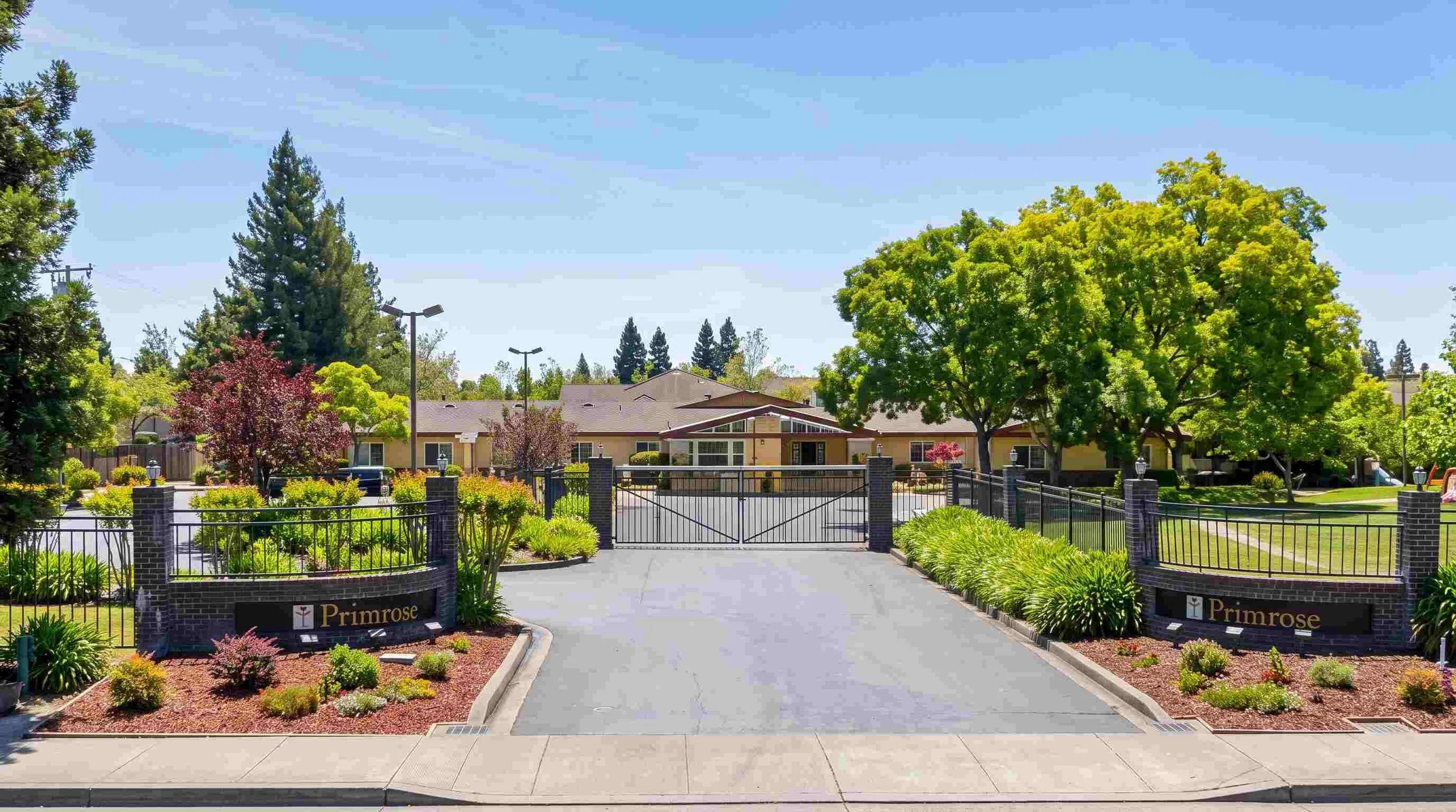
Primrose Alzheimer's Living, Inc. sits at 2080 Guerneville Road in Santa Rosa, CA 95403, and holds residential care facility for the elderly license #496803764 with a licensed capacity of 50. Every resident has a diagnosis of dementia or Alzheimer's disease, so this is a memory care building rather than a community serving a mix of needs.
What Makes Alzheimer's Care in Santa Rosa Different at Primrose?
It takes only people with memory loss, and it runs the whole range of memory care in one place. Primrose describes itself as focused exclusively on adults with memory loss, and says that offering a full continuum of Alzheimer's services is what separates it from assisted living companies that provide residential care alone. On its services page that continuum reads: residential care, respite care, hospice care, and adult day care.
For a family that difference shows up in practical ways. A parent can start at the day program while still living at home, move into a room months later, and keep the same staff, the same building, and the same daily routine instead of starting over with strangers at the hardest possible moment.
How Does the Day Club Work Alongside Residential Care?
It is a separate licensed program at the same address, carrying license #496803761. Primrose asks families to call Santa Rosa at (707) 578-8360 for information or a tour, and both the day and residential sides are run by the same organization. For plenty of households the day club is the first door in, used two or three days a week while someone is still managing at home.
Respite is the other kind of short stay. It covers a planned break, a caregiver's own surgery, or a trip out of state, and it gives a family a real look at how a parent settles into the building before any long-term decision has to be made.
How Does Primrose Handle Safety, Wandering, and the Garden?
With a locked, monitored perimeter and paths that let residents keep walking. Primrose says residents enjoy free movement to walk off stress and can get fresh air and exercise outdoors, with a secure perimeter that provides both protection and oversight, and gates that are locked and carefully monitored.
The inside of the building is built around the same problem. The provider describes way-finding cues, devices, and colors chosen to reduce confusion, with exterior areas landscaped using dementia-safe plants, activity areas, and wandering paths that have resting places along them.
That combination answers the question families ask first. Walking is not treated as a behavior to stop, which matters when a parent paces in the late afternoon and a locked front door at home has already turned into a nightly argument.
What Medical and Daily Support Happens in the Building?
Help with medications, bathing, meals, and laundry, plus visiting services booked as needed. Primrose lists three nutritious meals a day with snacks, supervision of activities of daily living, housekeeping and laundry, assistance with medications, salon services, podiatry care, physical therapy, and incontinence services and supplies among what it provides.
Physician visits are arranged separately in most residential care buildings, because an RCFE is a home rather than a medical facility. Families who would rather not drive to every appointment can look at clinicians who visit residential care communities and see a parent in their own room instead.
Hospice is handled on site where it fits. Primrose says it offers hospice waivers in appropriate situations, which allows a resident to stay in place rather than move again at the end of life, and hospice care appears on its own list of services.
How Do You Compare Memory Care and Board and Care Homes in Sonoma County?
By visiting at different times of day and asking every building the same questions. The National Institute on Aging (2024) suggests choosing a few places to visit, going at more than one hour of the day, and meeting the people who run the building before anything is decided.
Its list of questions is worth carrying on paper. How many staff are on duty and how many of them are trained to provide medical care, how many residents have Alzheimer's, whether a doctor checks on residents regularly and how often, what a typical day looks like, whether there is a safe place to go outside, and what the fee includes against what costs extra.
Two items from that guidance get skipped most often. Talk with other families who already have a parent living in the building, and read any contract carefully before signing it, including the part that sets out what happens when care needs change or the monthly fee goes up.
What Can Help Before a Move Becomes Necessary?
Adult day care, respite, home care aides, and a geriatric care manager all buy time at home. The National Institute on Aging (2024) sets out each of those services, what it usually costs, and how to find it locally, which saves a round of guesswork on the phone.
The notes on money are the part worth reading twice. NIA says adult day care tends to be less expensive than in-home or nursing home care and is charged hourly or by the day, that Medicare will not pay for adult day care while Medicaid and other government programs may, and that most private health plans do not cover it.
Respite follows a similar pattern. It is billed by the hour, day, or week, Medicare covers most of up to five consecutive days only for someone already receiving hospice care, and most private plans do not cover it at all. Local figures still have to be asked for directly, because none of this is priced the same way twice.
What Is the Guerneville Road Area Like?
It is a flat, built-up stretch of northwest Santa Rosa with shops, services, and freeway access nearby. Coddingtown Center sits a short way east along the same road, which makes a small outing or a quick errand easy to fit around a visit rather than turning it into a half-day expedition.
Hospitals are a drive rather than a walk. Providence Santa Rosa Memorial Hospital on Montgomery Drive and Sutter Santa Rosa Regional Hospital on Mark West Springs Road both serve the city, and Highway 101 runs north to south a few minutes away, which matters for relatives arriving from elsewhere in Sonoma County or from further off.
What Is the Next Step?
Call the building, book a tour, and start the medical paperwork in parallel. Primrose asks families to call (707) 578-8360 in Santa Rosa for information or to arrange a visit, and its contact page carries the street address, the fax number, and both license numbers in one place.
If the search is wider than one building, a placement agency can shortlist memory care and board and care homes across Santa Rosa and the rest of Sonoma County and set up the tours. That help counts for most when a hospital discharge has already put a deadline on the decision.
Primrose Alzheimer's Living, Inc. at 2080 Guerneville Road, license #496803764, is one name on that list rather than the only one. Services, availability, and licensing all change, so the details worth leaning on are the ones the building confirms on the day you call it.
Sources Used
About Us – Primrose Alzheimer's Living
Alzheimer's Caregiving: Finding Long-Term Care – National Institute on Aging (2024)
Contact Us – Primrose Alzheimer's Living
Getting Help With Alzheimer's Caregiving – National Institute on Aging (2024)
Our Services – Primrose Alzheimer's Living

Written by Sofiia Puhach
October 17, 2026
Explore More Assisted Living Communities


Address: 12823 North 65th Place, Scottsdale, AZ 85254