
Magnolia Park Assisted Living is an assisted living facility in Visalia, CA, at 2950 E. Douglas Ave, licensed by the state as a Residential Care Facility for the Elderly under number 547209193. It is licensed for 59 residents and has held that license since November 2021, which makes it one of the newer licensed homes in Tulare County.
Where Magnolia Park Is and What It Is Licensed For
The home sits at 2950 E. Douglas Ave in Visalia, CA 93292, in Tulare County, and the listed telephone number is (559) 625-6001. The state licensing record names RDE2 LLC as the licensee and Meshell Ramos as the facility administrator, and the license status reads LICENSED.
What the Numbers on the License Mean
Two numbers on that record do most of the work for a family. The licensed capacity of 59 tells you the maximum number of residents the state allows, which sets the scale of the place. The first license date of November 15, 2021 tells you the operation is recent rather than long established under this licensee.
A recent license is neither good news nor bad news on its own. It does mean there is less history to look up, so the questions you ask on a tour carry more weight than they would at a home with thirty years of record behind it.
What Daily Life Looks Like in a Facility This Size
Assisted living is built for people who need help with daily care but not the level of care a nursing home provides. The National Institute on Aging (2023) describes facilities in this category as ranging from as few as 25 residents to 100 or more, usually offering a few levels of care, with residents paying more when they need extra services.
The same guidance lists what is normally included: up to three meals a day, help with personal care, assistance with medications, housekeeping and laundry, 24-hour supervision and on-site staff, and social and recreational activities. Residents usually have their own room or apartment and share the common areas.
At 59 licensed beds, Magnolia Park sits in the middle of that range. In practice that usually means a staffed building with shared dining and activity space rather than a converted house, and it is worth asking how many caregivers are on duty overnight as well as during the day.
Is This Assisted Living or a Board and Care Home?
Assisted living, by size. Families searching for a board and care home in Visalia are usually picturing something much smaller: the National Institute on Aging (2023) describes board and care homes – also called residential care facilities or group homes – as small private facilities with 20 or fewer residents, where rooms may be private or shared and residents receive personal care and meals.
Both kinds hold the same California license class, which is why the search results mix them together. The difference you actually feel is scale: a six-bed home in a residential street runs on one or two caregivers and a family rhythm, while a 59-bed building runs on shifts, a schedule and a larger activity program.
Neither model is better in the abstract. Some people settle faster in a small house with the same two faces every day, and others do better where there are more people to sit with at lunch. If you are comparing sizes across the county, Autumn Oaks in Porterville is a useful point of contrast in the same county.
What About Memory Care in Visalia?
Ask the facility directly, because the license alone does not answer it. In California, assisted living and memory care are licensed under the same Residential Care Facility for the Elderly category, so a license number does not tell you whether a home is set up for dementia.
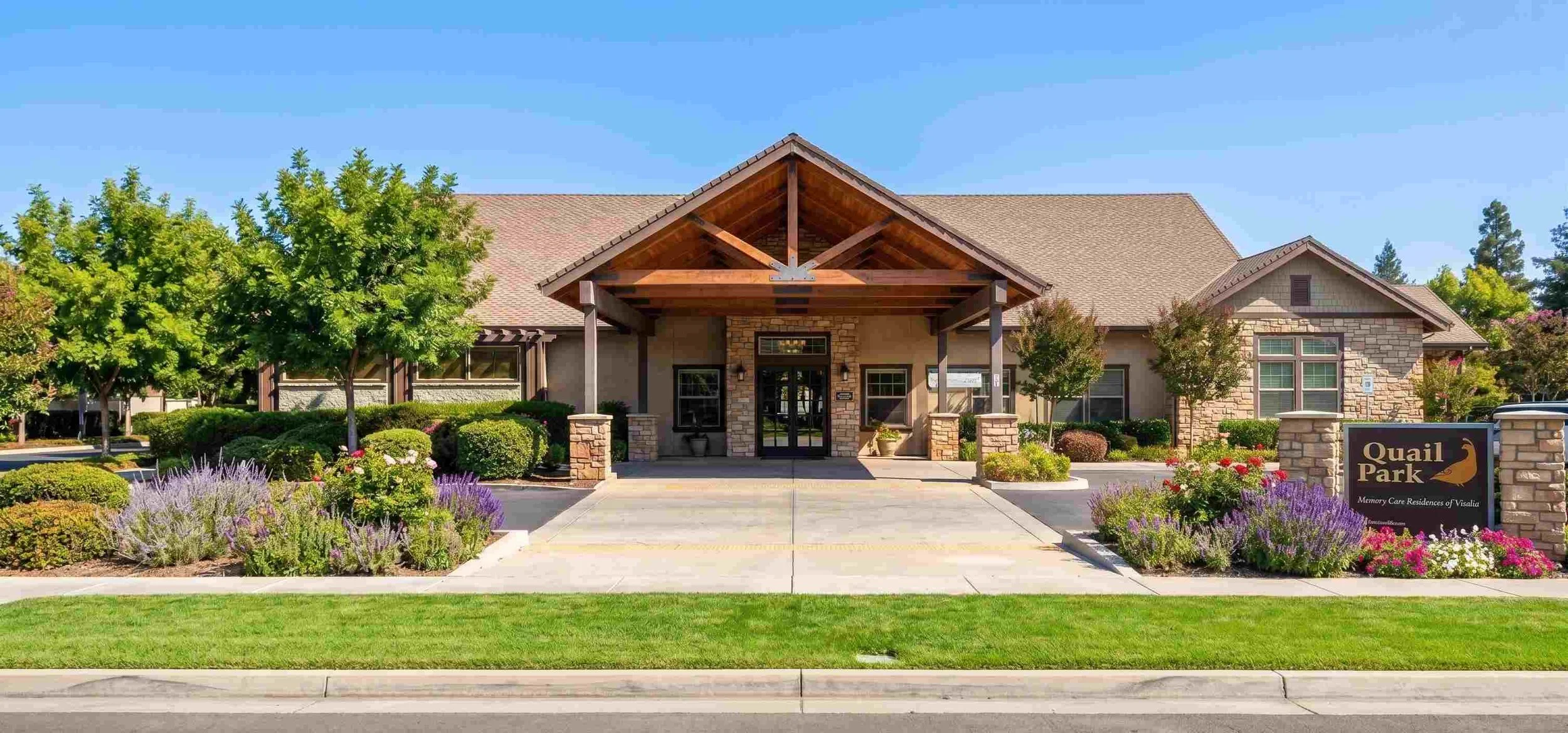
What to ask instead is concrete: whether the home currently accepts residents with a dementia diagnosis, whether there is a secured area, and what behavior would end a placement. If a dedicated memory care setting is what you need, Quail Park Memory Care Residences in Visalia is the other local option worth putting on the same list.
The National Institute on Aging notes that some residential facilities offer special programs for people with Alzheimer's disease and other types of dementia, and that exact arrangements vary by facility and by state. That variation is the reason this question cannot be answered from a directory listing.
How to Check the Place Yourself Before You Sign Anything
Visit more than once, and once without warning. The National Institute on Aging (2023) suggests visiting several facilities in person, meeting the director and nursing director, and then making a second visit without calling ahead, on a different day of the week or time of day, so you meet different staff.
What to Look at While You Are Standing There
The same guidance gives a short list worth carrying in your head: current state licensing, accessibility for people with disabilities, residents who are appropriately dressed and well cared for, warm and respectful interaction between staff and residents, and a clean, fresh-smelling, well-maintained building.
Two reads make the visit sharper. The red flags worth watching for on a tour covers what staff behavior tends to signal, and the questions to ask before signing an assisted living agreement covers the paperwork, where the real costs and the discharge rules live.
Ask What Happens When Needs Grow
Assisted living is not permanent by nature. Ask, in plain words, what change in condition would mean the home can no longer keep someone: a feeding tube, two-person transfers, wandering, oxygen overnight. The answer you get on a calm Tuesday is far more useful than the one you get during a crisis.
Medical Care Once Someone Lives There
Assisted living is housing with care, not a medical facility, so residents keep their own doctors. For a resident who no longer travels well, a physician who sees patients where they live keeps routine care, prescription reviews and the paperwork moving without a car trip for every appointment.
That matters more than families expect at the start. Most of what goes wrong in the first year is ordinary: a medication that needs adjusting, a urinary infection, a blood pressure that drifts. Catching those where the person already lives is usually the difference between a phone call and an ambulance.
The Area Around E. Douglas Ave
The address is on the east side of Visalia, in the 93292 zip code, which puts it inside city limits rather than out on county roads. For a family driving in for a Sunday visit, that is the practical difference: ordinary city streets, and a destination you can reach without planning the trip around daylight.
For anyone searching from Tulare or the smaller towns nearby, a Visalia address keeps the whole arrangement inside Tulare County. That keeps the county's own aging services, the local hospitals and the familiar pharmacies in the same place as the resident, which simplifies every handoff later on.
A Reasonable Next Step
Call the facility at (559) 625-6001 and ask two things: whether there is a bed open now, and what the total monthly cost would be at the level of care your parent actually needs. Those two answers decide whether a tour is worth the drive.
If you are weighing several homes at once, or you are doing this from out of town, a licensed placement agency can narrow the list to homes that will accept the level of care in question before anyone books a visit. That saves the tours that were never going to work out.
And whichever home you land on, the LIC 602A will be waiting at the end of it. Getting the exam done early, at home, keeps the form from becoming the thing that holds up a move-in date everyone has already agreed on.

Written by Sofiia Puhach
November 29, 2026
Explore More Assisted Living Communities

Address: 2950 E. Douglas Ave, Visalia, CA 93292 (Tulare County)