
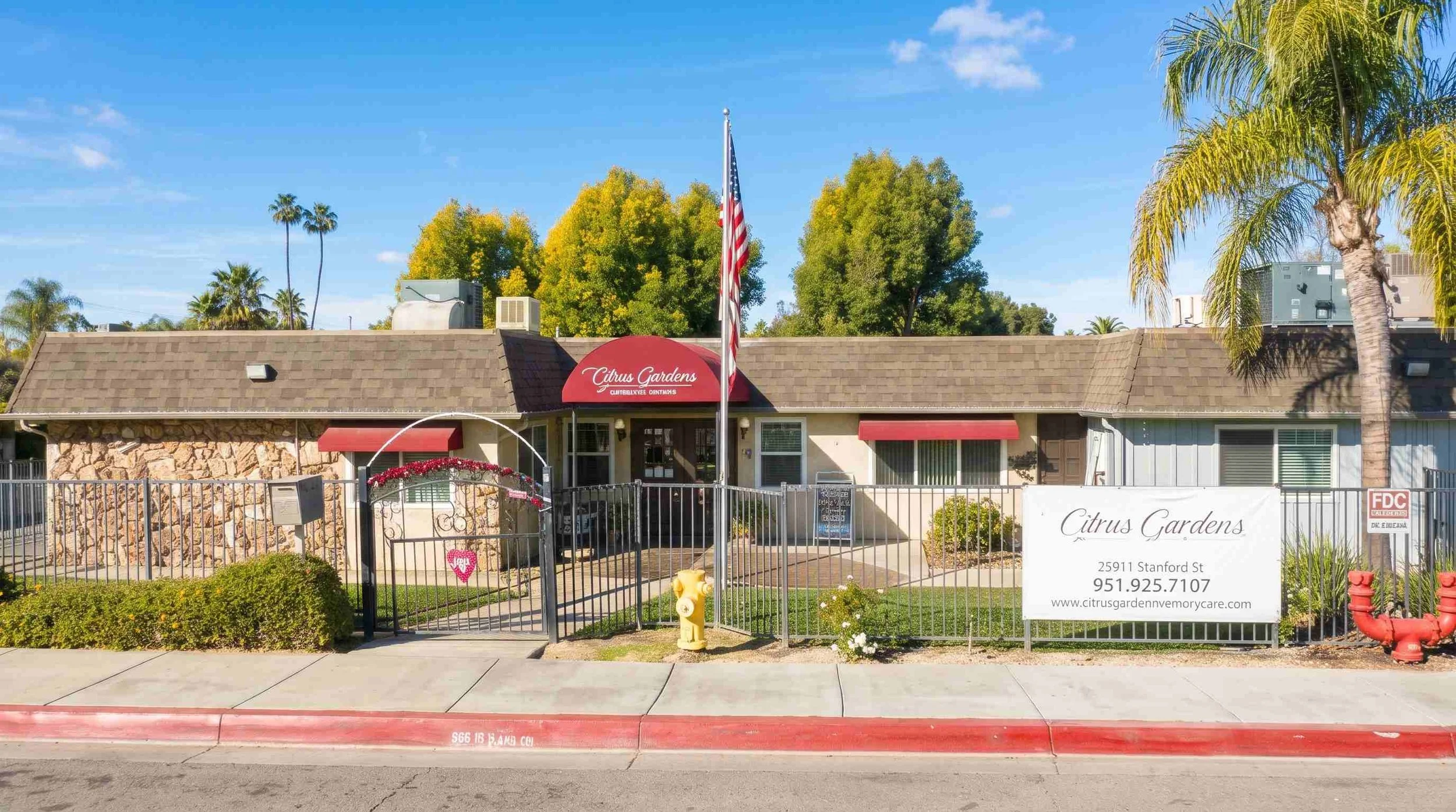
Citrus Gardens sits at 25911 Stanford Street in Hemet, licensed by the state under license number 336426759 for a capacity of 55 residents. For families comparing assisted living in Hemet, the detail that shapes everything else here is the layout: cottages around a central courtyard rather than one long corridor.
What Kind of Community Is Citrus Gardens?
It is a residential care facility for the elderly that runs two programs side by side: assisted living and memory care. Citrus Gardens Leasing LLC holds the license, and the administrator on the license record is Tracy Langendoen.
Size and License Record
Fifty-five licensed beds puts this in the middle range for California assisted living, well above a six-bed board and care home and well below a large campus. The license record shows the facility first licensed in July 2015 and currently in licensed status, in Riverside County.
That number has a practical meaning on a tour. A community this size usually has staff who know every resident by name, while still being large enough to run a daily activity schedule and keep a kitchen going seven days a week.
Cottages Instead of Corridors
The community describes private and shared suites surrounding a central courtyard, with a choice of floor plans for private or semi-private cottages that residents furnish with their own belongings. It is a gated, secure setting with caregivers on site around the clock.
For someone with dementia who paces or wanders, a courtyard layout can be easier than a building where every door leads to a hallway. For someone who is frail and uses a walker, the same layout means more outdoor distance between rooms, which is worth walking yourself during a visit.
What Do the Daily Services Include?
Personal care, meals, medication help, and housekeeping, with most of it inside the basic monthly rent rather than billed separately. Trained personal care assistants are in attendance 24 hours a day to help with daily living activities.
What the Monthly Rent Covers
The community lists help with medication management, dressing, grooming, bathing, mobility, ambulation, and using the restroom. Included in the basic monthly rent are 24-hour staffing seven days a week, an emergency call system, three daily meals with menus reviewed by a registered dietitian, laundry and housekeeping, grounds maintenance, and utilities.
There is also a pre-move-in evaluation and consultation used to build an individual plan for health care and quality-of-life needs. That document is the one to ask for a copy of, because it is where the promises become specific to one person.
Amenities and Daily Life
Common areas indoors and out, with serene courtyards and communal seating
Spacious private and shared suites, fully furnished or filled with your own things
A pet-friendly environment
Cable TV hook-up, with basic cable available
An activity room, plus social and leisure activities
Three meals and snacks daily
Scheduled transportation to doctors, shopping, and community events
The transportation line is easy to skim past and matters more than it looks. A community that drives residents to appointments removes the single most common reason families end up taking a day off work every few weeks.
How Does the Memory Care Side Work?
It runs as a program within the same licensed community rather than at a separate address. The facility presents memory care as one of its two services, built around a secure, gated setting with staffing in place around the clock.
That arrangement is common in California, and it is worth understanding before a tour. Some assisted living facilities have special dementia units with staff who check on and care for people with dementia, and residents pay more when they need extra services or special care (Alzheimer's Caregiving: Finding Long-Term Care).
So the questions to ask here are specific. How many residents are currently in the memory care program, what training the staff on that side have, whether the secure area is separate from the general assisted living area, and how the cost differs from the standard rate.
Families who have moved a parent here describe late-stage Alzheimer's care in the reviews on the community's own site. Reviews are useful for tone rather than for facts, so treat them as a reason to ask better questions on a visit rather than as an answer in themselves.
How Is Assisted Living Paid For in California?
Almost always out of pocket, and that is the part families most often discover late. Most people pay the full cost of assisted living themselves, Medicare does not pay for it, and Medicaid may cover some aspects depending on the state and whether the person is eligible (Long-Term Care Facilities: Assisted Living, Nursing Homes, and Other Residential Care).
Assisted living generally costs more than living independently and less than a nursing home, and some long-term care insurance policies cover part of it. A community typically offers a few levels of care, with residents paying more when they need extra services, so the quoted base rate is rarely the final number.
Two questions settle most of the budgeting. What triggers a move to a higher level of care and what that costs, and which items in the monthly statement can change without a new contract. Ask for both answers in writing before anyone signs.
What Happens About Medical Care?
An assisted living community is a residence rather than a medical facility, so routine care stays with the resident's own doctor. Staff manage medications and watch for changes; they do not replace a physician.
Scheduled transportation covers some of the gap, and a visiting physician covers the rest. A doctor who sees residents where they live can handle routine follow-up, review medications, and complete the forms the facility needs without putting a frail resident in a car.
That matters after a hospital stay more than at any other time. A discharge usually arrives with medication changes and a follow-up window measured in days, and a visit to the community is the difference between keeping that window and missing it.
What Is the Area Around Stanford Street Like?
Residential and flat, in the southeastern part of Hemet in Riverside County. Hemet sits in the San Jacinto Valley inland from the coast, which means hot, dry summers and the practical need for shade and indoor activity space during the hottest months.
Hospital access is the question families ask next. Hemet Global Medical Center, a general acute care hospital at 1117 East Devonshire Avenue with 327 licensed beds and an emergency department, is the main facility in town. It is a short drive from Stanford Street rather than a trip to another city.
Families living in Menifee, San Jacinto, or the communities along Highway 74 often look at Hemet for this reason: the licensed capacity in town is larger than in the smaller valley towns, and the drive for weekly visits stays short enough to actually happen every week.
Visit frequency is worth being honest about when comparing locations. A community twenty minutes away that the family visits weekly usually serves a resident better than a nicer one an hour away that gets visited monthly.
How Do You Judge It on a Tour?
By watching the residents rather than the lobby, and by visiting more than once. Going at different times of day gives a fuller picture than a single scheduled appointment, when everything is arranged for visitors.
What to Look At
Published guidance for families from the National Institute on Aging suggests a short list to work through: how staff care for residents and whether they are friendly, whether the place feels comfortable, whether residents look clean and well cared for, whether mealtimes are comfortable, whether the building is well maintained and smells clean, and whether staff speak to residents with patience and respect.
What to Ask
How many staff are on each shift, and how many are trained to provide medical care
How many residents currently live with dementia, and what the memory care program includes
Whether a doctor checks on residents regularly, and how often
What a typical day looks like for a resident at this level of care
Whether there is a safe outdoor space a resident can use alone
Exactly what the fee includes, and which services cost extra
How a resident gets to medical appointments, and who arranges it
Then ask the same questions of a family who already has someone living there. The gap between the two answers tells you more about a community than any brochure, and it is the fastest way to find out whether the staffing described on a tour is the staffing on an ordinary Tuesday.
The Next Step
Call the community directly to ask about current availability and the base rate, since both change month to month. The facility can be reached at (951) 925-7107, and the community's own pages describe both programs in more detail.
Current details, floor plan options, and the tour request form are on the Citrus Gardens website. Licensing status and capacity should be confirmed against the state record rather than taken from any third-party listing, including this one.
Families comparing several communities at once often work with a placement advisor instead of calling each one. Assisted Living Solutions covers Riverside County and handles the care and budget assessment, the shortlist, tours, and the admissions paperwork, and other placement agencies in the network cover nearby areas.
Whichever route you take, settle the medical paperwork early. The physician's report is the one item in an admission packet that depends on someone outside the family's control, and it is the usual reason a move-in date slips by a week.
Sources Used
Alzheimer's Caregiving: Finding Long-Term Care – National Institute on Aging (2024)
Long-Term Care Facilities: Assisted Living, Nursing Homes, and Other Residential Care – National Institute on Aging (2023)
Welcome to Citrus Gardens Assisted Living located in Hemet California – Citrus Gardens (page title; the page carries no H1)

Written by Sofiia Puhach
October 28, 2026
Explore More Assisted Living Communities

Address: 25911 Stanford Street, Hemet, CA 92544