
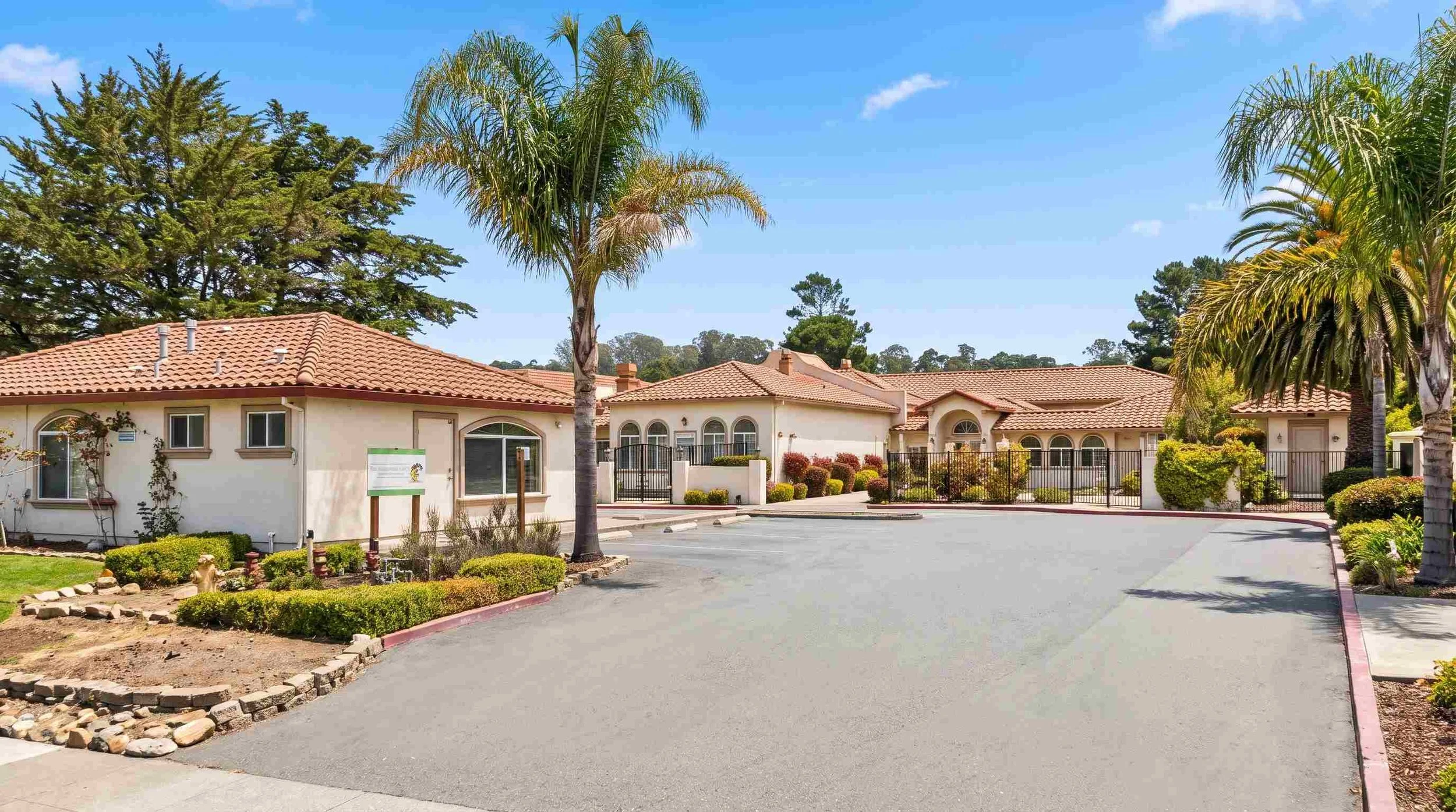
Peninsula Reflections sits at 205 Collins Ave, Colma, CA 94014, in northern San Mateo County, and it holds California license number 415600976. State records list it as a licensed residential care facility for the elderly with a capacity of 57, operated by Claremont Retirement Management Services Inc, and licensed since October 2016.
What makes this one worth a closer look is where its attention goes. Many communities add a memory care wing to an assisted living building. Here the memory care side is the main event, and the assisted living level is described as the earlier stage of the same journey rather than a separate business.
Two Levels of Care Under One Roof
The community runs what it calls two levels of care, and the dividing line is how much support a person needs rather than a diagnosis on paper. Assisted living here is aimed at the early stages of dementia and Alzheimer's disease, with residents keeping the privacy of their own suite with a bathroom and access to 24-hour support.
Memory care is for more advanced dementia, and for people whose memory loss comes with physical limitations or health conditions that need a higher level of help. The published list of included services covers care staff around the clock, a full-time nurse, medication management, help with bathing, dressing and mobility, support with eating and hydration, reminders and prompting, laundry and housekeeping, and an emergency response system.
Two other options sit alongside those. Respite stays can run from about a week to as long as a family needs, which matters when a caregiver at home is ill or simply out of road. Hospice care is provided in partnership with several agencies, so a resident who reaches that stage does not have to move again.
How the Building Itself Does Some of the Work
Good memory care is partly architecture. Peninsula Reflections uses a color-based wayfinding system so residents can find their own way around without being corrected or escorted, which sounds like a small thing and is not. Being able to locate your own room is a daily piece of independence.
The rest of the layout follows the same idea. There are quiet rooms placed throughout the community for residents who get overwhelmed, courtyards spread across the property rather than one token patio, a game room, and a great room where families can sit with their person instead of hovering in a corridor. A security system runs throughout the building.
Technology shows up in one specific place: an iN2L touch-screen system used for resident engagement. It is the kind of detail worth asking about on a tour, because the value is entirely in how often staff actually use it and whether anyone sits with a resident while they do.
Daily Life, Meals and the Calendar
Dining is structured around three meals a day, served restaurant style in the dining room or brought to a resident's room by tray when that works better. Snacks are available through the day, menus rotate, and a registered dietitian both designs them and carries out regular nutritional assessments.
That last point deserves weight. Weight loss is one of the quietest ways dementia care goes wrong, and a community that has a dietitian checking in has already built a tripwire for it. Meals that can be adapted for therapeutic and supplemental diets also mean fewer reasons to move someone later.
Activities and Shared Spaces
The activities calendar runs both on and off campus, with scheduled transportation for outings. Sunday church services are held on site, the salon and barbershop open twice a week, and a happy hour runs on Fridays. A concierge is available from 8 AM to 5 PM, and a 24/7 pharmacy supports the medication side.
None of that tells you whether the calendar is full on a Tuesday afternoon in February, which is the question that matters. When you visit, ask to see the current month rather than a sample, and ask who runs the activities when the activities director is off.
Memory Care and Assisted Living Are Not the Same Product
Families often use the two names interchangeably, and communities do not. Assisted living is housing with support attached. Memory care adds a secured setting, staff trained specifically in dementia, and a daily structure designed around people who cannot reliably hold a plan in mind.
Plenty of assisted living buildings accept residents with memory loss without offering any of that. MedlinePlus (2025) lists assisted living facilities and nursing homes with special memory care units as distinct services, and treats the question of which one fits as something a caregiver has to work out deliberately rather than assume.
That is why the licensing detail at the top matters more than a brochure. A license number tells you what the state has inspected and approved; a website tells you what the marketing team wanted to lead with. Both are worth reading, in that order.
What Changes as Dementia Progresses
Needs rarely stay still, which is the practical argument for a community that already runs more than one level of care. Cleveland Clinic (2025) puts the scale of this at an estimated 6.7 million U.S. adults aged 65 or older living with dementia, and notes that dementia usually affects people after age 65.
The same source describes moving to a full-time care facility as one of the choices families face as symptoms progress, alongside non-medication supports such as staying socially engaged and keeping hobbies that challenge thinking skills. A community whose calendar and common rooms are built around exactly that is doing something clinically sensible, not just pleasant.
For a family, the useful question on a tour is what happens next. Ask what a move from the assisted living level to memory care involves, who decides, how the cost changes, and whether the person has to change rooms. Getting that answer in writing before move-in saves a difficult conversation later.
Medical Care Once Someone Lives There
A residential care facility is not a medical facility, and the distinction catches families out. The staff here handle daily care and medications, and a full-time nurse is on the roster, which is more than many communities of this size offer. Physician care, though, still comes from outside the building, and arranging it stays the family's job.
For many residents the simplest arrangement is a doctor who comes to them. A physician who sees patients in senior communities can handle routine visits, medication reviews and the paperwork that keeps piling up, without anyone being loaded into a car. That matters more as dementia advances and a waiting room becomes its own kind of ordeal.
Ask the community which physicians already visit regularly and whether your parents can keep the doctor they have now. The answer varies from one building to the next, and it is far easier to settle before the move than during the first week, when everyone is already dealing with a new room and a new routine.
The Neighborhood: Colma, Next Door to Daly City
Colma is small in a way that is hard to picture until you drive through it. The Town of Colma describes itself as roughly 2.2 square miles, incorporated in 1924 and known as a cemetery city, with a population recorded at 1,502 in the 2020 federal census. The community markets itself to both Colma and neighboring Daly City, and that is a fair description of where it sits.
For visiting families, the useful fact is the BART station, which opened for service in February 1996 on the line that later reached Millbrae and San Francisco Airport. A relative in San Francisco can visit without a car, which quietly raises how often visits actually happen.
The flip side is worth saying out loud. A small town means fewer shops and restaurants within walking distance than a downtown location would offer, so if your family pictures a weekly lunch out nearby, check what is actually within reach before you decide.
What to Ask Before You Commit
Bring a short list and use it at every community you visit, not only this one. Comparable answers across three places are far more useful than exhaustive notes on a single tour, and the differences between the answers usually tell you more than any individual answer does.
Is a nurse on site at all times, or only during certain shifts?
What is the staff-to-resident ratio on the memory care side, overnight as well as during the day?
How long have the care staff worked here, and how is dementia training handled?
What triggers a move from one level of care to the other, and what does it cost?
Which hospice agencies do you work with, and what happens if private funds run out?
Visit more than once, at different times of day, and sit through a meal if you can. A Tuesday lunch tells you more about staffing levels and the mood of the room than any scheduled tour will, and a second visit that nobody prepared for tells you more again. Trust what you see on the ordinary day.
Contact and the Next Step
Peninsula Reflections is at 205 Collins Ave, Colma, CA 94014, license number 415600976. The community publishes 650-263-4147 as its main number and gives (650) 731-4670 for current residents and families, and tours are arranged through its own Peninsula Reflections website.
If you are comparing several communities across San Mateo County and San Francisco, a placement specialist can narrow the list to the ones that actually have an opening at the right level of care. You can find a placement and care management agency through the network directory, which saves a round of phone calls when time is short.
Whatever you decide, start the LIC 602A early. It is the one piece of the move that depends on a doctor's calendar rather than yours, and the form is far easier to deal with before a move-in date is on the wall.
Sources Used
Alzheimer's Caregivers – MedlinePlus (2025)
Colma History – Town of Colma
Dementia – Cleveland Clinic (2025)
Welcome to Peninsula Reflections Retirement Community – Peninsula Reflections

Written by Sofiia Puhach
November 20, 2026
Explore More Assisted Living Communities

Address: 2780 26th Avenue, Oakland, CA 94601