
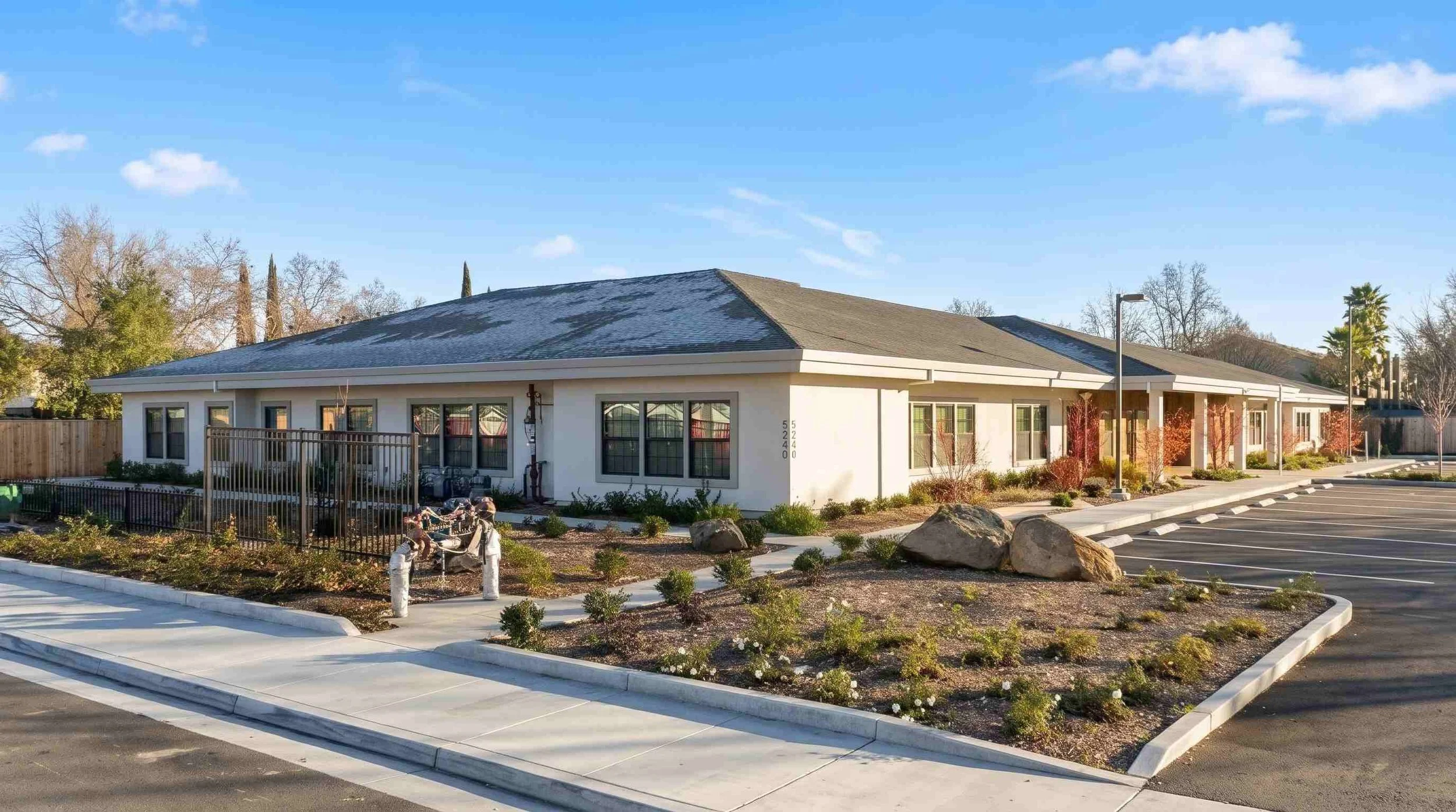
For families comparing assisted living in Sacramento, Vista Esperanza is the unusual entry on the list. It is a 54-bed residential care facility for the elderly at 5240 Jackson Street in North Highlands, licensed by the state as facility number 345920088, and it was built specifically for older adults whose primary diagnosis is a mental health condition.
That focus changes almost everything about how it works, from who gets into what the nursing staff can handle. If your parent has schizophrenia, bipolar disorder, or long-standing severe depression alongside their aging, this is one of very few places in California designed around that combination rather than tolerating it.
What Makes Vista Esperanza Different From Other Sacramento Communities?
It was purpose-built for seniors with serious mental illness, and it is the first facility of its kind for the company that runs it.
Vista Esperanza opened in September 2024 as the first residential care facility for the elderly operated by Psynergy Programs, Inc., which already ran residential mental health communities elsewhere in California. According to the company's announcement of the opening, it is Psynergy's fifth residential project in the state and the first aimed at people over 59 and a half who had aged out of the adult system of care, which serves ages 18 to 59 and a half.
The building came out of a specific state program. The California Community Care Expansion Capital Expansion program, established through Assembly Bill 172 in 2021, funds the acquisition, construction, and rehabilitation of adult and senior care facilities serving people at risk of or experiencing homelessness. Construction here had stalled in 2021 when pandemic costs halted the half-finished project.
When the California Department of Social Services announced the program in December 2022, Psynergy applied for grant funding and finished the building, making Vista Esperanza one of the first completed projects under the initiative. As of the opening announcement, nearly $570 million in Community Care Expansion funding had been awarded to 61 projects across the state.
Who Is the Community Actually Built For?
Older adults with a primary mental health diagnosis who would otherwise end up in a skilled nursing facility or a locked setting.
Psynergy's own explanation of the need is blunt. Clients were aging out of its adult properties and being moved into skilled nursing or locked settings at higher cost, because California had few assisted living programs with mental health services. People with catheters, colostomy bags, or insulin dependence who could not manage their own finger sticks had nowhere suitable to go.
A high share of residents carry a dual diagnosis involving substance use, past or present. The program is built around that rather than screening it out, with interactive journaling for people maintaining sobriety and a more intensive track called Recovery Path, combining individual and group therapy on a set schedule, for those with an acute diagnosis.
Four of the 54 beds are available for non-ambulatory individuals. That is a small number, so if mobility is the central issue rather than the mental health diagnosis, ask about availability early in the conversation.
What Clinical Care Is Available on Site?
Twenty-four-hour nursing, on-campus psychiatric visits, and medication management in a dedicated space.
The 24-hour nursing staff is what Psynergy describes as unique to this property, and it is the reason residents with catheters, colostomy bags, or insulin dependence can stay in a community setting instead of moving to skilled nursing. There is a medication room lounge designed to give some privacy around therapy and medication management.
The building has many private offices so that psychiatrists, mental health rehabilitation specialists, and others from Psynergy's outpatient clinics can see residents on site rather than sending them out. Soundproof booths support tele-therapy for anyone who wants to keep seeing an off-site therapist. A dietician builds menus for heart-healthy, vegetarian, and soft-palate diets, and meals are chef-prepared using local produce.
Outside care still has to be arranged by the family in most cases, and routine medical needs do not disappear in a mental health setting. Keeping a primary care relationship going matters, and physicians and specialists who see patients where they live are one way to handle check-ups, prescription reviews, and the admission paperwork without moving a frail parent across town.
What Does Daily Life on the Campus Look Like?
A secured two-acre campus laid out more like a hospitality property than a clinical one.
Resident rooms are shared, but each room has two separate sleeping areas, each with its own lighting and its own closet. Rooms and common spaces are finished with furnishings sourced from the hospitality industry, which is a deliberate choice rather than an accident of budget.
Common areas include a covered outdoor dining room that converts into an evening entertainment space with a widescreen television. Enclosed green spaces with automatic gates and built-in security cameras give residents somewhere safe to walk and sit outside. A concierge desk and a digital daily calendar keep track of what is happening on and off campus.
Security is part of the design rather than an add-on, and the stated aim is a homelike setting with a high level of supervision. For a family whose parent has wandered, been hospitalized repeatedly, or lost placements elsewhere, that combination is usually the deciding factor.
How Does an RCFE Compare With Board and Care or a Nursing Home?
Three different licenses, three different levels of medical care, and three different price structures.
The National Institute on Aging describes board and care homes as small private facilities, also called residential care facilities or group homes, that usually have 20 or fewer residents, provide personal care and meals with staff available around the clock, and generally do not provide nursing or medical care. Assisted living facilities range from about 25 residents to 100 or more, offer meals, personal care, help with medications, housekeeping, and 24-hour supervision, and sit between independent living and a nursing home in cost.
Nursing homes, also called skilled nursing facilities, focus more heavily on medical care, with nursing care, 24-hour supervision, and rehabilitation services. Medicare does not pay for assisted living, and Medicaid coverage for parts of it depends on the state and on whether the person qualifies.
Vista Esperanza is licensed as a residential care facility for the elderly, which is California's assisted living license, but with nursing capacity closer to what families expect from a skilled setting. If a smaller house would suit your parent better, small group homes work differently again, and other California options are listed in the assisted living guide.
Why Is Senior Housing for Mental Illness So Hard to Find?
Because the need grew quickly and the supply did not. This is the backdrop that explains why a single 54-bed building in North Highlands counted as state news.
A 2024 article in Public Policy & Aging Report describes the shift. The prevalence of nursing home residents with serious mental illness rose by nearly 80% over the previous 15 years, and as of 2017 almost one in five residents had a diagnosed serious mental illness. Few nursing homes specialize in psychiatric care, and most report that 20% to 40% of their residents have a serious mental illness.
The same article notes that access to and funding for community-based support for aging adults with serious mental illness remain insufficient, which leaves nursing homes absorbing people they were not designed to serve. Staff knowledge, training, and access to mental health services have not kept pace.
Read against that, a purpose-built RCFE with psychiatric services on site is less a luxury than a correction. It also explains the waiting lists at places like this one.
North Highlands and the Surrounding Area
North Highlands is a residential suburb in Sacramento County, just north of the city of Sacramento, and the campus sits on a quiet stretch of Jackson Street rather than a commercial strip.
That matters practically. A two-acre site in a suburban neighborhood gives room for the enclosed outdoor spaces that a downtown building cannot offer, and visiting families can usually park without trouble. Sacramento's medical centers and county behavioral health offices are a short drive away, which is relevant when appointments and case management are part of the routine.
Families comparing options across the county often look at communities in Citrus Heights, also in Sacramento County, alongside North Highlands. Those are mostly conventional assisted living and memory care settings, so the comparison is usually not like for like, and it is worth being clear with yourself about which problem you are solving first.
How Does Admission Work?
There are two routes, and most families arrive by the first one. Psynergy's admissions page explains that referrals generally come either through one of its county partner programs or from out-of-network families who are self-funding or using private insurance. County case managers are asked to confirm eligibility with their county partner organization before calling.
The payment side is worth understanding before you get attached to the place. Psynergy does not participate in insurance plans and does not accept direct reimbursement from any plan, so payments go directly to the company. It will prepare a health insurance claim form for families to submit themselves, but only after services have been delivered and the balance is paid in full.
If your parent is already connected to county behavioral health, start there rather than with the facility. If not, the self-funded route is open, and the admissions team is the right first call to find out whether the clinical fit is there at all.
Contact and Next Steps
The campus is at 5240 Jackson Street, North Highlands, CA 95660, in Sacramento County, licensed as facility number 345920088 with a capacity of 54. The phone number on the state license record is (415) 590-0579, and Psynergy's admissions line is (408) 412-7202. The license number can be checked against California's Community Care Licensing facility search, which also shows inspection and complaint history.
The facility's own Vista Esperanza page is the best place to see current photos and program descriptions before you call.
If the clinical fit is not right, or there is no opening, a placement professional can save months of calls. Placement agencies in the Doctor2me network work through this kind of search, including the harder cases where a mental health diagnosis narrows the list. Either way, ask about the physician's report early, since the paperwork is often what delays a move that everyone has already agreed on.
Sources Used
Admissions – Psynergy Programs, Inc.
Long-Term Care Facilities: Assisted Living, Nursing Homes, and Other Residential Care – National Institute on Aging (2023)
Policy Changes to Promote Better Quality of Life for People with Serious Mental Illness Living in U.S. Nursing Homes – Public Policy & Aging Report (2024)
Psynergy Programs' Vista Esperanza fulfills promise of California's Community Care Expansion initiative – Psynergy Programs, Inc. (2024)
Vista Esperanza – Psynergy Programs, Inc.

Written by Sofiia Puhach
October 26, 2026
Explore More Assisted Living Communities

Address: 5240 Jackson Street, North Highlands, CA 95660 (Sacramento County)