Home-Based Primary Care: How a House-Call Doctor Works for a Homebound Parent
Table of Content
A house-call doctor brings routine medical care into your parent's home. It is called home-based primary care, and it removes the hardest part: getting there.
More than 2 million Americans aged 65 and older are homebound, and among those who are completely homebound, only 11.9 percent said they received primary care at home, according to a 2025 review in Current Geriatrics Reports. For most families the gap is not medical. Nobody ever mentioned that a doctor can come to the house.
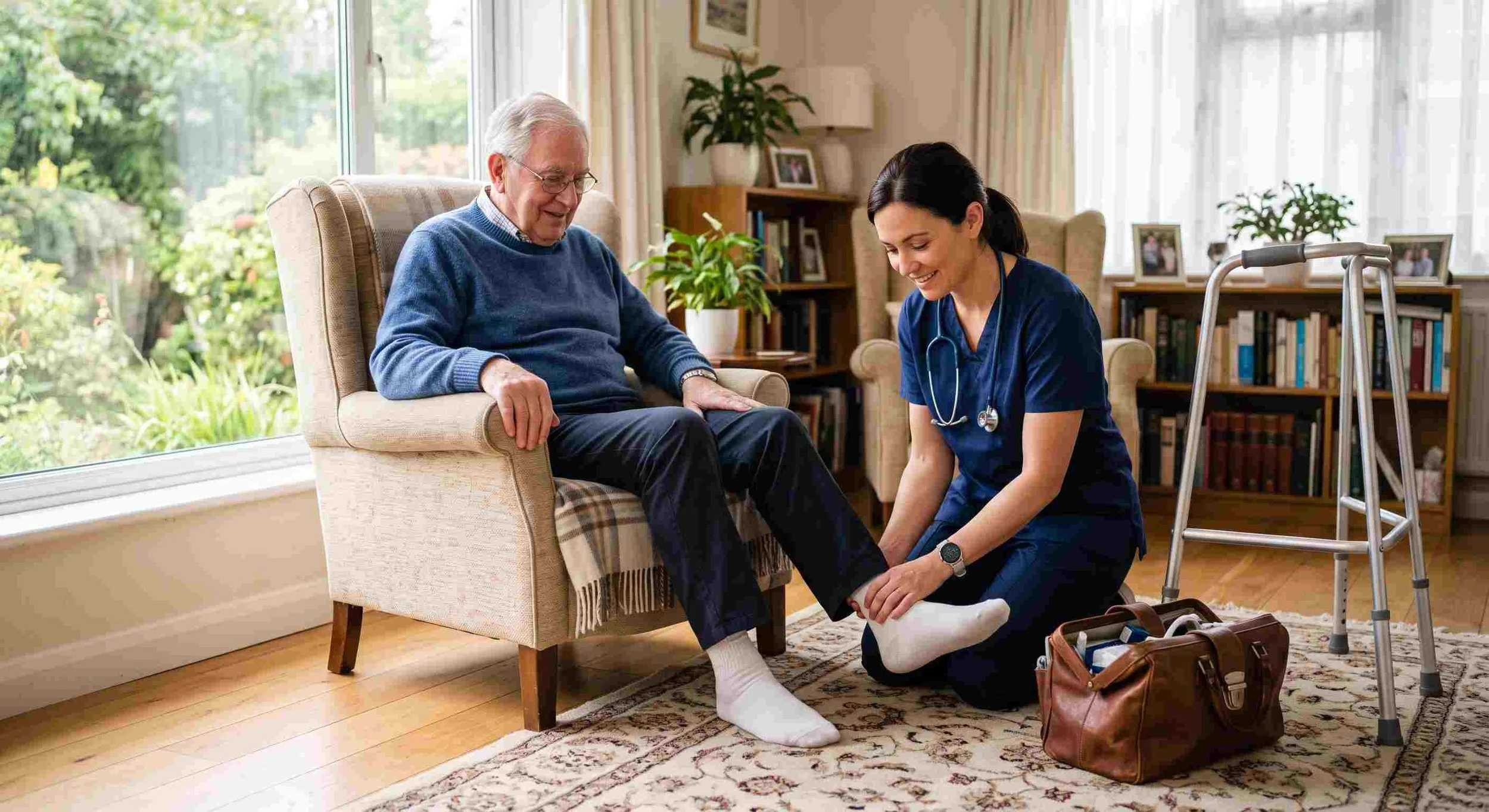
Home visits suit anyone for whom leaving the house has turned into a production: a wheelchair transfer, a two-person lift, a ride that will not wait. The doctor arrives with a bag, sits down, and works through the same list a clinic would work through.
What Does a House-Call Doctor Actually Do at Home?
A house-call doctor handles the same work as a primary care office visit, plus a few things a clinic cannot reach. The setting changes and the medicine does not. Chronic conditions get managed, new symptoms get examined, refills get reviewed, and referrals get written, all in the same room where your parents eat breakfast.
Inside a Typical Home Visit
Expect a history and physical exam, vital signs, a look at how your parents stand and walk, and a review of every bottle in the cabinet. Visits usually run longer than a clinic appointment because the schedule is not stacked with back-to-back rooms waiting down the hall.
What the Doctor Notices That a Clinic Never Sees
A home visit includes a look around: trip hazards, lighting, how medicines are stored, whether equipment such as home oxygen is working. That look matters. The CDC (2026) reports that more than one out of four adults aged 65 and older fall each year, and less than half of them tell their doctor about it.
Broken or uneven steps, throw rugs, and clutter all sit on the CDC's list of conditions that raise the odds of a fall. Those are easy to miss in a phone call and hard to miss when someone is standing in the hallway looking at them.
What Does Homebound Mean for Medicare?
Medicare counts your parents as homebound when two things are true at the same time. Medicare.gov states both: leaving home is not recommended because of their condition, or they need help to leave, such as a cane, walker, wheelchair, special transportation, or another person; and they are normally unable to leave home, and leaving takes a lot of effort.
Homebound is not the same as bedbound, which surprises a lot of families. Medicare allows trips out for medical treatment and short, infrequent absences for non-medical reasons such as religious services, and a person can still qualify while attending adult day care.
That definition governs Medicare's home health benefit, which pays for skilled nursing and therapy delivered at home. A physician's own house call is a separate service with its own billing, so ask any practice what a visit costs and how it is billed before the first appointment.
Does Medicare Cover Home Health for a Homebound Parent?
Medicare covers home health services when your parent is homebound and needs part-time or intermittent skilled care. The route runs through a provider rather than through the family, which catches people out. You cannot sign your parents up for this benefit directly, no matter how obvious the need looks from where you are standing.
A doctor or other provider, such as a nurse practitioner, has to see your parents in person, confirm that home health is needed, and order the care, and a Medicare-certified agency has to deliver it. Covered home health services cost you nothing, although a 20 percent share applies to covered medical equipment once the Part B deductible is met.
There is a ceiling. Part-time or intermittent generally means up to 8 hours a day and no more than 28 hours a week of skilled nursing and aide services combined, with a little more allowed for a short stretch if the provider decides it is necessary. Anything beyond that is a different conversation.
Families often assume home health covers everything that happens at home, then discover the line in the middle of a hard week. The table below sorts what this benefit pays for from what it leaves to you, so the gap is visible before anyone is relying on it.
|
Covered by Medicare home health |
Not covered by Medicare home health |
|---|---|
|
Part-time or intermittent skilled nursing care, such as wound care, injections, and monitoring an unstable condition |
Round-the-clock care at home |
|
Physical therapy, occupational therapy, and speech-language pathology, if conditions are met |
Home meal delivery |
|
Medical social services and home health aide care alongside skilled care |
Homemaker services such as shopping and cleaning that are unrelated to the care plan |
|
Durable medical equipment and medical supplies for use at home |
Personal care with daily activities, when that help is all your parent needs |
The right-hand column is where most families end up paying privately or hiring an agency. It is worth pricing that side out before a hospital discharge rather than after, because discharge planners work fast and the questions that matter most tend to surface on the drive home.
How Do You Arrange Doctor Visits at Home?
Two doors lead to the same place. You can ask your parent's current doctor for a referral, or you can call a visiting physician practice yourself. Neither route is wrong, and the better one usually depends on how connected your parent already is to a primary care provider who knows the history.
Going Through the Current Doctor
A referral is the smoother route when your parent already has a provider who knows the history. For Medicare home health, that in-person visit and written order are required anyway, and the provider is supposed to hand you a list of agencies that serve your area and disclose any financial interest in them.
Calling a Practice or Agency Directly
Plenty of families skip the referral and call a house-call practice on their own. Ask three things on that first call: which zip codes they cover, how soon someone can come, and what a visit costs. It also helps to know how same-day house calls actually work before you start comparing practices, and to browse a directory of doctors who make home visits in your parent's area.
Skilled nursing and therapy at home come from a home health agency rather than a physician's practice. 911 AM PM Home Health care, for one, provides in-home nursing, physical therapy, occupational and speech therapy, and infusions across Los Angeles, Ventura, Orange, Riverside, and San Bernardino counties.
Timing is the other question families ask. A scheduled home visit is not the right tool for chest pain or a suspected stroke, and it helps to know in advance how to choose between urgent care, the ER, and a house call. For a same-day problem that is not an emergency, there are usually more options than the walk-in clinic.
Managing Medications Without the Trip to the Clinic
Medication management is one of the most common reasons families book a home visit, and it is the task that travels the worst. The bottles live at home, the pharmacy calls the house, and the person who takes them is the one who cannot easily get to a clinic to have the list reviewed.
A home visit is a chance to spread every bottle on the kitchen table, check what is still needed, and stop what is not. Cleveland Clinic (2025) notes that deprescribing, taking a person off medicines that may be doing more harm than good, is something geriatric doctors are trained in, and that some patients leave a visit on fewer medicines than they started with.
Some prescriptions also depend on regular contact with the prescriber, which is precisely what a homebound person cannot arrange easily. The rules on prescribing at a distance keep moving; telehealth.hhs.gov (2026) reports that the current federal flexibilities for prescribing controlled medications run through December 31, 2026. A standing in-person visit at home keeps the plan steady whichever way those rules settle.
For a parent who cannot sit up without help, that difference is not small. A clinic appointment can mean two people, a lift, a van, an hour each way, and a day of recovery afterward. A home visit costs an hour in a familiar chair.
How to Bring It Up With a Parent Who Says They Are Fine
Lead with independence rather than decline. The goal your parents actually care about is staying in their own home, and a home visit is one of the few things that plainly serves that goal rather than threatening it. Say that part out loud before anything else.
Cleveland Clinic's geriatric team suggests a gentle, nonjudgmental tone and a line as plain as wanting them to be able to stay where they are. Framing the visit around prevention also works better than cataloguing everything that has gone wrong lately, which tends to end the conversation instead of starting it.
Shrinking the ask helps too. A home visit is not a move to a facility and not a handover of control, and saying so out loud is worth doing. It is one doctor, for about an hour, in the chair your parents already sit in.
If pride is the obstacle, hang the visit on something small and concrete, like a blood pressure check or swollen ankles. If memory is the worry underneath, a doctor at home can run a simple screen such as the clock drawing test without anyone having to say the word dementia first.
How a Visiting Physician Works With Your Parent's Current Doctors
A house-call doctor is built to work alongside the specialists your parent already sees rather than to replace them. Most visiting practices expect to inherit an existing cardiologist, kidney doctor, or neurologist, and part of their job is keeping those offices in the loop after every visit.
Home-based primary care generally runs as a team rather than a solo visit. Alongside the physician or nurse practitioner there may be nurses, social workers, therapists, and care coordinators, and those coordinators are often the ones who chase referrals, move records between offices, and connect families to meal programs and transportation.
Ask two questions at the start, and write down the answers. Who sends visit notes to the other doctors, and who calls the family afterward? Clear answers prevent the usual mess, where two prescribers change the same plan a week apart and nobody tells anyone.
One practice should own the overall plan, and everyone else should advise it. Families who settle that question in the first month spend far less time refereeing conflicting instructions later, and the rest of home-based primary care tends to run quietly in the background the way it is supposed to.
Sources Used
Facts About Older Adult Falls – Centers for Disease Control and Prevention (2026)
Home health services – Medicare.gov
How To Talk With Your Loved One About Their Memory Loss – Cleveland Clinic (2025)
Prescribing controlled substances via telehealth – Telehealth.HHS.gov (2026)
FAQ
-
In many areas, yes. Practices often arrange mobile blood draws and portable imaging so samples and scans happen at the house. Ask which services the practice can bring and which still require a trip out.
-
Plan for roughly 45 to 60 minutes for a first visit, and less for follow-ups. First visits run longer because the doctor is building a full history and reviewing every medicine.
-
No. Medicare's rule turns on how hard it is to leave home, not on whether someone can walk. Many homebound people move around the house and still qualify.
-
Gather every medicine bottle, including over-the-counter ones, plus the insurance card, a list of other doctors, and any recent hospital paperwork. A quiet room with a chair and good light makes the exam easier.
-
Many practices handle both, including same-day requests for things like a fever or a worsening cough. Anything that looks like an emergency still belongs to 911 or an emergency department.
-
Not necessarily. Some families keep the original doctor for oversight and use a visiting practice for hands-on care. Decide together who owns the main care plan so instructions do not conflict.

Written by Sofiia Puhach
September 24, 2026
You May Also Like