Home Oxygen Therapy Equipment
Breathing troubles reshape daily life. Home oxygen therapy equipment helps people stay safe and comfortable without leaving their home. When used right, it brings calm into routines that once felt uncertain.
Why Oxygen Therapy Matters
Oxygen keeps every cell alive. When levels drop, thinking blurs, the heart races, walking feels heavier. Doctors call it hypoxemia. It appears in COPD, asthma, lung cancer, heart failure — and sometimes after severe flu. Even mountain air can make breathing harder.
The National Institutes of Health (NIH) notes: oxygen therapy is necessary when oxygen pressure (PaO₂) stays at 55 mmHg or lower, or saturation (SaO₂) falls to 88 % or below. At that point, oxygen is not comfort — it’s treatment that helps people live longer.
Healthy oxygen usually ranges from 95 to 100 %, says Mayo Clinic. Anything lower means the body begins to fight for air. Extra oxygen lets it rest again.
Measuring Oxygen at Home
Small fingertip oximeters show oxygen saturation and pulse. To read them right, sit still, warm your hands, remove polish. The device gives a number, but the body gives context. Blue lips, fatigue, dizziness — those matter more than a screen.
Prescriptions list the flow rate and hours per day. Something like two liters per minute for fifteen hours. It’s written clearly because “as needed” doesn’t protect anyone. Oxygen is dosed like medicine.
Different Systems for Different Lives
No single setup fits everyone. Some people stay home all day. Others move around and need something light. What matters is matching the system to the person — not the other way around.
Oxygen Concentrators
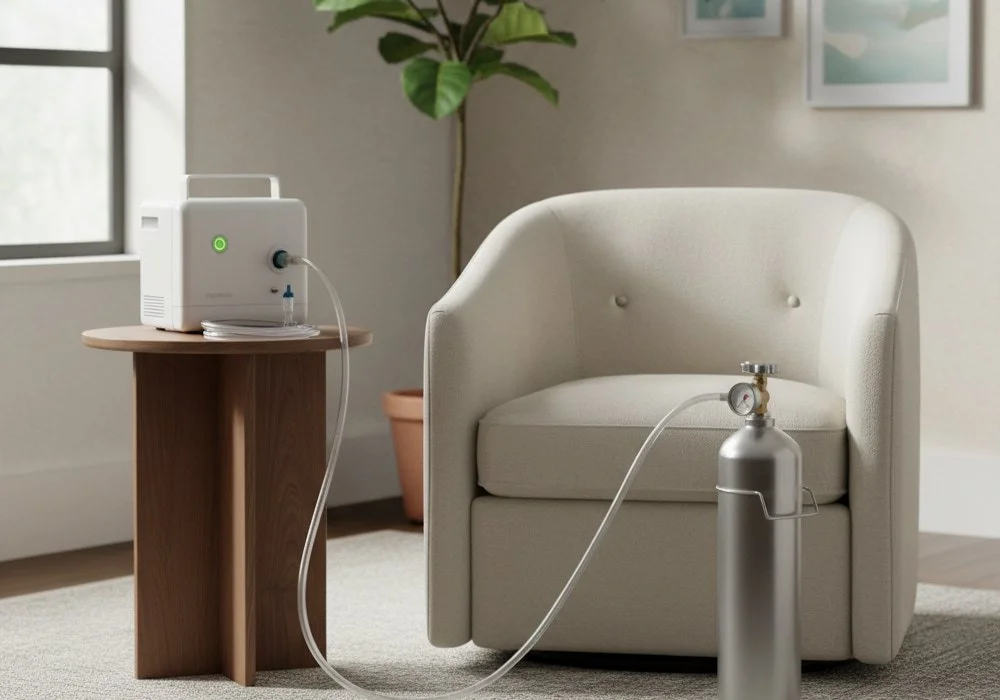
Concentrators pull oxygen from room air and remove nitrogen. Big models stand in corners and need steady power. They hum quietly and give a constant flow. Portable ones — POCs — use rechargeable batteries. You can take them in a car or on a plane. They release oxygen in short bursts as you inhale. That saves energy but limits flow.
Technicians from Medlife Medical Supply, Inc. deliver and maintain these concentrators around Los Angeles and Ventura County. They set up the device, check filters, explain cleaning — everything that keeps oxygen flowing safely.
Cylinders and Tanks
Gas cylinders hold compressed oxygen, usually 95 % or higher purity. They don’t need electricity, which helps during power cuts. Small ones go with you, large ones stay beside the bed. Every cylinder must stand upright, strapped or placed in a holder, never loose.
Liquid Oxygen Systems
Liquid oxygen (LOX) holds pure O₂ in an extremely cold liquid form. It lasts longer and supports high-flow users who want mobility. The trade-off: strict care. LOX must stay upright, away from heat, and handled gently to avoid frost burns.
Comparing Systems
| System | Source | Mobility | Flow | Notes |
|---|---|---|---|---|
| Stationary concentrator | Room air → filtered oxygen | Home use | Continuous flow | Needs electric power and air space |
| Portable concentrator | Battery-powered | Travel ready | Pulse dose | Lightweight but limited output |
| Gas cylinder | 95 % compressed oxygen | Portable or fixed | Continuous | Heavy; requires refills and safety straps |
| Liquid oxygen | 100 % cryogenic liquid | High mobility | High flow | Must stay upright; risk of frostbite |
Each system has a rhythm. Concentrators anchor home life. Cylinders serve emergencies. LOX helps active users stay outside longer.
Clean Equipment, Safer Breathing
The Centers for Disease Control and Prevention (CDC) stresses hygiene: clean humidifier bottles, rinse tubing, replace filters on schedule. Oxygen passes directly to lungs — dirt has no place there.
Quick routine:
Wash hands.
Check gauges or battery.
Use distilled water in humidifiers.
Keep tubing straight.
Test flow — dip the cannula tip in water; bubbles mean go.
Replace nasal cannulas every few weeks and tubing every two months. Medlife Medical Supply, Inc. technicians handle deep checks once a year, ensuring concentrators meet CDC cleanliness standards.
Fire, Power, and Product Safety
Oxygen itself doesn’t burn, but it feeds flame. The American Lung Association (ALA) advises keeping all devices five feet from heaters, stoves, or candles. Smoking near oxygen is never safe — not once, not briefly.
Avoid petroleum jelly, grease, or oil-based lotions; they ignite fast in oxygen-rich air. Choose aloe or water-based creams. Plug concentrators directly into grounded outlets. No power strips. Keep tubing short to avoid falls.
When to Reach Out for Help
Sometimes numbers look fine, but breathing feels off. Call your clinician if confusion, headache, or blue lips appear. Note what you were doing — sitting, walking, sleeping — so the doctor can adjust the settings accurately.
Extra Help at Home
Breathing therapy often connects with other home-based care. Professional Imaging Network provides in-home ultrasound and X-ray, letting oxygen-dependent patients skip hospital trips. These visits track lung and heart health without interrupting therapy.
Simple touches — clear floors, steady night lights, tucked tubing — prevent mishaps and keep life normal.
Understanding the Numbers
Below 88 % oxygen saturation, the body starts to struggle. The NIH and Mayo Clinic agree: maintaining higher levels lowers complications. Patients notice the change — fewer pauses while walking, steadier sleep, better focus.
It’s not just data; it’s daily life improving quietly.
Home oxygen therapy equipment lets people manage chronic breathing conditions at home instead of hospitals. With the right partners — Medlife Medical Supply, Inc. for equipment and Professional Imaging Network for diagnostics — patients can breathe easier knowing help is close.
For tailored advice, a short talk with a respiratory specialist can clarify which device and flow setting fit best.
FAQ
How do I know which oxygen system is best for my specific needs and lifestyle?
The right system depends on how much oxygen you need and how you live day to day. Your doctor determines the flow rate after testing your oxygen levels at rest and during activity. People who spend most of their time at home usually use a stationary concentrator. Those who move often benefit from portable concentrators or small cylinders. A respiratory therapist or supplier like Medlife Medical Supply, Inc. can guide you through the options and help match the equipment to your medical needs and mobility.
What should I do if my equipment stops working or gives unusual readings?
First, check simple things — power supply, tubing connections, or battery charge. If readings seem off, wait a few minutes and test again while sitting still with warm hands. If the problem continues, contact your equipment provider immediately. Medlife Medical Supply, Inc. offers technical support and in-home maintenance for concentrators and cylinders. If breathing becomes difficult or oxygen flow stops completely, call emergency services or go to the nearest medical facility.
Will my insurance cover all types of home oxygen equipment and maintenance?
Coverage usually depends on your medical diagnosis and the equipment prescribed by your doctor. Some systems, such as stationary concentrators, are typically covered when medical need is documented. Portable or specialty devices may require additional paperwork. Your healthcare provider and equipment supplier can explain what’s included and what may need prior approval. It’s best to review your coverage details before ordering new equipment.
What steps should I take if I want to travel with my oxygen equipment?
Plan early. Ask your doctor for a copy of your oxygen prescription and keep it with you. If you fly, confirm that your portable concentrator is approved for airline travel — most airlines require this. Bring enough charged batteries for the entire flight plus extra time for delays. When traveling by car, keep tanks secured upright and never leave them in a hot vehicle. For imaging or health checks while traveling, Professional Imaging Network provides mobile X-ray and ultrasound services that coordinate with home oxygen users.
You May Also Like