
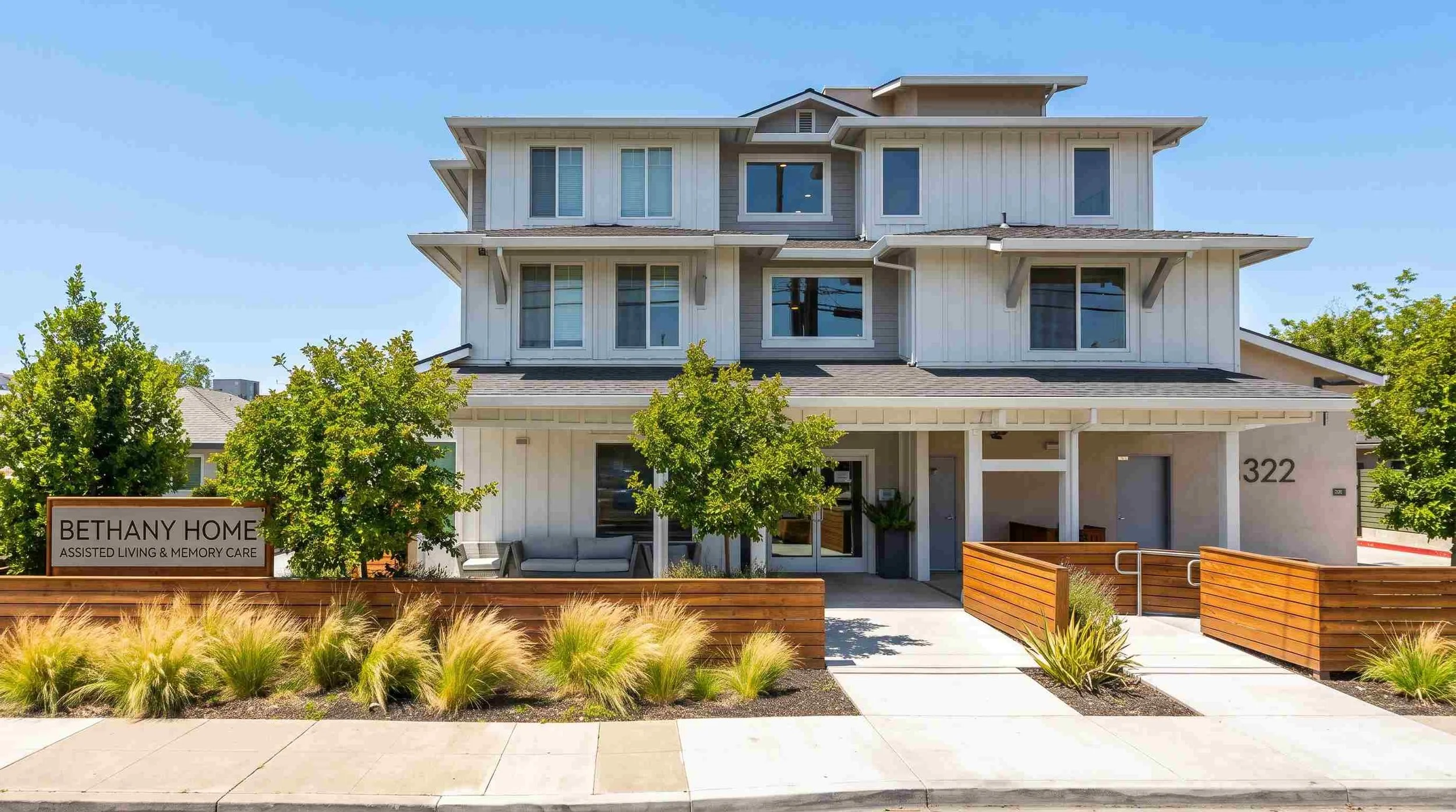
Bethany Home Senior Living, LLC is an assisted living home in Livermore, CA, at 3322 East Ave., Livermore, CA 94550, in Alameda County. It holds California license number 019200973 with a licensed capacity of 58 residents, and it is the largest and newest of several care homes run by the same family operator. The phone number published on its own site is (925) 443-6822.
What Kind of Place Bethany Home Senior Living Is
It is a licensed residential care home for the elderly, not a nursing home, and it is bigger than the houses this operator started with. That combination is the thing worth understanding before a tour, because it shapes who the house suits and who it does not.
The License Record in Plain Terms
The California licensing record lists the facility as Bethany Home Senior Living, LLC, license number 019200973, at 3322 East Ave. in Livermore, with a status of Licensed and a licensed capacity of 58 residents. It was first licensed on April 20, 2021, with Arpad Nagy named as administrator and Bethany Homes Senior Living, LLC as the licensee.
Capacity is the number to read carefully. Fifty-eight is the maximum the license allows, not the number of people living there on any given day, and it tells you the scale of the building rather than how many staff are on shift. Ask both questions separately on a tour.
A Board and Care Operator at Community Scale
The operator behind it is Bethany Homes, which describes itself on its own site as serving families since 1993 and says it was founded by Elizabeth when she began caring for her aging father and mother-in-law. The managing director, Ari, is described as having grown up around the homes.
Its other addresses are small houses: 3957 Harvard Ct. and 3234 East Ave. in Livermore, and 2201 Rockne Dr. and 3815 Concord Blvd. in Concord, each with its own license number. The East Avenue house at 3322 is flagged on the site as the newest one, and it is the only address among them with a capacity in the dozens.
That history is the main thing that distinguishes this option. Most 58-bed assisted living communities were built and run as communities from the start, while this one comes from an operator whose habits were formed in six-bed homes. Whether those habits survive the jump in scale is exactly what a tour is for, and it is a fair question to ask the administrator directly.
What the Care Actually Includes
The published service list is the usual assisted living range, with a few additions that matter more than they sound. Everything below comes from the operator's own description of its individualized service plans, so treat it as what is offered rather than as a verified account of any one shift.
Everyday Help and the Service Plan
The operator lists 24-hour care and supervision by trained caregivers, assistance with bathing, dressing, personal hygiene and other activities of daily living, mobility and transferring assistance, safety monitoring, medication management, continence management and night-time care. Individual service plans are described as being written for each resident, with what the site calls high staff-to-resident ratios.
Two items on that list are worth noting for families coming out of a hospital stay. Support with recovery after hospitalization and rehab is named explicitly, and so is coordination with physicians, home health nursing, physical therapy, occupational therapy and hospice professionals. A house that already does that coordination saves a family a great deal of telephone work.
Meals, Activities and the Small Things
Meals are described as home-cooked, made with seasonal ingredients, tailored to individual preferences and diets. Housekeeping and laundry are included, rooms are described as furnished, and daily activities and exercise are run by staff and volunteers. In-house hair and nail services and community pets are also on the list.
Transport is the practical one. The service list includes travel arrangements with wheelchair-accessible transportation for doctor's appointments and outings, which removes one of the most common reasons an older person misses medical care. Worth confirming how far that transport goes and whether it costs extra.
Memory Care and the Later Stages
Alzheimer's and memory care is one of the four care programs the operator names, alongside assisted living, short-term stays and working with hospice. The site describes training staff to keep residents safe and dignified, and frames the memory care program around peace of mind for families.
Why a Home-Like Building Helps
The environment argument is the one they lead with. Each care home is described as designed for the needs of seniors without the feel of an institutional setting, which they say makes the initial transition easier, especially for someone with Alzheimer's or another dementia. For a person who is already disoriented, a smaller-feeling building does help.
The Questions to Ask About This Building
What to ask about specifically is the secured side of memory care. A house that accepts residents who wander needs doors and a yard built for it, and that is a question about this particular building rather than about the operator's philosophy. Ask to see where a resident who walks at night would be able to go.
Hospice is handled in partnership rather than in-house, which the site states directly. In practice that means a resident can usually stay in place as needs grow, with an outside hospice team coming in, and it is worth confirming that in writing before a move.
Assisted Living, Board and Care, or Memory Care: What the Words Mean
These three terms get used interchangeably in listings, and they are not the same thing. Getting them straight saves a lot of wasted touring, because the right word narrows a search further than any filter does. It also changes what you are entitled to ask about, since a six-bed board and care home and a fifty-eight-bed community are licensed under the same category but run very differently.
What Assisted Living Actually Covers
MedlinePlus (2023) defines assisted living as housing and services for people who need some help with daily care, such as dressing, bathing, taking medicines and cleaning, but who do not need the medical care a nursing home provides. It notes that these facilities also go by names such as residential care facilities, and that they range in size from as few as 25 residents to 120 or more.
That size range is where board and care sits at one end and a community like this one sits in the middle. The services MedlinePlus lists as typical are up to three meals a day, help with personal care and medicines, housekeeping, laundry, 24-hour supervision and on-site staff, social and recreational activities, and transportation. Facilities usually offer several levels of care, with residents paying more for the higher levels.
Where Long-Term Care Planning Usually Starts
The National Institute on Aging (2023) makes the point that the need for long-term care more often develops gradually than suddenly, and that the best time to think about it is before it is needed. Planning early gives a family time to learn what is available locally and what it costs, while the person involved can still take part in the decision.
It also notes that some residential facilities offer only housing and housekeeping while many provide personal care, activities, meals and medical services, and that some run special programs for people with Alzheimer's and other dementias. Reading a facility against that spectrum is more useful than reading it against its own brochure.
Before any tour, it helps to know what commonly goes wrong. Assisted living facility red flags cover what to watch for before and after a move-in, and it is worth reading on the way over rather than afterwards. Most of the signs that matter are things you can notice in twenty minutes if you know to look, and almost none of them appear in a brochure.
How Medical Care Works After a Move-In
An assisted living license does not come with a doctor. The house handles medication management and coordination, but prescribing, examinations, paperwork and the ongoing management of chronic conditions stay with the resident's own physician, exactly as they did at home.
What the House Does Not Cover
That is the gap most families notice in the second month rather than the first. Appointments still have to be arranged, transport still has to be booked, and anything that needs a signature still needs a visit. The transport the operator offers helps, but only for the appointments somebody has already scheduled.
Bringing the Doctor to the Building
Visiting clinicians are the usual answer. Arranging primary care and medical specialists who see patients where they live keeps routine review, prescription renewals and forms inside the building, which matters most for a resident whose day gets worse with every car journey.
The LIC 602A sits in this same category, and it comes up more than once. It is needed before a move-in, and a change in condition can mean it has to be done again, so knowing that a physician can complete it in the building rather than in an office is worth remembering past the first admission.
The East Avenue Neighborhood and Nearby Care
East Avenue runs through residential south-east Livermore, which puts the house in a quiet part of a small city rather than on a commercial strip. For visiting families the practical consequence is easy parking and a short walk in, which sounds minor until it is a twice-weekly trip.
Hospitals and Urgent Care Nearby
Medical access locally is better than the size of the city suggests. Stanford Health Care Tri-Valley, the hospital system formerly known as ValleyCare, has run a Livermore campus at 1133 E. Stanley Blvd. offering urgent care, imaging, laboratory services and an ambulatory surgery center, and has been serving the Tri-Valley since 1961.
The emergency room, though, is in Pleasanton. The Tri-Valley hospital campus at 5555 to 5575 W. Las Positas Blvd. in Pleasanton lists the emergency room, intensive care, cardiology, neurology, stroke care and surgical services, on 925-847-3000. That is the drive to plan for in advance rather than to discover during one.
Getting There From Pleasanton and the Tri-Valley
The wider area is the Tri-Valley, and the operator says it serves Livermore, Pleasanton, Dublin, Walnut Creek, Concord and Pleasant Hill. For a family searching for assisted living near Pleasanton, East Avenue is a realistic option rather than a long detour.
What a Next Step Looks Like
Start with a tour and a list, in that order. Capacity on the day, staff on each shift, how the memory care side is secured, what the transport covers, what the levels of care cost and where this resident would sit on them, and what happens as needs grow. The answers to those six questions settle most decisions.
Who to Call
Contact details come from the operator's own site: the phone number is (925) 443-6822 and the email is info@bethanyhomecare.com, with the East Avenue address listed on the Bethany Homes website alongside license number 019200973. Confirming availability by phone before driving over is sensible, since a 58-bed license does not mean a free room.
If You Are Comparing Several Homes
If this is one of several places on a list, working with a placement agency shortens the search considerably. Someone who already knows which houses in Livermore and the Tri-Valley take which level of care, and which currently have space, can save weeks of calls at a point when weeks matter.
And whichever house is chosen, the LIC 602A has to be signed before anyone moves in. Getting that scheduled early, at home if travel is difficult, keeps the paperwork from becoming the thing that holds up a move that has already been decided. Families often leave it until a room is confirmed, and then lose two weeks waiting for an appointment that could have happened weeks earlier.
Key details at a glance, as the licensing record and the operator's own site state them:
|
Detail |
What the Record Shows |
|---|---|
|
Facility name |
Bethany Home Senior Living, LLC |
|
Address |
3322 East Ave., Livermore, CA 94550, Alameda County |
|
License number and status |
019200973, status Licensed |
|
Licensed capacity |
58 residents |
|
First licensed |
April 20, 2021 |
|
Administrator and licensee |
Arpad Nagy; Bethany Homes Senior Living, LLC |
|
Care offered |
Assisted living, Alzheimer's and memory care, short-term stays, and care alongside outside hospice |
|
Phone and email |
(925) 443-6822; info@bethanyhomecare.com |
Sources Used
Assisted Living – MedlinePlus, National Library of Medicine (2023)
Locations – Stanford Health Care Tri-Valley
Residential Care Facility for the Elderly – Bethany Homes
What Is Long-Term Care? – National Institute on Aging (2023)

Written by Sofiia Puhach
November 23, 2026
Explore More Assisted Living Communities

Address: 3322 East Ave., Livermore, CA 94550 (Alameda County)