
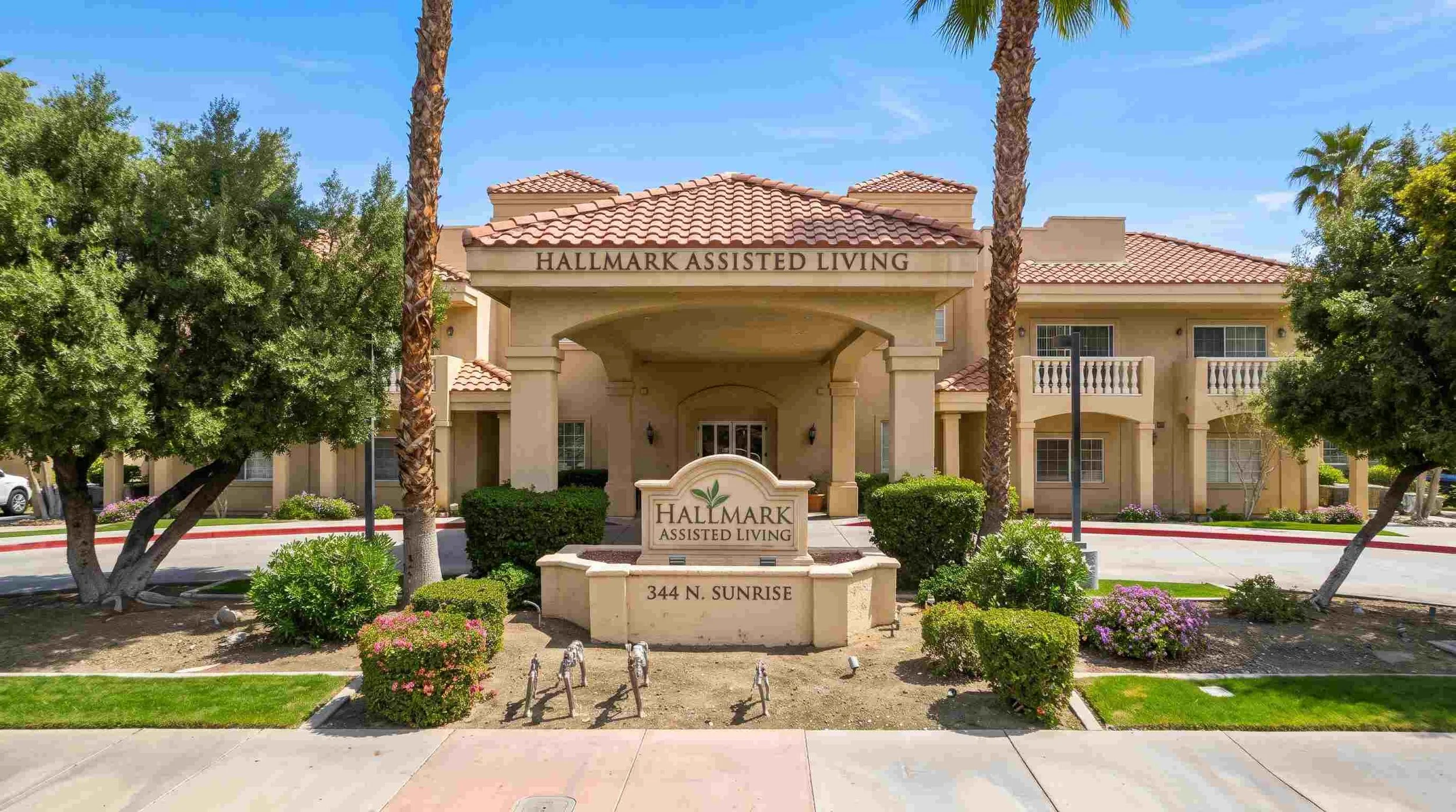
Hallmark Palm Springs is a licensed assisted living community in Palm Springs – a Residential Care Facility for the Elderly, or RCFE – at 344 N. Sunrise Way, Palm Springs, CA 92262, License Number 336412441. State records list it as licensed for 55 residents, with the license first issued in March 2007, and the community itself says it has been serving families in Palm Springs since 1995.
What You Get for the Money, in Plain Terms
An apartment with a kitchenette, three meals, staff on site around the clock, and a month-to-month agreement rather than a lease.
That last point is unusual enough to lead with. The community states that rent is month to month, with no leases and no buy-ins, which means a family is not signing away a six-figure entrance fee to find out whether the place suits their mother. If it does not work, you are not locked in for a year.
The scale is small by design. Hallmark lists forty-six apartments, which puts it near the lower end of the range the National Institute on Aging gives for assisted living facilities – from as few as 25 residents to 100 or more. In a building that size, staff tend to know residents by name rather than by room number.
What the Apartments Are Like
Private apartments with their own bathrooms, starting at roughly 600 square feet. There are no shared bedrooms in the floor plans the community describes.
Hallmark lists oversized one-bedroom apartments alongside deluxe and standard studios, all with private accessible bathrooms and kitchenettes. The majority, according to the community, have balconies or private patios that open onto a park-like lawn and garden – which in Palm Springs means a usable outdoor spot for most of the year.
Small pets are welcome, and the community also mentions dog care. For someone whose dog is the main reason they resist moving at all, that detail often decides the conversation.
What Care Looks Like Day to Day
Awake staff 24 hours a day, caregivers and medication technicians working under a licensed vocational nurse and a licensed administrator.
The community describes 24-hour awake staffing in a secure environment, with a licensed nurse overseeing help with daily living needs. Every resident has a call pendant for assistance and emergencies, which is the practical answer to the question families actually ask: what happens at three in the morning.
Hallmark also lists respite and hospice services as available. Respite matters when a family caregiver needs a week off without arranging everything from scratch; hospice availability means a resident whose health declines may not have to move again at the end.
The administrator on the state record is Gloria Gourlay, and the community's listed phone number is (760) 322-3955. Ask who the current administrator is when you call, since that role turns over at many communities and the person in it sets the tone of the building.
Meals, Activities and Getting to Appointments
Three meals a day from dietitian-created menus, a full-time activities director, and a wheelchair-accessible bus for medical appointments.
Dining is restaurant style rather than tray service, with three meals daily and accommodations for specialized diets. That last part is worth confirming against a specific diet – a low-sodium or diabetic plan is routine, while something stricter deserves a direct question before move-in.
Activities are run by a full-time director, and the published list runs to shopping trips, lunch outings, happy hour entertainment and an exercise program. Weekly housekeeping and linen service and an on-site beauty salon round out the week.
Transportation is the detail families forget to ask about. Hallmark lists scheduled bus transportation with a wheelchair lift to doctor's appointments, which removes the recurring problem of who drives Dad to the cardiologist on a Tuesday.
How Assisted Living in Palm Springs Differs From a Nursing Home
Assisted living helps with daily life; a nursing home delivers medical care. Searching for nursing homes in Palm Springs and ending up at an RCFE is one of the most common mix-ups families make.
The National Institute on Aging draws the line clearly: assisted living is for people who need help with daily care but not as much as a nursing home provides, with residents living in their own apartments and sharing common areas. Nursing homes, also called skilled nursing facilities, focus on medical care and offer nursing care, 24-hour supervision and rehabilitation services such as physical, occupational and speech therapy.
An RCFE license is the California version of the first category. It allows a community to provide room, meals, help with daily activities and medication assistance – and it does not allow the skilled nursing care that a hospital discharge sometimes requires. If a parent needs a wound dressed daily by a nurse or IV medication, that is a different license.
Money follows the same split. The National Institute on Aging notes that most people pay the full cost of assisted living themselves, while Medicaid may cover some nursing home costs for people who qualify based on income and resources. In-Home Supportive Services hours also do not follow a person into an RCFE, which surprises families who were relying on them.
How This Compares With Rancho Mirage and Palm Desert
The Coachella Valley has assisted living in every direction, and location usually comes down to who visits and how often.
Families looking at assisted living in Rancho Mirage or Palm Desert are shopping the same valley, often within twenty minutes of Palm Springs. The practical differences tend to be building size, whether there is a secured memory care wing, and how far the community sits from the adult child who will be dropping in on a Saturday.
Hallmark does not advertise a separate memory care unit, which is a question to raise directly if dementia is part of the picture. The National Institute on Aging suggests asking whether a facility has a special unit for people with Alzheimer's disease or another form of dementia, and what services that unit actually provides.
A shorter drive beats a slightly nicer lobby. A resident whose daughter visits three times a week does better than one whose family visits monthly because the drive is forty minutes each way, and that pattern holds across every community in the valley.
What to Ask on the Tour
Ask the staffing and turnover questions first, because they predict the experience more reliably than the decor does.
The National Institute on Aging's guidance on choosing a long-term care facility lists questions worth bringing to Hallmark or anywhere else:
How many care providers are there per resident, and what training do they have?
How long have the administrator and the heads of nursing, food and activities worked here, and how often do key staff turn over?
Is there a doctor who checks on residents regularly, and how often?
What is planned for residents on weekends, and can you sit in on an activity yourself?
Is there a safe place for residents to go outside?
How do residents get to medical appointments?
Go at a meal time if you can. A dining room at noon tells you more about staffing levels and resident mood in ten minutes than a scheduled tour of an empty model apartment does in an hour.
The Neighborhood Around North Sunrise Way
North Sunrise Way is one of the main north-south streets through Palm Springs, which puts the community close to the parts of town families actually use.
Desert Regional Medical Center, the city's hospital, sits a short drive west on North Indian Canyon Drive. The community itself points to being close to shopping, dining, hospitals and medical care, and the museums and art galleries that downtown Palm Springs is known for.
The flat terrain is an underrated advantage here. Palm Springs sits on a valley floor, so sidewalks and short walks are manageable with a walker in a way that hillside communities elsewhere in California are not, at least outside the hottest months.
Medical Care While Living There
Residents keep their own doctors, and much of the routine care can happen in the apartment rather than in a waiting room.
An RCFE does not employ the physician who manages a resident's conditions. That stays with the person's own doctor, which is why many families in assisted living arrange a physician who visits residents in the community instead of booking transport for every appointment and recheck.
Diagnostics can travel too. A mobile x-ray service such as Gentry Imaging, which covers the Inland Empire, brings digital imaging equipment to where the patient already is – useful after a fall, when moving someone to an imaging center is the hardest part of finding out whether anything is broken.
Ask the community how it handles a resident who declines. Some families discover only later that an RCFE must discharge a resident whose needs exceed what the license permits, and knowing that in advance makes the next decision less sudden.
A Next Step That Commits You to Nothing
Call, tour, and get the current rate in writing before anything else. Published amenities are a starting point, not a quote.
Hallmark Palm Springs can be reached at (760) 322-3955, and floor plans, photos and a tour request form are on the community's own site at hallmarkpalmsprings.com. Ask what the base rate covers, what triggers a higher level of care, and how much notice a rate change requires.
If you are comparing several communities across the valley at once and running out of weekends, a placement agency can narrow the list to the ones that match the care level and the budget before you spend a Saturday driving. Many are paid by the communities, so ask how the agency is compensated.
And whichever place you land on, the LIC 602A will be waiting at the end of the paperwork. Getting the physician's report done early keeps it from becoming the thing that delays a move everyone has already agreed on.
Sources Used
How To Choose a Nursing Home or Other Long-Term Care Facility – National Institute on Aging (2023)
Long-Term Care Facilities: Assisted Living, Nursing Homes, and Other Residential Care – National Institute on Aging (2023)
Senior Assisted Living – Hallmark Palm Springs

Written by Sofiia Puhach
October 31, 2026
Explore More Assisted Living Communities


Address: 344 N. Sunrise Way, Palm Springs, CA 92262