
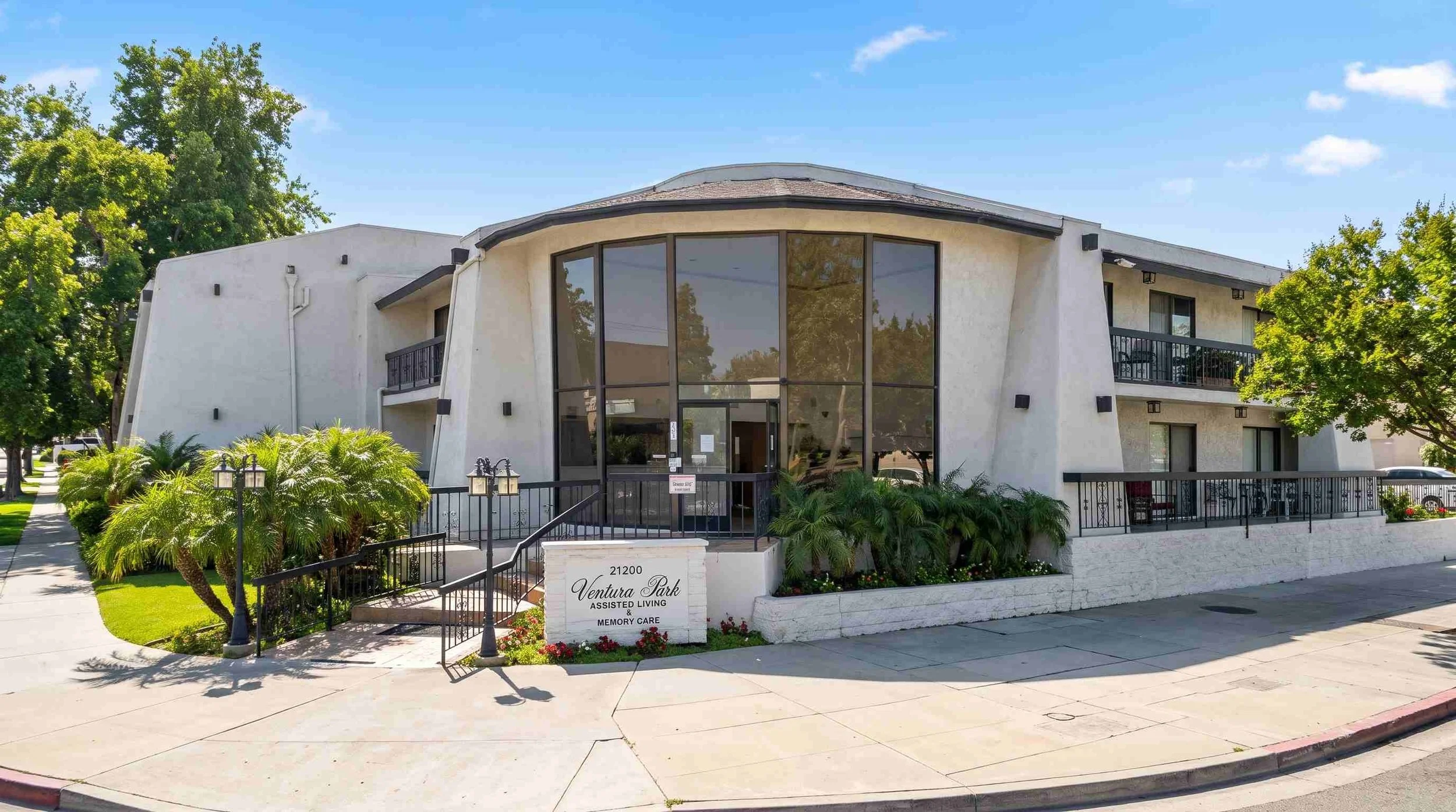
Inn at the Park Ventura is an assisted living community in Woodland Hills, at 21200 Ventura Blvd, California 91364, in Los Angeles County. It holds License 195850339 from the California Department of Social Services, with a licensed capacity of 200 residents and a license first issued on August 2, 2023. The licensee of record is Ventura Park Management LLC, and the administrator listed with the state is Rose Anguiano.
The phone number on the state record is (818) 884-7100. Two things about this community are worth settling before you go anywhere near a tour: the name, which confuses almost everybody, and the size, which changes what you should be asking about.
Why the Name Says Ventura but the Address Says Woodland Hills
The Ventura in the name is the boulevard, not the city. Families searching for senior living in Ventura, Oxnard, or Camarillo land in this community regularly and then discover it is roughly sixty miles away, in the west San Fernando Valley, inside the city of Los Angeles.
That matters for a practical reason. If the plan is for a daughter in Ventura County to visit twice a week, this address means a drive over the hill each time, and in Los Angeles traffic that is a different commitment than the map suggests. Check the actual drive at the hour you would really be making it.
It also matters for paperwork and services. The community sits in Los Angeles County, so the county agencies, the long-term care ombudsman program, and the hospital network around it are all Los Angeles ones rather than Ventura County ones. Nothing about that is a problem; it is just not what the name implies.
What a 200-Resident Community Changes
Two hundred is large, and large cuts both ways. A campus this size usually supports a full activity calendar, several dining rooms or seatings, on-site therapy space, and enough staff on each shift that a single call-out does not reshape the day. Smaller houses rarely manage any of that.
The trade is anonymity. In a 200-resident building you will not meet most of the people caring for your parent, and a quiet resident who stops coming to meals can go unnoticed longer than they would in a sixteen-bed home. Ask specifically how the community notices when someone withdraws.
Questions That Only Matter at This Scale
A short list separates a well-run large campus from a merely big one:
How many residents does each caregiver have on days, evenings, and overnight?
Who is the one person we call when something changes, and who covers them?
How long does a call light take to answer, and is that measured?
Is the building split into neighborhoods with consistent staff, or do caregivers rotate?
How are new residents introduced so they do not spend the first month alone?
A License First Issued in 2023: What to Ask
The license date is recent, and that is a fair question to raise. A license first issued on August 2, 2023 does not mean the building is new; in California a change of ownership or operator generally produces a new license number, while the walls stay where they were.
So ask directly who operated the community before, when the current operator took over, and how much of the staff stayed through that change. Continuity of caregivers is the thing families actually feel, and a recent transition is where it tends to break.
Ask to see the state licensing file too. Any family can request a review of a facility's file through the Community Care Licensing regional office, and a newer license number simply means there is less history in it to read. Whatever is there, read it before you sign.
Falls Are the Risk to Ask About First
Falls, not infections, are what most often change a resident's trajectory. According to the CDC (2026), more than 14 million older adults, about 1 in 4, report falling each year, and the age-adjusted fall death rate for people 65 and older rose 21 percent between 2018 and 2024, from 64.7 to 78.4 per 100,000.
A large campus has long corridors, and distance is a factor. Ask how far the walk is from a resident room to the dining room, whether the route has handrails and places to rest, and what the bathroom layout looks like at night, which is when most falls happen.
Then ask what happens after one. Who assesses the resident, how quickly the family hears, whether the care plan changes, and what the threshold is for sending someone to the hospital. A community that answers that fluently has thought about it before you asked.
Who Keeps Track of the Medicines
Assisted living in California offers medication reminders and assistance, not nursing-level medication management, and the difference surprises families. MedlinePlus (2026) advises keeping an up-to-date list of every medicine and supplement, bringing it to every appointment, and working with a pharmacist who can track the list and answer questions about side effects.
The reason this is not busywork is in the same guidance: drug interactions can cause sleepiness, raise the risk of falls, and bring on memory trouble, poor coordination, or irritability. In other words, a medication problem often arrives disguised as decline, and gets treated as decline.
So ask who reviews the whole list, how often, and what happens when a hospital sends someone back with three new prescriptions. Also ask whether the community accepts an outside pharmacy, because families often want to keep the one that already knows the case.
Memory Loss and What This Community Is Set Up For
Ask what the license actually permits before anyone falls in love with the dining room. Dementia is common at this stage of life and it is not a side issue: the CDC (2026) recorded 116,022 deaths from Alzheimer disease in the United States in 2024, making it the sixth leading cause of death.
Assisted living communities differ widely in what they will take on. Some have a secured memory care area with dementia-trained staff; some accept early memory loss in the general population; some decline residents who wander or who need help with every meal. Get the answer in writing, not in the tour.
The follow-up question matters more: what would make you ask us to move out. Needing more help over time is not unusual, and a family that knows the move-out conditions in advance is not blindsided by them eighteen months later.
Doctors, Hospitals, and Care That Comes to the Building
Residents keep their own doctors, and the community does not supply medical care. For anyone who no longer travels well, a doctor who makes visits to residential communities can handle routine checks, medication review, and required forms in the resident's own room, which removes the ride, the waiting room, and most of the day.
The nearest major hospital sits a few minutes east. Providence Cedars-Sinai Tarzana Medical Center is at 18321 Clark St in Tarzana, and its emergency department is designated by the Los Angeles County Department of Health as a STEMI and stroke receiving center. Ask the community which hospital it routinely sends residents to and why.
Some families also add private help on top of the community's own staff. Extra one-to-one hours for bathing, meals, or simple company are common after a hospital stay, and agencies such as A Better Solution In Home Care cover personal care and dementia support in this part of Los Angeles County. Check the community's rules on outside caregivers first.
The Neighborhood Along Ventura Boulevard
This stretch of Ventura Boulevard is busy, commercial, and well served. Pharmacies, medical offices, banks, and restaurants are within a short drive, which suits visiting family running errands around a visit. It is not a quiet residential street, so ask for a room away from the boulevard if traffic noise bothers the person moving in.
Green space is close enough to use. Warner Center Park, at 5800 Topanga Canyon Blvd in Woodland Hills, has picnic tables and a bandshell, and it is flat, which matters for anyone pushing a wheelchair or walking slowly. It is the sort of outing that works for an hour on a Sunday.
Summer heat is the local constraint worth planning for. The west Valley runs considerably hotter than the coast, so ask how common areas and resident rooms are cooled, and what the community does on days when going outside is not sensible.
A Sensible Next Step
Call (818) 884-7100 first and ask three things: current availability, the care level the community is staffed for today, and what it will not accept. Then book one scheduled tour and come back once unannounced, at a mealtime or in the evening, before deciding anything.
If you are weighing this community against others across the Valley, that comparison gets unwieldy quickly. A placement agency can shorten the list to places that will actually accept your parent's care needs and budget, and can tell you which ones have real openings rather than waiting lists.
Leave time for the physician's report. It is the one step in the whole process that depends on a doctor's availability rather than yours, and it is also the step families most often discover during the very week they were hoping to move in. Starting it early costs nothing.
Sources Used
Alzheimer Disease – Centers for Disease Control and Prevention, National Center for Health Statistics (2026)
Caregiving - medication management – MedlinePlus (2026)
Older Adult Falls Data – Centers for Disease Control and Prevention (2026)
Providence Cedars-Sinai Tarzana Medical Center – Providence

Written by Sofiia Puhach
November 13, 2026
Explore More Assisted Living Communities


Address: 21200 Ventura Blvd, Woodland Hills, CA 91364 (Los Angeles County)