
Long Distance Caregiving: Coordinating an Aging Parent's Care
Table of Content
Long distance caregiving works when you stop trying to be there and start building a system: one local person, one shared record, one clear role each.
Distance changes what you do, not whether you help. The jobs that travel well are the ones that run on phone calls, paperwork and research. The jobs that do not travel are the ones that need hands or a key to the front door, and those have to belong to someone who lives nearby.
What Can You Actually Do From Hundreds of Miles Away?
More than most families expect, and almost all of it is coordination rather than care.
The National Institute on Aging (2023) lists the tasks a long-distance caregiver can take on: money management, insurance claims and bills; arranging care management or in-home help; ordering medicines, equipment and supplies; acting as the information coordinator on conditions and benefits; helping with advance care planning; and researching long-term care options.
Those jobs have one thing in common. They are done at a desk. Nobody has to be in the room to compare three home care agencies, call an insurer twice in a week, or keep a medication list current, and doing them well takes real pressure off whoever is local.
The One Job You Cannot Do Remotely
Somebody has to be able to reach the house in under half an hour. That person answers the alarm, meets the plumber, waits for the ambulance and notices the smell of a fridge nobody has cleared. If no such person exists yet, finding one is the first task on the list.
Who Should Be on the Local Team?
Three kinds of help: a public starting point, paid hands, and one person who holds the whole picture.
The public starting point is free. The NIA (2023) points families to the Eldercare Locator at 800-677-1116, which connects to the Area Agency on Aging covering your parent's address, and to the Family Caregiver Alliance navigator at 800-445-8106. A single call there usually produces a list of local services it would take you a week to assemble.
Paid help fills specific gaps rather than everything at once. In-home support covers personal care, chores, meals, money management, some health care tasks, transport and home safety, and families normally start with one or two of those and add more later.
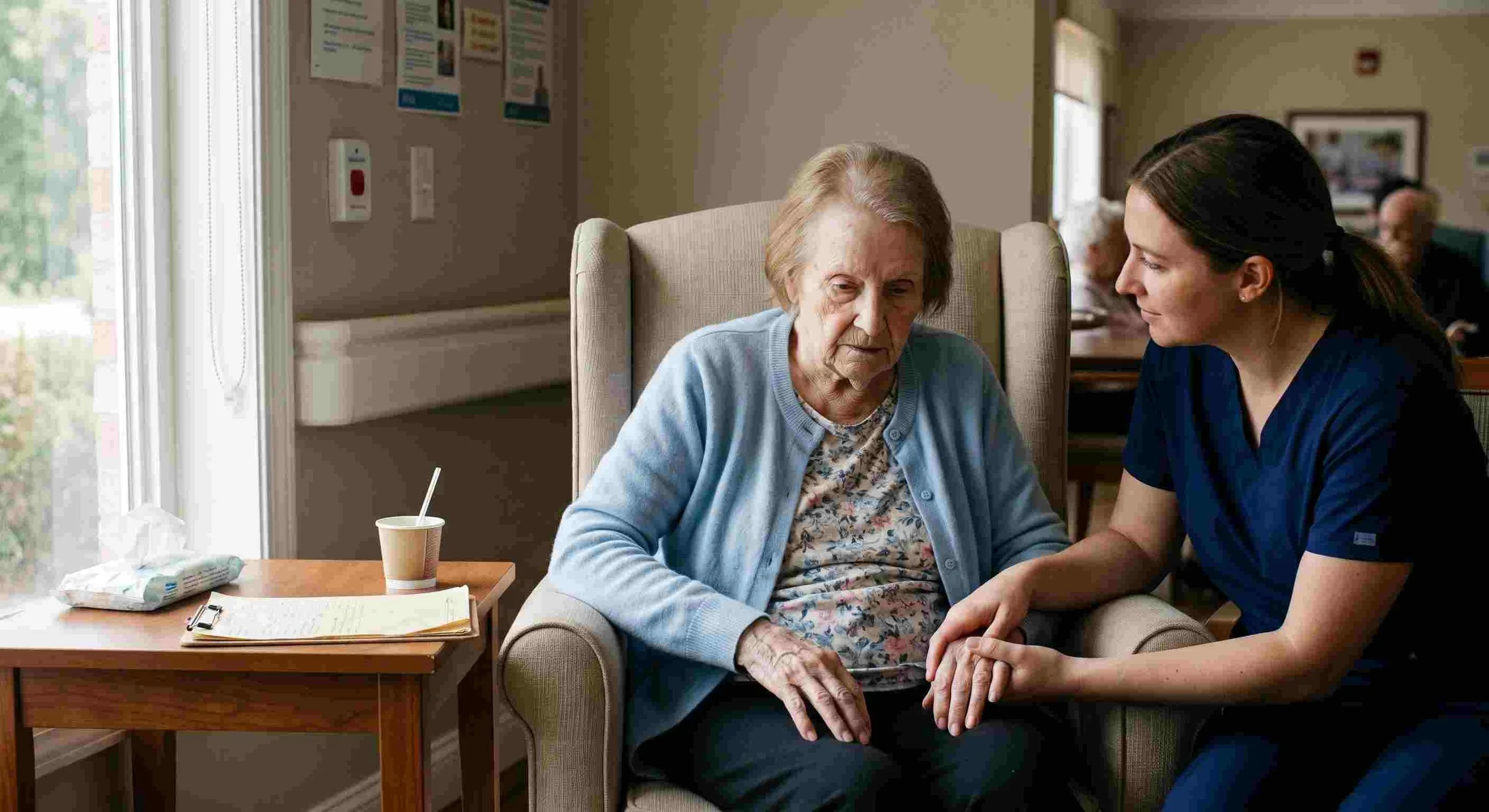
The third piece is a care manager, and it is the one most families have never heard of. A care manager assesses what is needed, hires and supervises aides, attends medical appointments and reports back. Where dementia is involved, that work is its own specialty, which is what a service like Dementia Partner handles for families across the San Fernando Valley.
What a Care Manager Is Worth From a Distance
The value is judgement on the ground. A care manager can tell you whether a change is a bad week or a real decline, which is the question video calls never answer. Late in dementia, when the signs of the final stage start appearing, having someone local who recognises them matters more than any amount of coordination.
How Do You Keep Track From a Distance?
Put everything in one shared place and let whoever touches it update it.
The NIA recommends a short, practical set of habits: a shared list of phone numbers and email addresses, a shared online calendar, attending telehealth visits with the person's permission, joining calls with facility staff remotely, and helping the older person use the texting and video features already on their phone.
Medical alert systems fit here, with honest limits. A pendant or watch brings help after a fall and gives the person a way to call without finding a phone. It does not prevent the fall, it only works if it is worn, and the ones that detect falls automatically still miss some. Treat it as one layer rather than the plan.
Changes That Deserve a Closer Look
Confusion is the one family misread most often. New muddle, unsteadiness or sudden fatigue can come from something ordinary and fixable, and dehydration mimics dementia symptoms closely enough to fool experienced relatives. An infection does the same.
If the worry is memory rather than a bad day, there are simple screens a doctor can run in minutes, including the clock drawing test. None of them diagnose anything on their own, and all of them are more useful than a phone argument about whether Mum is slipping.
How Do You Divide the Work With Siblings Without a Fight?
Name a primary caregiver, split the rest by skill, and do it before there is an emergency.
The NIA's guidance on sharing caregiving (2023) sets out three steps. Work out the care needs together, ideally in a meeting or conference call that includes the older person and happens while nothing is on fire. Name a primary caregiver even if one is not needed yet, so somebody can step straight in during a crisis. Then assign tasks to the people best suited to them.
Its list of sorting questions is worth reading out loud at that meeting. Who is best at finding information? Who is comfortable with email and texting. Who do people call for emotional support? Who is confident talking to medical staff. Who lives close enough for shopping and cooking. Who is good with numbers? And who can step in so the primary caregiver gets a break.
The table below shows how those answers usually land once a family has had the conversation. It is a starting split rather than a rule, and the NIA is clear that it needs revisiting as needs and availability change.
|
Task |
Who Usually Takes It |
|---|---|
|
Bills, insurance forms and benefit paperwork |
The far-away family member who is good with numbers |
|
Researching conditions, medicines and care options |
The far-away family member acting as information coordinator |
|
Finding and vetting in-home help |
Arranged from a distance, confirmed during an in-person visit |
|
Groceries, laundry and household chores |
Someone local, paid or family |
|
Rides to appointments |
Someone local, or a transport service |
|
First call in an emergency |
The named primary caregiver, who lives nearby |
|
Attending medical appointments |
Either one, in person locally or by video with permission |
|
Keeping the shared record current |
Whoever touches it that day |
The last row is the one that quietly fails. A shared document that only one person updates stops being shared within a month, and then everyone is working from a different version of the truth.
When a Parent Says No to All of It
Refusal is common and it is not always stubbornness. In dementia, a person can be genuinely unable to see their own memory loss, and a practical account of how to get an evaluation anyway is more useful than another round of persuasion.
Arguing about facts tends to backfire for the same reason. Meeting the feeling rather than correcting the detail is the approach behind validation therapy, and it works as well on the phone as in person.
Which Papers Do You Need Before You Need Them?
A health care proxy and a living will, and a single place that holds everything else.
MedlinePlus (2026) describes a living will as the document that sets out which treatments a person wants if they are dying or permanently unconscious, covering choices such as dialysis, breathing machines, resuscitation, tube feeding and organ donation. The second document names a health care proxy, the person trusted to decide if your parent cannot speak for themselves.
That second document goes by several names, including durable power of attorney for health care and medical power of attorney. The form and the wording are set by state law, so the version that matters is the one valid where your parent lives, not where you live.
The List That Holds Everything Else
Around those two, build one list and keep it current: providers and phone numbers, the pharmacy, medications with doses, insurance details, bank and benefit contacts, and where the originals are kept. Advance care planning is one of the tasks the NIA puts squarely in the long-distance caregiver's column, and it is easier to do calmly than urgently.
How Do Medical Appointments Work When You Are Not There?
Two ways: you join remotely, or care comes to the house.
Joining remotely takes one piece of paperwork and one habit. With your parent's permission, you can sit in on telehealth visits and on calls with facility staff, and a written release lets the practice speak with you directly. Send three questions ahead of the visit, because appointments move fast and nobody remembers the list afterwards.
The other route suits people who struggle to leave the house at all. A doctor who comes to the home can handle routine review, new symptoms and follow-up without the whole production of getting someone into a car. It also means somebody clinical actually sees the house.
After a Hospital Stay
After a hospital stay or an operation that leaves someone bedridden for weeks, that is often the only way an appointment happens at all. Recovery visits, dressing changes and medication review all travel better than the patient does.
Home Safety Is the Cheapest Problem to Fix From Afar
It is also the one you can work on without being in the room.
The NIA's guidance on aging in place (2023) suggests going through the house room by room, fixing the immediate dangers first, such as loose stair railings and poor lighting, then working through the rest. It also notes that help paying for repairs and safety updates may be available through a state housing finance agency, a social services department, community development groups or federal programmes.
A local assessment turns that checklist into specifics. Companies that fit bath safety equipment, grab bars, ramps and stairlifts usually start with a free walk-through of the house, and Call Before You Fall works that way across the San Fernando Valley, Santa Clarita and Ventura County.
The Cheap Fixes First
Do the cheap things first. Lighting on the route from bed to bathroom, loose rugs gone, a raised toilet seat, a grab bar by the shower and a phone within reach of the bed cost very little and prevent the falls that end independence.
What Do You Do About the Guilt?
Take it seriously as a warning sign, because the caregiver who burns out takes the whole plan down.
Cleveland Clinic (2023) defines caregiver burnout as physical, emotional and mental exhaustion from caring for someone else, and reports that studies show more than 60 percent of caregivers experience burnout symptoms. The signs it lists include withdrawing from friends, losing interest in things you used to enjoy, feeling helpless, changes in sleep or appetite, trouble concentrating and a shorter temper.
Its advice is unglamorous and it works: keep your own medical appointments, sleep, eat properly, accept the help people offer, and say no when the load gets too heavy. Respite care exists for exactly this, from a few hours to a few weeks.
Where the Guilt Belongs
Guilt at a distance usually attaches to the wrong thing. Not being there is a fact of geography. Whether the bills are paid, the aide is vetted, the paperwork is signed and the local sibling has had a weekend off are the things you control, and they are what actually hold the arrangement together.
FAQ
-
Before anything goes wrong. A calm talk about what help is wanted now and what might be needed later is far easier than one held in a hospital corridor, and the decisions tend to be better. There is no age that triggers it, only the first sign that something is getting harder.
-
Sometimes, but it costs them their doctors, their neighbours and the streets they know. Many families find that strengthening the local support network works better than a move, at least until care needs grow past what any home can hold.
-
A current medication list with doses, insurance cards, the names and numbers of the regular providers, the pharmacy, the advance directive and proxy paperwork, and a short page on baseline function: how the person normally walks, eats and thinks.
-
Usually by moving real work off their plate rather than offering more sympathy. Taking over the bills, the phone calls and the hiring is worth more than a weekly check-in. Ask what they want handed over instead of guessing.
-
Some states and some long-term care policies pay family caregivers under specific conditions, and the rules vary widely. The Eldercare Locator and your parent's local Area Agency on Aging can tell you what exists where they live.
-
Often enough to see the house, not just the person. Video calls hide an empty fridge, unopened mail and a bathroom that has become hard to use. Many families settle on a pattern of regular short visits plus one longer stay a year.
Sources Used
Advance Directives – MedlinePlus (2026)
Aging in Place: Growing Older at Home – National Institute on Aging (2023)
Anosognosia: How to Get a Dementia Evaluation When Your Parent Won't Go – Dementia Partner (2026)
Caregiver Burnout – Cleveland Clinic (2023)
Frequently Asked Questions About Caregiving – National Institute on Aging (2023)
Sharing Caregiving Responsibilities – National Institute on Aging (2023)
What Is Long-Distance Caregiving? – National Institute on Aging (2023)
The Caregiver's Handbook – NIH (2023)

Written by Sofiia Puhach
October 12, 2026
You May Also Like


Long distance caregiving works when someone local handles the day and you handle coordination, records and the paperwork.