
The Gardens
If your family needs that form arranged quickly, it can be requested through the link above. After it is done comes an assessment by the community, a look at whether the level of care fits, and a conversation about cost and availability. Most families discover the paperwork is the easy part, and that the harder question is whether this particular building suits the person they love.
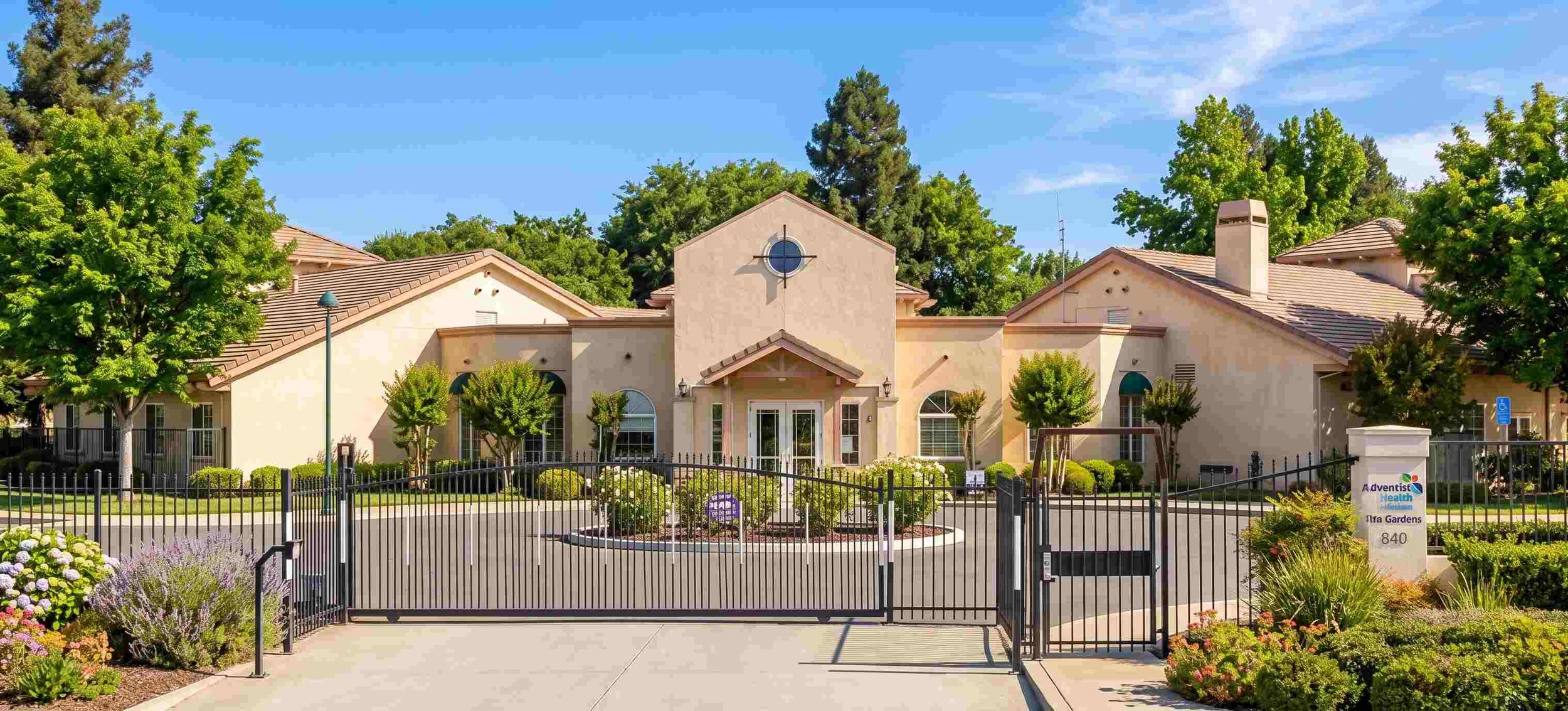
The Gardens is a memory care community in Yuba City, licensed by the state of California under number 515001365 and located at 840 Washington Avenue. It sits on a senior care campus alongside a skilled nursing facility and a separate assisted living community, which matters more than it sounds.
What Makes This Community Different
The building itself does part of the caregiving. Most memory care communities rely on staff to redirect a resident who is lost in a hallway. The Gardens is designed so the hallway answers the question first, before anyone has to be corrected.
Adventist Health and Rideout describes location-identifying murals throughout the community and personalized glass memory boxes outside each resident's room. The mural tells you which wing you are in without a sign to read. The memory box holds objects from a person's own life, so the door is recognizable even on a day when the room number is not.
That design philosophy shows up in how the community describes itself: secure, but feeling like home, with walking areas indoors, outdoors and through the courtyard. The community states that it specializes in memory care supporting a dignified lifestyle in secure and supportive surroundings, with a safe and nurturing home environment and personal attention from professional caregivers.
The Grounds
The grounds are part of the design rather than decoration. The community is surrounded by acres of landscaped grounds with a secure outdoor patio, which means a resident who wants to walk outside can do so without a staff escort and without a locked door becoming the day's main event.
Who The Gardens Is Built For
The community is designed for people living with mild to advanced stages of Alzheimer's disease or similar dementia, which is a wider range than many memory care settings accept. That matters if you are weighing whether a move now means another move in two years.
Staff work from consistent routines fitted to each resident's personal schedule rather than one community timetable applied to everybody. For someone living with dementia, a routine that matches their own body clock does more good than almost any activity on a calendar, because predictability is what lowers the anxiety underneath most difficult behaviour.
The state license lists a capacity of 49 residents, and the community's own pages describe a small assisted living community rather than a large campus building. Ask directly about the current number of residents and the staffing pattern on evenings and weekends when you tour, since those two numbers shape daily life more than the total ever will.
Services and Daily Life
The published list covers the practical side of living there: assistance with daily living needs, medication assistance, daily nutritious meals and snacks, housekeeping and laundry services, beauty and barber shop services, and transportation services. Regular health and wellness assessments are part of the routine rather than something arranged only when a problem appears.
Activities are listed as active social, recreational and educational programs. The community's day program gives a fuller picture of what those look like in practice: arts and crafts, bingo, dominoes and card games, chair exercise, cooking classes, garden walks, music therapy, outings to community activities, religious groups, and quiet areas for rest.
The quiet areas deserve a mention of their own, because they are easy to overlook on a tour. Communities that plan for the afternoons when a resident needs less stimulation, rather than only for the mornings when they want more of it, tend to have calmer days and fewer late-day crises.
Respite and Day Programs
The Gardens runs an adult day program as well as residential care, open from 8 a.m. to 5 p.m. seven days a week. That combination is unusual and genuinely useful for a family that is not ready for a permanent move.
The day program includes 24-hour supervision while at the facility, individualized care plans, lunch and snacks, and the activity schedule described above. A parent can attend during the day and come home at night, which lets a working caregiver keep a job and lets everyone test whether the community is a fit before committing to it.
Respite care is available separately, described by the community as enabling families to take vacations or enjoy a break for a few hours. Using respite once before a crisis makes the eventual decision far less frightening, because the building stops being an unknown.
Medical Care and Health Support
Regular health and wellness assessments are part of the community's stated services, and medication assistance is included. What a residential care facility does not provide is the level of nursing available in a skilled nursing facility, which is a distinction worth understanding before you sign anything.
Many California families arrange for a physician to visit the community rather than transporting a parent to appointments. A visiting doctor for assisted living residents can handle routine primary care on site, which removes the transfers, the waiting rooms and the confusion that a trip out often causes for someone with dementia.
Hospice care is an option for residents whose health is declining while living at The Gardens, according to the community. That means a resident does not necessarily have to move again at the end of life, which is one of the questions families most often forget to ask and most often regret not asking. Inside Hospice: How Spiritual Care Really Works for Families covers what that support involves.
A Change in Ownership Worth Asking About
Adventist Health and Rideout has announced that it has begun the process of divesting its senior care campus, which includes the skilled nursing facility, the separate assisted living community and The Gardens. Cypress Healthcare Group has been selected to assume operations of the campus, and the change had not yet completed at the time the announcement was published.
The health system states that the transfer is subject to standard legal review and required approvals, a process expected to take a minimum of six months. Its own frequently asked questions state that the campus is not closing, that no services are being reduced, and that residents will not need to move.
None of that is a reason to rule the community out, and it is a reason to ask current questions on your tour. Find out where the process stands today, who the administrator will be, and whether staffing and programming are expected to change. A community that answers those questions plainly is telling you something useful about how it communicates.
Understanding Memory Care Before You Choose
Memory care is a licensed setting with secured exits, staff trained in dementia behaviours, and programming built around cognitive ability rather than general activity. Standard assisted living usually cannot provide the supervision that unsafe wandering requires, which is where most families first hit the difference.
The decision is rarely about memory alone. It usually turns on safety, on whether someone is eating and taking medication reliably, and on whether the current arrangement is working for the person doing the caregiving as well as the person receiving it.
If you are still at the stage of working out what you are seeing, the clock drawing test explains one of the screening tools clinicians use and what its results actually mean. For the comparison stage, How to Choose the Right Assisted Living Home walks through what to look for on a tour.
The Yuba City Area
Yuba City sits in Sutter County, across the Feather River from Marysville, and The Gardens is close to the centre of it on Washington Avenue. Families come from both cities and from the smaller communities around them, which is why the search term is often assisted living in Marysville even when the building is in Yuba City.
The campus setting is the practical advantage. Having skilled nursing and a separate assisted living community on the same grounds means a change in care level does not automatically mean a change in neighbourhood, and a spouse in a different level of care stays within walking distance.
Acute medical care in the region runs through Adventist Health and Rideout, which describes itself as the Yuba-Sutter region's only full-service acute care provider and its trusted provider of emergency services, cancer care and outpatient services. The hospital is in Marysville, a short drive away, which is worth knowing when you are thinking about emergencies at two in the morning rather than about activity calendars.
Address, License and Contact
The Gardens is located at 840 Washington Avenue, Yuba City, CA 95991, in Sutter County, and holds California residential care licence number 515001365, first issued in July 2003. The community can be reached on (530) 790-3075, and the adult day program operates from 8 a.m. to 5 p.m. seven days a week.
Current details live on the operator's own site, and the memory care page for The Gardens is the place to check services and availability before you call. Licensing status and any inspection history can be confirmed through the California Department of Social Services facility search.
Taking the Next Step
Visit before you decide, and visit twice if you can manage it. Go once at a scheduled time and once unannounced in the late afternoon, because the second visit shows you the staffing level your parents would actually live with.
Bring the questions this overview raises: where the ownership transfer stands, what the evening staffing pattern looks like, how the community handles a resident whose needs increase, and what happens if hospice becomes part of the picture. Write the answers down, because by the third community they blur together.
If comparing options is more than your family can take on right now, that is a normal place to be. A placement agency knows which communities in the Yuba City and Marysville area are genuinely accepting residents this month, what the real cost range looks like, and which ones suit a particular stage of dementia. Starting with one conversation costs nothing and usually shortens the search by weeks.
Sources Used
Adventist Health and Rideout to divest senior care campus – Adventist Health and Rideout
Memory Care – Adventist Health and Rideout
The Gardens Adult Day Program – Adventist Health and Rideout

Written by Sofiia Puhach
September 25, 2026
Explore More Assisted Living Communities

Address: 2030 23rd St, Sacramento, CA 95818