
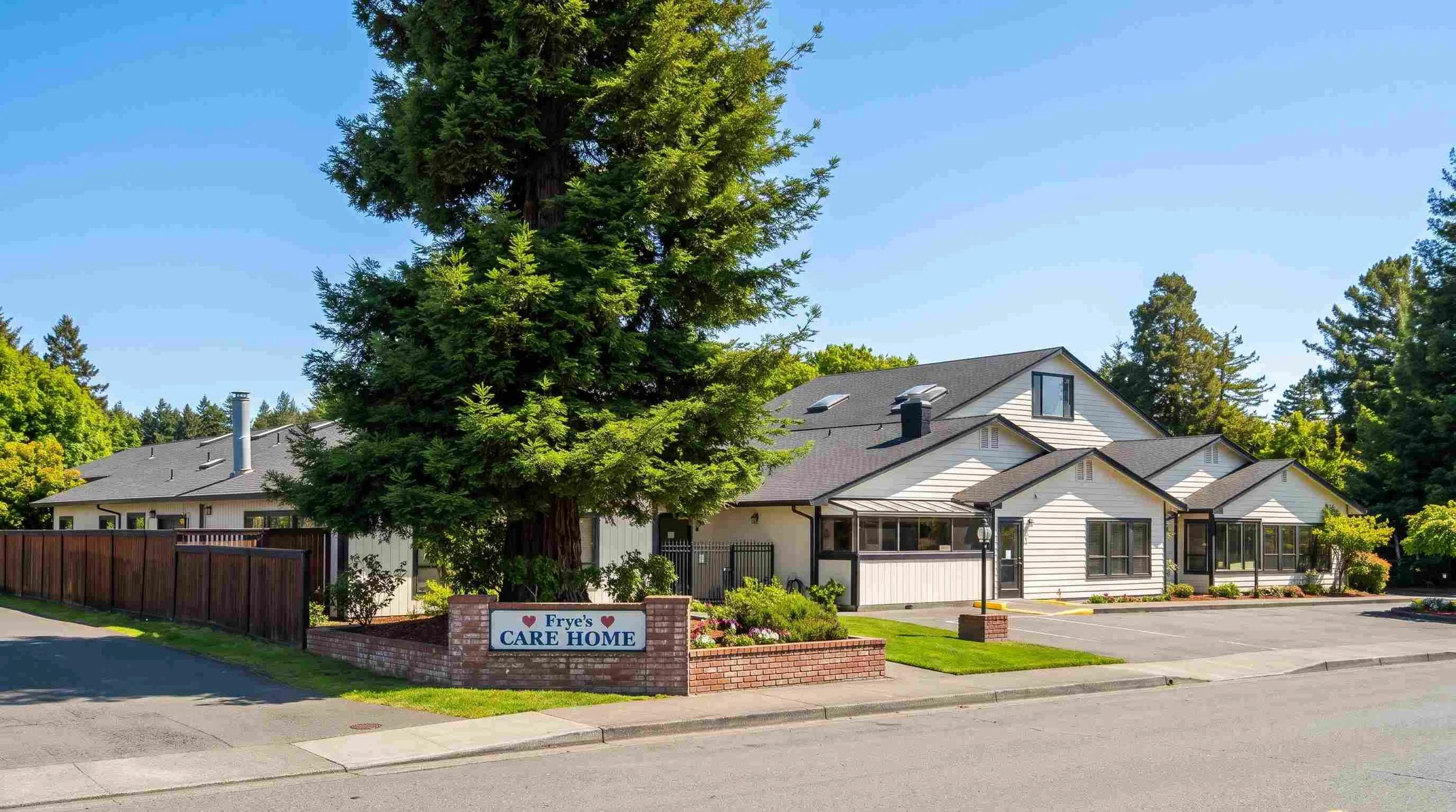
Frye's Care Home is an assisted living and memory care community in Eureka, CA, at 2240 Fern Street, licensed by the state as a Residential Care Facility for the Elderly under number 121372020. It has been licensed since 1989 and is privately owned and operated.
Where Frye's Care Home Is and What It Is Licensed For
The facility's own website publishes its license number on every page, which is a useful sign in a sector where paperwork is sometimes vague. Its licensed capacity is 58 residents, the phone number listed is (707) 442-2712, and the license was first issued on 6 February 1989, making this one of the longer-running care homes in Humboldt County.
RCFE is the license category California uses for assisted living, and it is what allows a home to provide personal care rather than nursing care. The licensee of record here is Pyong Sil Frye and the administrator of record is Delores Frye. The home describes itself as offering both assisted living and memory care.
The size is worth noticing. The name says care home, which usually suggests a small house, but 58 beds puts this closer to a mid-sized assisted living community than to a six-bed board and care. That changes what daily life looks like: more staff on shift, more residents at meals, and more structure to the day than a small family-style home.
What Assisted Living Actually Covers
Assisted living is housing plus help with daily care, for people who do not need the medical care a nursing home provides. MedlinePlus (2023) puts it plainly: residents may need help with dressing, bathing, taking their medicines and cleaning, and the point of the arrangement is to let them live more independently than they could elsewhere.
The service list itself is fairly standard across facilities, although it varies by state and by the level of care a resident is paying for. What a family should expect to find included, at one tier or another, looks like this:
Up to three meals a day
Help with personal care such as bathing, dressing, eating, and getting in and out of bed or a chair
Help with medicines
Housekeeping and laundry
Twenty-four-hour supervision, security and on-site staff
Social and recreational activities
Transportation
Levels matter more than the list. Most facilities offer a few tiers, and residents pay more as they need more. When you tour, the useful question is not whether a service exists but which tier it sits in, what triggers a move up a tier, and how much that costs each month.
How Memory Care Differs From the Assisted Living Side
Memory care is a separate program for residents with dementia, usually in a secured area with staff trained for it. The National Institute on Aging (2023) notes that some residential facilities run special programs for people with Alzheimer's disease and other types of dementia, which is the category Frye's Care Home describes on its website alongside assisted living.
Having both under one license matters practically. If memory changes progress, a resident may be able to move within the same building rather than move out entirely, which spares a family a second search. Ask directly how that transfer is decided, who decides it, and whether a spot on the memory care side is actually available when it is needed.
Day-to-day approach is worth asking about too. Staff who are trained to work with confusion rather than correct it tend to produce calmer evenings, and how a home responds to a resident's version of reality tells you more about the culture than a brochure does.
When Does a Move Like This Become Necessary?
Usually when everyday activities stop being manageable at home. NIA defines long-term care as the services that meet a person's health or personal care needs once they can no longer perform everyday activities on their own: bathing, dressing, eating, taking medications, and supervision to keep them safe.
The timing is rarely obvious. NIA notes that the need can arrive suddenly after a heart attack or stroke, but more often it builds gradually as someone gets frailer or a long-running condition worsens. Families usually recognize it in hindsight, after a fall, a missed medication or a night that went badly.
It helps to separate two decisions. One is whether more help is needed, which is a health question. The other is where that help should happen, which is a practical and financial one. Choosing an assisted living home goes more smoothly when the first question has already been answered honestly.
How Medical Care Works Once Someone Lives Here
A care home is not a medical facility, so residents keep their own doctors. NIA is explicit that nursing and medical care are usually not provided inside a residential care home, which means appointments, prescriptions and follow-ups stay with the resident's own physician rather than with the building.
That is where getting out of the building becomes the hard part. For a resident who no longer drives and finds a waiting room exhausting, a physician who visits the residence can cover routine reviews, paperwork and assessments without a trip across town. It is worth asking the home where visiting clinicians already come in regularly.
Ask about the practical chain, too: who notices a change in a resident, who calls the family, who calls the doctor, and how quickly. The answer to that sequence tells you more about a facility's day-to-day quality than its newest furniture does.
The Neighborhood: Fern Street and Eureka
Fern Street is in the Cutten area of Eureka, a residential part of town rather than a commercial strip. Eureka sits in Humboldt County on California's north coast, which shapes two things families notice: a cool, damp climate most of the year, and long drives for anyone visiting from outside the county.
That distance is a real factor in the decision. Visiting often is what keeps a placement working, and a home two hours closer to family will usually be visited more than a better-rated one four hours away. Worth mapping the drive honestly before touring, not after.
Locally, ask about what is within walking distance, whether residents go out, and how the home handles the wet months when outdoor time drops. In a coastal town, indoor activity programming carries more weight than it would in a dry climate.
What to Ask When You Tour
Start with needs, not with the building. NIA's guidance on choosing a facility (2023) is to work out which services are needed now and which may be needed later, then to call and visit several places in person, meeting the director or nursing director rather than only the marketing contact.
How many residents live here now, and is there a waiting list?
What does the monthly cost cover, and what sits outside it?
What are the care levels, and what moves someone from one to the next?
Is state licensing current, and can we see the most recent inspection findings?
Which doctors, pharmacies and home health agencies already work with this home?
What happens if care needs outgrow what the license allows?
Then read the paperwork slowly. The admission agreement is where notice periods, rate increases and discharge conditions live, and the things worth noticing on a tour are often small: call bells going unanswered, an unexplained smell, staff who cannot say how long they have worked there.
Contact and License Details
Everything below comes from the facility's own listing and website as checked on 26 November 2026. The website is minimal and says so itself, so the contact page and the phone number are the practical routes to a tour or a question about availability.
|
Detail |
Information |
|---|---|
|
Facility name |
Frye's Care Home |
|
Address |
2240 Fern Street, Eureka, CA 95503 (Humboldt County) |
|
Phone |
(707) 442-2712 |
|
License type and number |
RCFE 121372020 |
|
License status |
Licensed; first issued 6 February 1989 |
|
Licensed capacity |
58 residents |
|
Care offered |
Assisted living and memory care |
|
Licensee of record |
Pyong Sil Frye |
|
Administrator of record |
Delores Frye |
A Calm Next Step
If Frye's Care Home looks like a possibility, call about availability first, because a licensed capacity of 58 says nothing about open beds this month. Then tour in person, with the questions above written down, and read the agreement before anyone signs anything.
If the search is wider than one home, a placement agency can shortlist facilities that match a budget and a care level, which saves calling two dozen numbers. What those specialists actually do is worth understanding before engaging one, including how they are paid.
Sources Used
Assisted Living – MedlinePlus (2023)
How To Choose a Nursing Home or Other Long-Term Care Facility – National Institute on Aging (2023)
Long-Term Care Facilities: Assisted Living, Nursing Homes, and Other Residential Care – National Institute on Aging (2023)
What Is Long-Term Care? – National Institute on Aging (2023)

Written by Sofiia Puhach
November 26, 2026
Explore More Assisted Living Communities

Address: 2240 Fern Street, Eureka, CA 95503 (Humboldt County)