
What Fingernails Give Away About the Rest of the Body
Table of Content
Nail health rarely announces a disease. Shape and color changes across several nails say far more than one white speck on a thumb.
Mayo Clinic (2024) describes healthy fingernails as smooth, one color, free of spots, and without pits or grooves. Most people who look down and worry are looking at something ordinary. A smaller group is looking at a real signal, and the difference is usually in how many nails changed and in what way.
What Do White Spots on Nails Actually Mean?
White spots usually mean the nail went through some kind of stress.
Cleveland Clinic (2023) describes leukonychia as a common and generally harmless condition, and lists injury to the nail plate or nail matrix as the most frequent cause. Bumping a nail, biting it, wearing shoes that are too small, or a vigorous manicure can all do it, and the spot appears weeks later when that part of the nail has grown out.
Less common causes exist. Allergies to nail products, fungal infections, exposure to toxic heavy metals such as arsenic and lead, and some medicines can produce white spots. Systemic conditions including diabetes, heart failure and psoriasis can too, though white spots are a rare sign of those rather than a typical one.
The timing confuses people. Because nails grow slowly, the injury that caused the mark happened long before the mark showed up, so the two rarely feel connected.
Is It Really a Calcium or Zinc Deficiency?
The short answer is that nobody has proven that, and the popular version of the story is not supported.
Cleveland Clinic (2023) puts it plainly: healthcare providers and medical researchers are not sure whether deficiencies cause white spots at all. Some believe a shortage of iron, calcium or zinc may be involved, others suspect a vitamin, and others think the link is not real or that the research is too thin to conclude anything.
So the standard advice to drink more milk because of a few white specks has no solid basis. A real mineral problem tends to show up in blood work and in how a person feels, not as scattered dots on two fingernails.
Zinc does appear elsewhere in nail medicine, though. It turns up on the list of causes behind grooves that run across the nail, which is a different finding entirely and is covered further down.
Which Nail Changes Are Myths and Which Are Real Signals?
Shape changes across several nails are the ones clinicians take seriously.
Mayo Clinic (2023) sets out seven findings worth an appointment, and the pattern behind them is useful. A single mark on one nail after an injury is a local event. A change in shape, thickness or color that appears on most of the nails at once points toward something happening in the body.
The table below pairs each finding with what it can point to. Read it as a list of possibilities a clinician would consider, not as a diagnosis, since almost every line also has harmless explanations.
|
Nail Change |
What It Looks Like |
What It Can Point To |
|---|---|---|
|
Pitting |
Small round dents or notches in the nail surface |
Psoriasis, eczema, alopecia areata |
|
Clubbing |
Fingertips widen and nails curve around them over several years |
Low oxygen in the blood, lung disease, heart problems, liver cirrhosis |
|
Spoon nails |
Soft nails turned up at the edges with a dip in the middle |
Iron deficiency anemia, or iron overload called hemochromatosis |
|
Terry's nails |
Nail mostly white with a narrow pink or red band at the tip |
Aging, or liver problems, congestive heart failure, diabetes |
|
Beau's lines |
Grooves running across the nail |
Infection, poorly controlled diabetes, peripheral artery disease, a high fever illness, low zinc |
|
Nail separation |
Nail loosens from the bed, and the loose part looks white, yellow or green |
Injury, infection, thyroid disease, psoriasis, a reaction to a product |
|
Yellow nail syndrome |
Thick, slow-growing nails with a yellow tint |
Lung disease such as chronic bronchitis, or swelling called lymphedema |
What Do Ridges and Dents in Nails Mean?
Direction is what separates the ordinary ones from the ones worth asking about.
Lines That Run Lengthwise
Vertical ridges running from cuticle to tip are normal, and they become more noticeable with age. Mayo Clinic (2024) treats them as an ordinary feature of older nails rather than a warning, in the same way skin gets drier and thinner over the years.
Brittle, peeling nails often belong in the same category. MedlinePlus (2025) notes that brittle nails are frequently just a result of aging, although long exposure to moisture or nail polish will do it as well.
Grooves That Run Across
Beau's lines are the horizontal kind, and they form when nail growth pauses. Mayo Clinic links them to infection, diabetes that is not well controlled, peripheral artery disease, illnesses with a high fever, low zinc, and certain medicines.
There is a useful detail in that list. Because a nail records the pause as a dated stripe, a clinician can estimate roughly when the body was under strain by measuring how far the groove has moved from the cuticle.
Peripheral artery disease is worth noticing on that list too, because it shows up in the feet long before it shows up anywhere convenient. Cold feet, slow-growing toenails and thin skin are part of the same picture, and what persistently cold feet can mean for circulation covers that pattern in more detail.
Which Conditions Show Up in the Nails?
Several do, and each one announces itself in a different way.
Iron and Anemia
Spoon nails are the classic iron finding. Mayo Clinic describes them as soft nails turned up around the edges and names iron deficiency anemia as the usual reason, with hemochromatosis, a condition in which the body absorbs too much iron, as the opposite possibility. MedlinePlus (2025) describes the same shape as thin, curved inward, with raised ridges.
Fatigue almost always arrives before the nails do. A nail finding tends to confirm a story the person has already been living with, which is why constant fatigue is worth taking seriously on its own rather than waiting for a visible sign.
Vitamin B12
B12 deficiency is in the popular nail lore, but it does not have a reliable nail signature. The National Institutes of Health (2023) lists tiredness, weakness, megaloblastic anemia, pale skin, heart palpitations, loss of appetite, numbness or tingling in the hands and feet, balance problems, confusion, poor memory and a sore mouth or tongue.
The groups most likely to run low are worth knowing. Older adults often lack enough stomach acid to absorb B12 from food, and people with pernicious anemia, atrophic gastritis, celiac disease, Crohn's disease, previous stomach or intestinal surgery, or a vegetarian or vegan diet are also on that list.
Psoriasis
Psoriasis leaves a distinctive mark. Pitting, splitting of the nail plate from the nail bed, and long-term destruction of the nail plate are all documented nail effects, and pitting is also linked to eczema and alopecia areata.
Skin and nails are usually read together. A dermatologist such as Ronald Rigor, MD in Pasadena will look at the scalp, elbows and knees along with the nails, because a nail finding is more convincing when the skin agrees with it.
Fungal Infection
Nail fungus is the most common explanation for a thick, discolored nail, especially on the feet. Mayo Clinic (2024) describes a nail that thickens, turns whitish to yellow-brown, becomes brittle or ragged, changes shape, separates from the nail bed, and sometimes smells slightly foul.
Risk rises with age, reduced blood flow, heavy sweating, athlete's foot, walking barefoot in damp shared spaces, minor nail injury, diabetes and a weakened immune system. Toenails are treated by a podiatrist more often than by anyone else, and Arkady Kaplansky, DPM handles ingrown and damaged nails as part of routine foot care in Los Angeles County.
Which Nail Changes Lead to a Blood Test?
Changes that cover several nails, appear without an injury, and come with symptoms elsewhere are the ones that usually prompt testing.
Cleveland Clinic describes the workup for white spots with no injury behind them: a biopsy of nail cells, a blood test to check for systemic disease, or a nail clipping sent to a laboratory to look for fungi. It also flags new nail symptoms that arrive alongside weakness, constant tiredness, blurred vision, confusion or shortness of breath.
One finding gets its own rule. MedlinePlus (2025) notes that a dark streak running the length of a nail can be subungual melanoma, a potentially deadly cancer, and that a darkening of the cuticle next to a pigmented streak, called Hutchinson sign, may signal an aggressive melanoma. Red streaks in the nail bed, known as splinter hemorrhages, can follow certain infections, including of a heart valve.
Context carries the rest. Nails that changed alongside breathlessness, swelling, or a blood pressure problem are read differently from nails that changed alone, which is one reason high blood pressure gets described as a quiet condition until something else brings it to attention.
For an older adult who cannot easily get to an office, the exam does not have to happen in a clinic. A clinician who visits at home can look at the hands and feet and order the same blood work.
How Long Does It Take for a Nail to Grow Out?
Long enough that patience is part of the treatment.
Cleveland Clinic (2023) gives the timeline: white spots on fingernails may take six to nine months to grow out, and spots on toenails twelve to eighteen months. Fingernails grow slowly and toenails grow slower still.
This matters for judging whether something is improving. A mark that stays in the same place on the nail for months is not healing, while a mark that has visibly moved toward the tip is simply growing out as it should.
Taking Care of the Nails You Have
Most nail trouble is mechanical, so the care is mechanical too.
Mayo Clinic suggests keeping nails dry and clean, cutting them with sharp clippers or manicure scissors, and moisturizing the nails and cuticles. The habits to drop are biting nails, picking at cuticles, pulling off hangnails rather than clipping them, and using harsh polish removers.
MedlinePlus adds a few practical ones: wear shoes that do not squeeze the toes, cut toenails straight across, bring your own tools to a nail salon, and do not let a manicurist work on your cuticles.
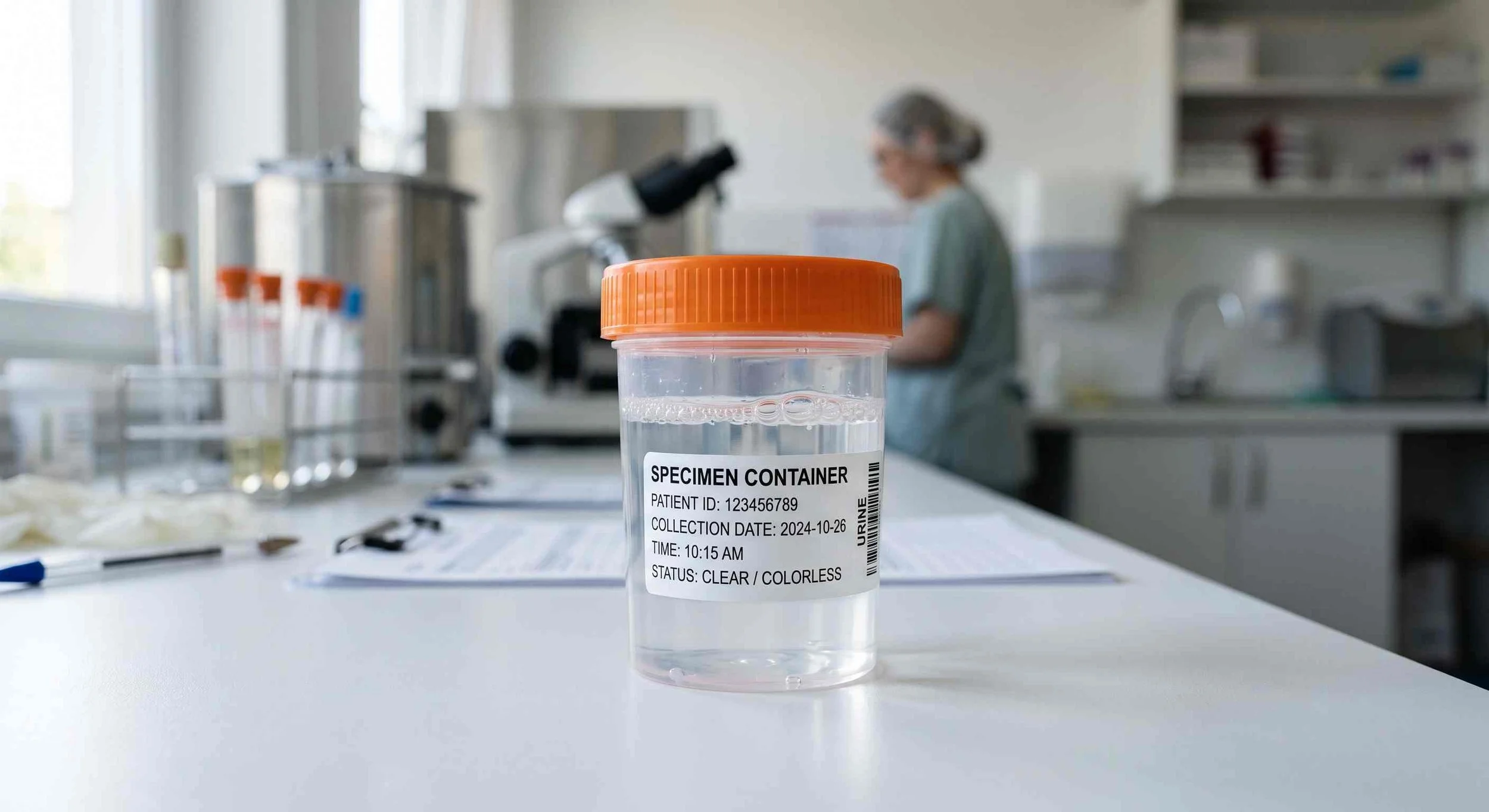
Color is worth watching more than texture. The body uses the nail bed to show circulation and oxygen, which is the same reason other everyday signals like urine color get read as rough indicators rather than as diagnoses.
FAQ
-
Nail growth does tend to speed up in warmer months and slow down in cold ones. The difference is small, but it can change how quickly a mark reaches the tip.
-
Crushing the base of the nail or the nail bed can cause a permanent deformity. Lighter injuries usually grow out cleanly, though it may take most of a year.
-
A blue tint can follow silver intake, and it also appears when blood is carrying less oxygen. Either way it is one of the changes worth bringing to a provider promptly.
-
The products themselves and the removal process can both irritate the nail. Hardeners, adhesives and allergic reactions to nail products all appear on the lists of causes for separation and white spots.
-
They can. Kidney disease allows nitrogen waste products to build up in the blood, which damages nails, and liver disease damages them by a different route.
-
It is a common suggestion for strengthening nails, and clear nail polish containing protein is another. Ask a provider before starting any supplement, since high doses can interfere with certain lab results.
Sources Used
7 Fingernail Problems Not to Ignore – Mayo Clinic (2023)
Cold Feet All the Time: Circulation, PAD, and the Signs That Matter – Arkady Kaplansky, DPM
Fingernails: Do's and Don'ts for Healthy Nails – Mayo Clinic (2024)
Nail Abnormalities – MedlinePlus (2025)
Nail Fungus – Mayo Clinic (2024)
Vitamin B12 – NIH Office of Dietary Supplements (2023)
White Spots on Nails (Leukonychia) – Cleveland Clinic (2023)
Nail structural alterations and zinc levels in the elderly: an observational cross-sectional study – PMC (2026)
Brittle nails – MedlinePlus Medical Encyclopedia Image (2025)
Peripheral arterial disease (PAD) – NHS (2026)
Nail Psoriasis – Psoriasis UK (2025)
Hutchinson’s Nail Sign: Key Indicator for Subungual Melanoma and Differential Diagnosis – Korea Med (2025)

Written by Sofiia Puhach
October 7, 2026
You May Also Like



Most white spots come from minor injury, not calcium; shape changes like spooning or clubbing matter far more.