Table of Content
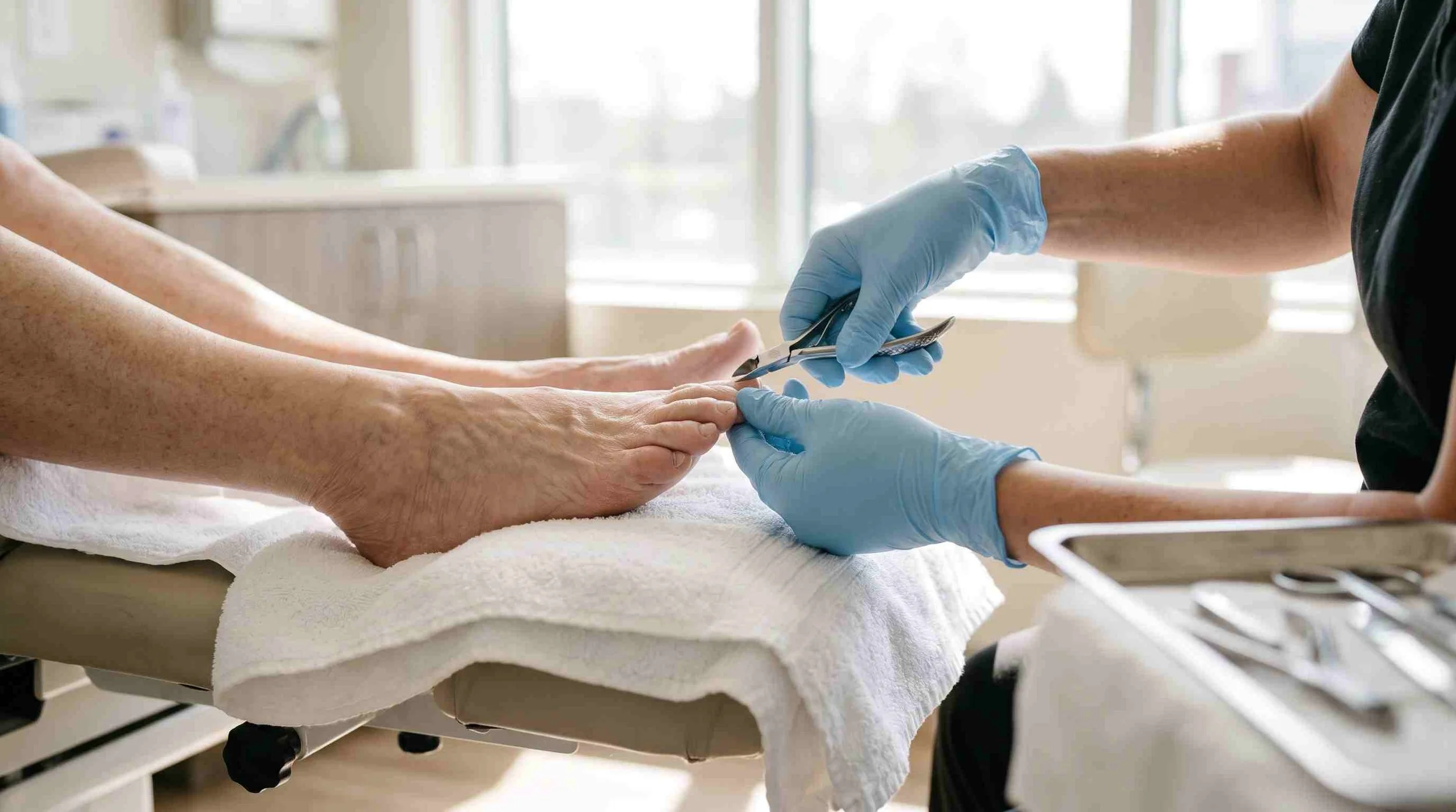
Thickened toenails can be cut by a podiatrist, a doctor or a trained nurse. Medicare covers it only when a medical condition makes doing it at home unsafe.
Thick nails are mostly an age thing. Mayo Clinic (2026) names aging as the most common cause, because the nail plate grows more slowly as the years pass, and lists psoriasis, injury to the toes, tight-fitting shoes and fungal infection alongside it. Which one is behind it decides who should be holding the clippers, and whether anyone else pays for it.
Why Do Toenails Get So Thick in the First Place?
Because the nail keeps being made while it stops being worn down. A slower-growing nail plate piles up on itself instead of growing out cleanly, and anything that irritates the nail bed adds to the pile. Several causes can run at once in the same foot.
Age and Slower Nail Growth
This is the ordinary explanation, and it is the most common one. The nail grows at a lower rate, thickens, and gets harder to cut with household clippers, which is usually the point at which a family notices. On its own, Mayo Clinic says, a thickened toenail usually needs no medical care at all.
When It Is a Fungal Infection
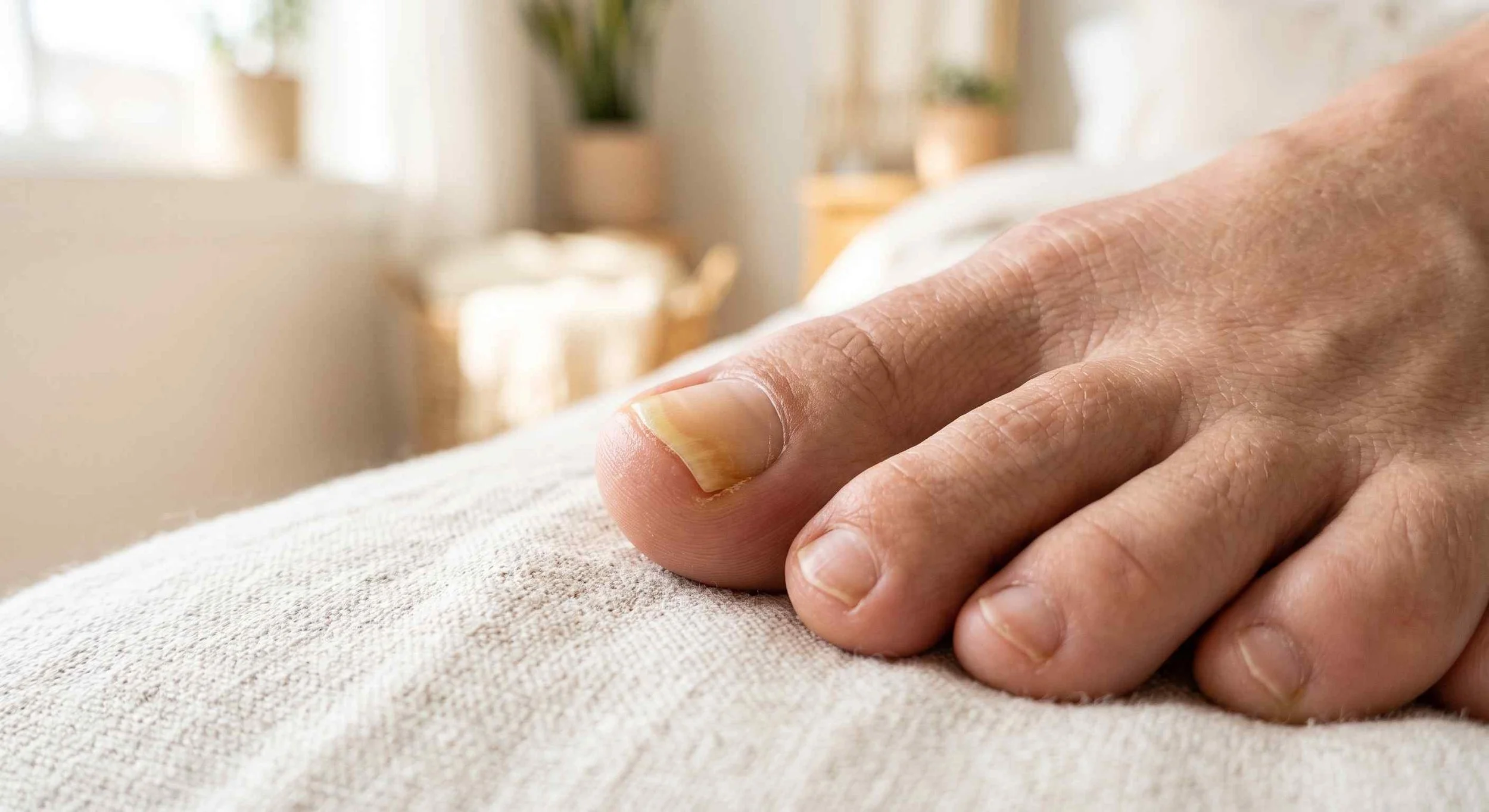
Fungus is another frequent cause, and it changes the plan. MedlinePlus (2024) describes a fungal nail infection as a fungus growing in and around the nail. It is more common in toenails than fingernails, and most often in adults as they age. The signs it lists are thickening, brittleness, crumbling edges, debris under the nail, loss of shine, and white or yellow streaks along the side.
It also lists who is more exposed: diabetes, peripheral vascular disease, peripheral neuropathies, minor nail or skin injuries, nails that are already deformed, skin kept moist for long stretches, immune problems, family history, and shoes that never let air reach the feet. Appearance alone does not settle it; the diagnosis comes from scrapings looked at under a microscope, and a culture can take four to six weeks.
Pressure, Injury and Circulation
Repeated pressure does the same work as a single injury, only slower. A shoe that presses on the nail for years, or a stubbed toe from a decade ago, can leave a nail that grows thick for the rest of its life. What goes on the foot matters here, which is why a podiatrist's view on whether walking barefoot is bad for your feet is worth a read for anyone whose nails have started changing.
Blood flow is the fourth thread. Nails need a working supply to grow properly, and the color and texture of a thickened nail can carry information about what is reaching the toes. There is a fuller explanation in what thick, yellow toenails say about circulation, and it is the part of this subject most often skipped.
Who Can Cut Thick Toenails: Podiatrist, Nurse or Salon?
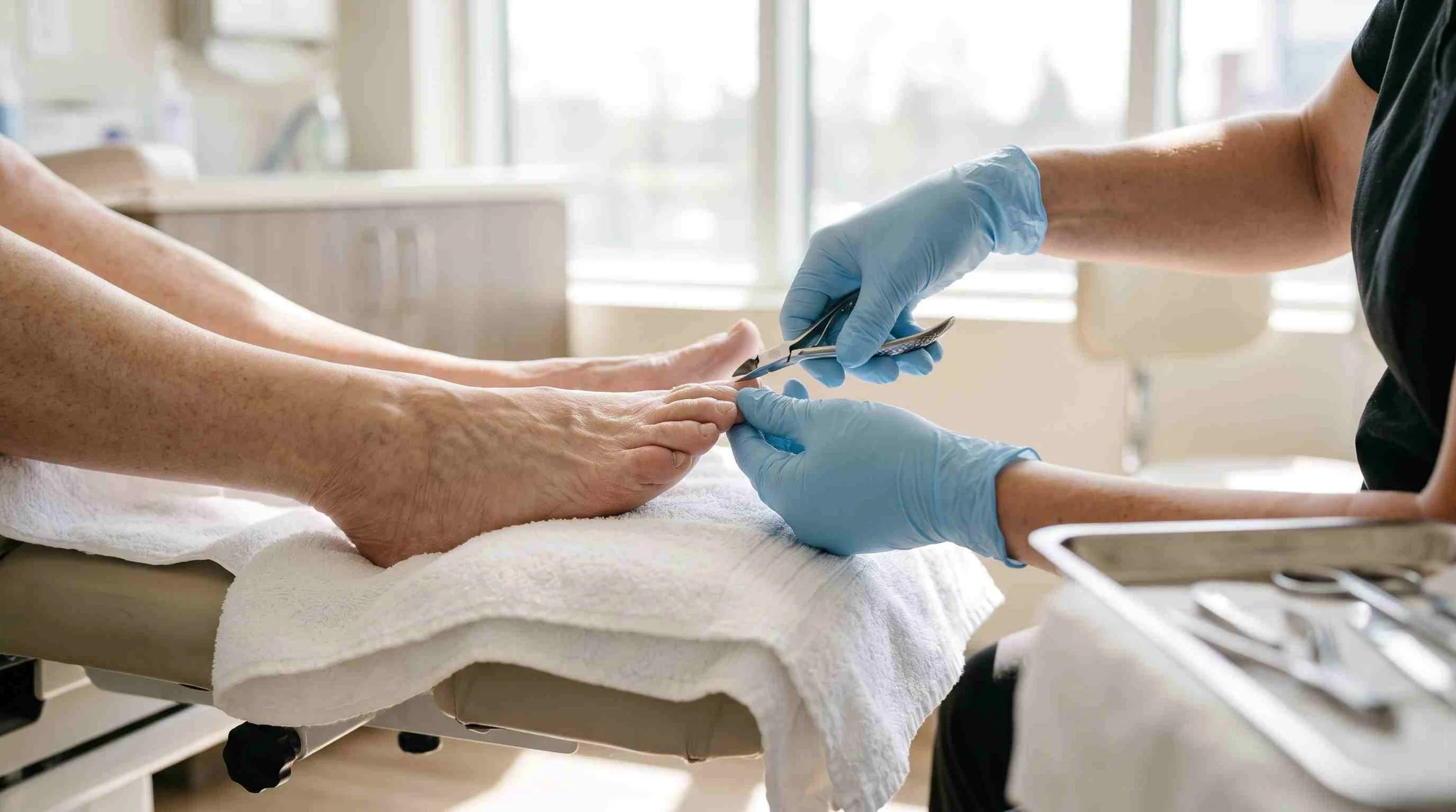
A podiatrist is the usual answer, and for a medically complicated foot it is the only comfortable one. Podiatrists cut nails that are too thick, too hard or too close to something fragile for ordinary clippers, and they do it with instruments built for the job rather than the ones in the bathroom drawer.
Doctors do it too, and so do nurse practitioners and physician assistants. In practice the choice is often about access rather than training: podiatry appointments are usually easier to get for feet specifically, and a podiatry office is set up for it. Mark Lembersky, DPM provides general podiatry services in Los Angeles, which is the kind of listing to look for when the problem is routine but the nails are not.
What Medicare Counts as a Professional
Medicare's billing rules are specific about this. The CMS Billing and Coding article on foot care, revised in October 2025, sets out who counts as a professional here. The list is a Doctor of Medicine, a Doctor of Osteopathic Medicine, a Doctor of Podiatric Medicine, a nurse practitioner, a clinical nurse specialist or a physician assistant.
A registered nurse with foot care certification can also perform covered foot care, but only under direct supervision of a physician or other practitioner, with the certification documented and the rest of the coverage rules met. The same article makes the key point that the exclusion of foot care is decided by the nature of the service, not by who performs it.
Where a Nail Salon Fits
A salon pedicure is a reasonable option for a healthy older foot and a poor one for a complicated foot. Nobody there can diagnose a nail, no part of it is billable to Medicare, and MedlinePlus lists not sharing manicure or pedicure tools among the ways fungal nail infections spread in the first place.
The line is not about skill. It is about what happens if the skin is nicked: on a foot with good circulation and normal sensation, very little, and on a foot with neither, a small cut is how a much larger problem starts.
Does Medicare Cover Toenail Cutting?
Generally no, with two real exceptions. The CMS foot care article states plainly that routine foot care is usually performed by the person themselves or by a caregiver, and is generally excluded from coverage. Trimming nails sits inside that exclusion by default.
The exceptions are where most families actually land, because an elderly parent with thickened nails often meets one of them. They split into a route based on another medical condition and a route based on the state of the nails themselves.
The Systemic-Condition Route
Foot care becomes coverable when a systemic condition is present. The article names metabolic, neurologic and peripheral vascular diseases as the categories, and these are the conditions whose peripheral complications raise the danger of infection and injury if a non-professional does the cutting. The claim has to carry a specific billing modifier and a matching diagnosis.
There is a second requirement that trips people up. For certain diagnoses, the parent must be under the active care of an M.D. or a D.O., and that is treated as met if they were seen for the complicating condition in the six months before the foot care. A long gap since the last visit with the doctor managing the diabetes or the circulation problem can be the reason a claim fails.
The Thick, Painful Nail Route
Nails can qualify on their own merits, without any systemic condition. For a patient who walks, the article requires marked limitation of walking, pain, or a secondary infection resulting from the thickening and deformity of the infected nail plate. For a patient who does not walk, pain or secondary infection is enough by itself.
That is the clause worth knowing before an appointment. A nail so thick that it hurts to wear a shoe, or that has become infected at the edge, is a different conversation from a nail that simply looks bad. The difference is what the note in the chart has to describe.
Set out as conditions, Medicare's exceptions for nail care look like this:
|
What Has to Be True |
What It Means in Practice |
|---|---|
|
A systemic condition is present |
A metabolic, neurologic or peripheral vascular disease, with the required findings and a billing modifier on the claim |
|
Active care from an M.D. or a D.O. |
For certain diagnoses, the parent must have been seen for that condition in the six months before the foot care |
|
No systemic condition, patient walks |
Marked limitation of walking, pain, or secondary infection from the thickened, deformed nail plate |
|
No systemic condition, patient does not walk |
Pain or secondary infection from the thickened, deformed nail plate is enough on its own |
|
How often it is allowed |
Covered exceptions are considered medically necessary once in 60 days; more frequent visits are denied |
|
Who may perform it |
An M.D., D.O., D.P.M., nurse practitioner, clinical nurse specialist or physician assistant, or a certified foot care nurse under direct supervision |
Read it as a checklist rather than a menu. One route or the other has to be documented, the frequency rule applies on top of whichever route is used, and none of it changes the fact that an ordinary nail trim on a healthy foot is simply not a Medicare benefit. Local contractors apply these national rules, so the exact paperwork can differ, and a plan's own rules sit on top again.
How Often Does Medicare Pay for Toenail Cutting?
Once in 60 days, where the service qualifies at all. The CMS article puts it directly: covered exceptions to routine foot care are considered medically necessary once in 60 days, and more frequent services are denied as not reasonable and necessary.
Roughly every two months is also about the rate at which a thickened nail grows back to being a problem, so the rule and the biology are not far apart. Families who book too early tend to do it after a bad month rather than because the nail needed it sooner.
If a parent genuinely needs attention more often than that, the extra visits are usually paid out of pocket, and the price depends on where you are and who does it. Worth asking at the first appointment rather than discovering it on a statement.
Is It Dangerous to Cut Thick Toenails Yourself?
It depends entirely on the foot, not on the nail. On a healthy foot with normal feeling and normal circulation, careful home trimming is a chore. On a foot that cannot feel a cut or heal one quickly, the same chore carries real risk.
Who Should Not Try It at Home
The clearest instruction comes from MedlinePlus (2026) on diabetes foot care: do not cut very thick toenails yourself, and do not trim thick or discolored nails that may be fungal. It also says to see a podiatrist if eyesight is poor or feeling in the feet is reduced, and to keep every blade away from corns and calluses.
The CDC (2024) adds the practical version of the same rule: trim straight across and smooth the edges with a file, and have a podiatrist do the trimming if you cannot see or reach your feet. About half of all people with diabetes have some kind of nerve damage, most often in the feet and legs, which is why this is not a cautious footnote.
Reduced feeling is the thing to take seriously, and it is not always obvious. Numbness, tingling and burning are the symptoms that point to it, and feet that burn at night is one of the ways families first notice. Where it is present, a small nick can turn into a foot ulcer that will not heal, which is a far bigger problem than an untidy nail.
Mayo Clinic's own caution is the same, in fewer words: nail nippers are very sharp, and anyone with diabetes, poor circulation or reduced sensation in the feet should take care and ask their care team first. If a small cut on that parent would be hard to stop or slow to close, that question belongs with whoever manages their medicines, not with the person holding the clippers over the bathtub.
How It Is Done When It Is Safe to Try
Mayo Clinic's method is short. Soak the feet in warm water for five to ten minutes, dry them properly, and use nail nippers rather than ordinary clippers, since they are lighter and easier to control. Start at a corner and make small straight cuts across, which stops the nail splintering.
Do not round the edges with nippers, because cutting straight across is what lowers the risk of an ingrown nail. Finish by smoothing the edge with an emery board, which also keeps the nail from catching on socks. If the nail keeps thickening, becomes painful, or simply cannot be cut safely, that is the point to hand it over.
Can Someone Come to the House If a Parent Cannot Travel?
Yes, and for a parent who no longer drives it is often the only version that happens at all. Some podiatrists see patients at home as well as in the office, and a foot that gets looked at every two months at the kitchen table is in better shape than one waiting on a ride that never gets arranged.
Podiatrists Who Travel
Arkady Kaplansky, DPM is one example of a Los Angeles County podiatrist offering home visits as well as office and video appointments, which matters for nails that need attention on a schedule rather than once. Mobile foot care for seniors is its own small market now, and availability varies a lot by area.
When the Visit Should Cover More Than the Nails
Where the nails are part of a wider picture, the visit that covers everything is a primary care visit rather than a foot appointment. Arranging a doctor who comes to the home can put the nails, the circulation, the medicines and the active-care requirement for a Medicare claim into the same hour. How home-based primary care works for a homebound parent explains what that kind of visit usually involves.
One practical note on booking. If the goal is a covered nail visit, it helps to have the parent's recent visit for the systemic condition already on record, because the six-month active-care window is a documentation question that nobody can fix after the fact.
FAQ
-
Yes. The CMS foot care article says services that do not meet the national coverage criteria are denied as statutory non-covered services, meaning the exclusion is in the law rather than a judgment call on the day. A plain trim on an otherwise healthy foot does not become covered by being done in a medical office.
-
They can cut ordinary nails on a healthy foot, and that is exactly what Medicare treats as routine and does not pay for. For nails that are very thick, discolored or possibly fungal, MedlinePlus advises against anyone trimming them at home, which puts them back with a professional whether or not a claim is involved.
-
Slowly, and only if the cause has been dealt with. MedlinePlus notes that nails grow slowly and a new clear nail may take up to a year, and that medicines clear a fungal infection in about half of the people who try them. Nails thickened by age keep needing trimming rather than getting better.
-
No, and assuming it is a waste of time. Mayo Clinic lists aging, psoriasis, injury and tight shoes alongside fungal infection as causes of thickening. MedlinePlus is clear that identifying a fungus needs scrapings examined under a microscope, with a culture taking four to six weeks.
-
It can, and shared tools are the route. MedlinePlus lists not sharing manicure or pedicure tools among its prevention steps for fungal nail infections. A salon that sterilizes properly or lets clients bring their own instruments removes most of that risk.
-
Because the pressure comes from the nail pressing down into its own bed, not from the shoe pressing in. Medicare's own criteria recognize this, treating marked limitation of walking, pain or secondary infection caused by the thickening and deformity of the nail plate as grounds for coverage on its own.
Sources Used
Billing and Coding: Foot Care – Centers for Medicare and Medicaid Services, Medicare Coverage Database (2025)
Diabetes - taking care of your feet – MedlinePlus, National Library of Medicine (2026)
Fungal nail infection – MedlinePlus, National Library of Medicine (2024)
How to trim thickened toenails – Mayo Clinic (2026)
Is Walking Barefoot Bad for Your Feet? – Arkady Kaplansky, DPM (2026)
Your Feet and Diabetes – Centers for Disease Control and Prevention (2024)

Written by Sofiia Puhach
November 23, 2026
You May Also Like