Patient Lifts for Home Use: Ceiling Hoists and Access Solutions for Mobility Issues
The challenge of managing mobility issues at home often reaches a breaking point where physical strength is no longer enough. For families and professional caregivers, heavy lifting during daily routines is the leading cause of chronic back injuries. Ceiling lift systems, also known as ceiling hoists, have emerged as the gold standard for solving this problem, offering a seamless blend of safety, dignity, and modern technology.
Understanding the System: More Than Just a Medical Lift
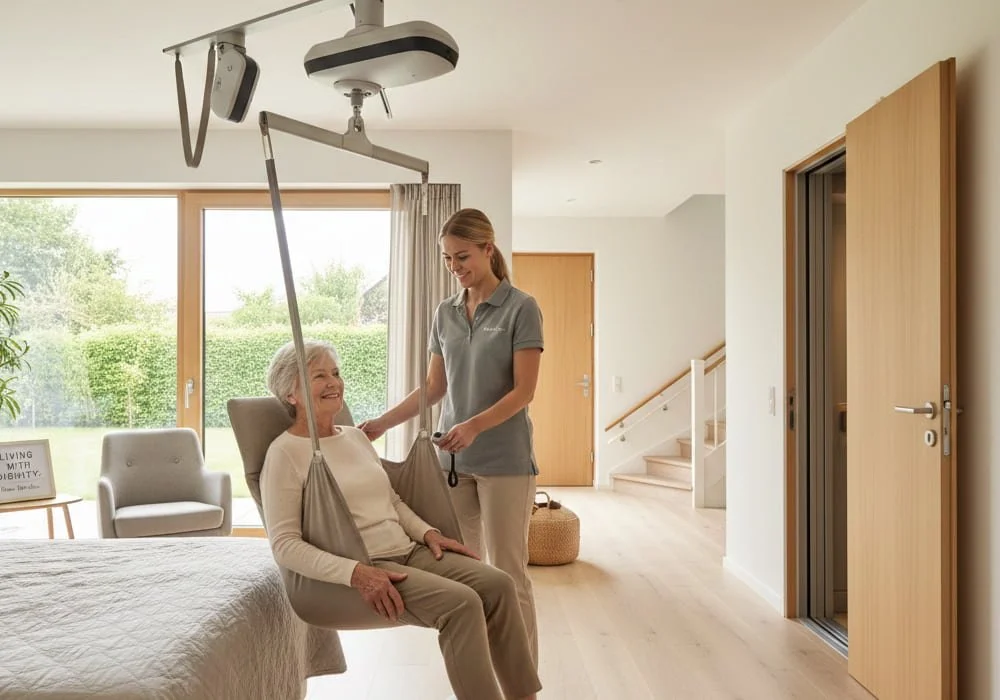
A ceiling lift is a permanently installed or semi-portable medical lift solution that utilizes overhead tracks to move individuals. Unlike a bulky manual hoyer lift that requires significant floor space and physical force to push, these systems utilize the "dead space" on your ceiling.
Core Components
The Track (Rail System): These provide the path for movement. You can opt for a straight track for simple transfers or an H-system (traverse rail) that provides full-room day access.
The Lifting Motor: This is the heart of the system. Some choose a portable hoyer lift motor that can be unhooked and moved between different rooms, while others prefer a permanent, high-capacity motor.
The Sling and Spreader Bar: This replaces the traditional patient lift transfer chair. The sling is custom-fitted to the individual to ensure they are cocooned safely during the transition.
When to Transition to Patient Lifts for Home Use
Many families delay looking for patient lifts for home use until a crisis occurs – usually a fall or a caregiver injury. However, proactive installation is key to "Aging in Place." You should consider a patient lift if:
The patient can no longer weight-bear consistently during a pivot transfer.
The caregiver experiences pain when providing moving assistance.
The home layout is too narrow for a lift for wheelchair users to maneuver.
There is a high risk of skin shears or bruises during manual handling.
Ceiling Lifts vs. Other Access Solutions
When researching access solutions, homeowners often compare various technologies. While a home elevator near me might seem like a luxury fix, it only solves the problem of moving between floors – it doesn't help a patient get out of bed.
Similarly, while a stair lift installation or a stair lift for elderly family members is excellent for vertical mobility, they still require the user to be able to transfer onto the chair. A ceiling lift bridges that gap, providing a total end-to-end transfer from a lying position to a seated one without any manual hauling.
| Feature | Ceiling Hoist | Manual Hoyer Lift | Stair Lift |
|---|---|---|---|
| Effort Required | Minimal (Electric) | High (Manual pumping) | Minimal |
| Floor Space | None | High (Requires 3–5 ft clearance) | Low |
| Primary Use | Bed, bath, and chair transfers | Room-to-room transfers | Floor-to-floor travel |
| Safety Level | Very high (No tipping risk) | Moderate (Risk of tipping) | High |
The Clinical and Psychological Impact
Beyond the mechanics, a medical lift significantly improves the mental health of both the patient and the provider.
Fall Prevention: Programs such as Call Before You Fall focus on reducing environmental risks before accidents happen. Ceiling lifts fit perfectly into this "safety-first" design.
For the Patient: Research by the CDC indicates that mechanical lifts reduce the "fear of falling," which often leads to muscle guarding and pain.
For the Caregiver: The CDC reports that healthcare workers have high rates of musculoskeletal disorders. Using a patient lift eliminates the dangerous pressure placed on the spine during heavy lifting.
Specialized Care and Professional Integration
Professional care teams, such as Eternal Life Hospice and Assisted Living Solutions, integrate these systems to ensure a "no-lift" policy. This is especially vital for:
Rehabilitation: Allowing patients to practice standing without the risk of a catastrophic fall.
Diagnostics: Mobile providers like Gentry Imaging can perform X-rays more efficiently when a patient can be precisely repositioned via a lift.
End-of-Life Care: Ensuring that every movement is as gentle and pain-free as possible.
Installation and Technical Considerations
A stair lift installation or a ceiling lift setup requires professional assessment. Technicians check the structural integrity of your ceiling joists to ensure they can support the weight (usually rated up to 450–1000 lbs). For those in temporary living situations, "pressure-fit" tracks are available that do not require permanent drilling into the ceiling.
Conclusion: Investing in Safety
Whether you are choosing between a portable hoyer lift or a permanent ceiling lift, the goal remains the same: providing the best possible moving assistance while protecting the health of the caregiver. These access solutions transform a house from a place of obstacles into a place of freedom.
Key Benefits Recap
Eliminates the danger of heavy lifting.
Provides day access to essential areas like bathrooms and bedrooms.
Superior to a manual hoyer lift in both safety and ease of use.
Essential for managing complex mobility issues at home.
FAQ
1. Medical Ceiling Lifts (Patient Care)
1.1 What is a ceiling lift?
A ceiling lift is a motorized assistive device that runs on a track system mounted to the ceiling. It is used to lift and transfer individuals with limited mobility safely.
1.2 What is a ceiling lift used for?
It is primarily used for transferring patients between a bed, wheelchair, or bathtub, and for repositioning someone in bed to prevent pressure sores. It eliminates the need for manual lifting by caregivers.
1.3 What is a portable ceiling lift?
A portable ceiling lift is a motor unit that can be detached from the track and moved to another track in a different room. This allows one motor to be used in multiple locations, saving on equipment costs.
1.4 How to use a ceiling hoyer lift?
Prepare the Sling: Place the sling under the patient according to the manufacturer's instructions.
Attach: Lower the lift motor and attach the sling loops to the spreader bar.
Lift: Use the hand control to raise the patient until they clear the surface.
Transfer: Gently slide the motor along the track to the new location.
Lower: Use the remote to lower the patient into the chair or bed, then detach the sling.
1.5 How much does a ceiling lift cost?
Costs vary widely depending on the track length and motor type. Generally, systems range from $3,000 to $12,000 including professional installation.
2. Car Lifts & Garage Requirements
2.1 How much ceiling height for a car lift?
The minimum ceiling height for a car lift is typically 10 feet (120 inches) for a standard garage, though this only allows for low-profile vehicles.
2.2 How high should a garage ceiling be for a 4-post lift?
For a 4-post lift where you intend to "stack" two cars, you generally need at least 11 to 12 feet. To calculate your specific needs:
Height of Car 1 + Height of Car 2 + 6 inches (for the lift platform and safety clearance) = Minimum Height.
2.3 What is the lowest/minimum ceiling height for a car lift?
You can install a "low-rise" or "mid-rise" lift in a ceiling as low as 8 or 9 feet, but you will not be able to stand fully upright under the vehicle.
3. Drywall Lifts & Home Improvement
3.1 How to use a drywall lift for ceilings?
Load: Place the drywall sheet onto the lift’s support arms while they are tilted.
Position: Level the arms and wheel the lift into place under the joists.
Crank: Use the wheel or handle to raise the sheet until it is tight against the ceiling.
Fasten: Screw the drywall into the joists while the lift holds the weight.
3.2 How to use a drywall lift on a vaulted ceiling?
Most professional lifts have a tilting cradle. Set the angle of the cradle to match the pitch of your vaulted ceiling before loading the sheet and raising it.
3.3 How to hang ceiling drywall without a lift?
If you don’t have a lift, you can:
Build a "T-brace": Two pieces of 2x4 lumber nailed together in a 'T' shape to prop the board up.
The Two-Person Method: Use two people on ladders and a third to help guide.
Cleat Method: Screw a temporary wooden cleat to the wall to hold one edge of the board while you lift the other.
4. Financial & General Terminology
4.1 What does it mean to lift the debt ceiling?
This is a financial term referring to the U.S. Congress increasing the legal limit on how much money the federal government is allowed to borrow to pay its existing legal obligations. It is not a physical lifting device.
4.2 How to build a ceiling storage lift?
A ceiling storage lift is usually built using a pulley system or an electric winch mounted to the ceiling joists. You attach a platform or hooks to the cables to raise items like bikes, kayaks, or storage bins out of the way.
You May Also Like