
Dark Chocolate and the Health Claims: What Actually Holds Up
Table of Content
Dark chocolate benefits are real but small. Bars at 70% cocoa and above carry flavanols linked to better blood flow and lower diabetes risk, in modest amounts.
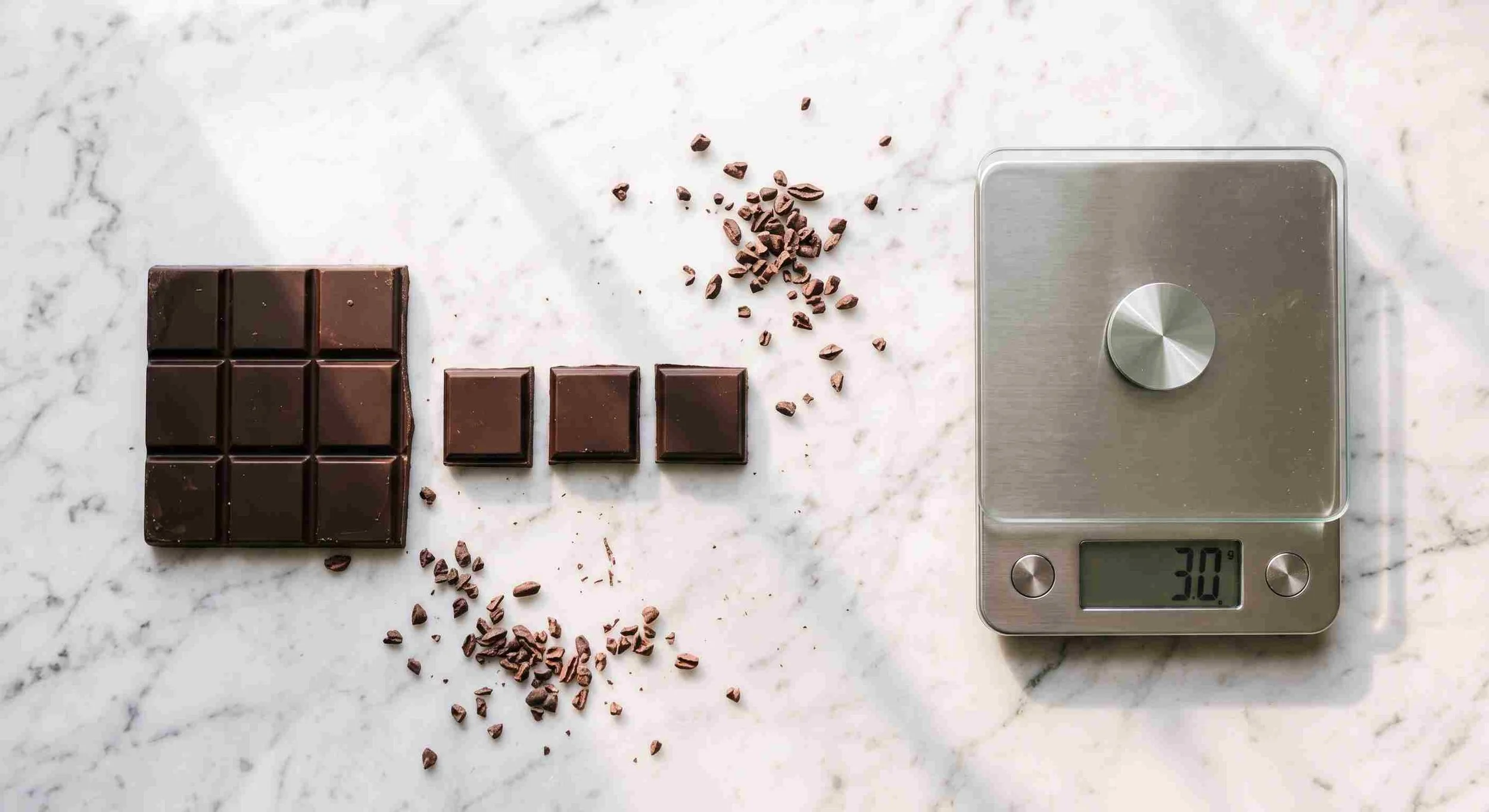
The caveats travel with them. One ounce of 70 to 85% dark chocolate holds about 170 calories and 12.1 grams of fat, according to the Cleveland Clinic, which also puts a sensible serving at one to two ounces. An ounce is roughly three thin squares snapped off a bar.
This article walks through each popular claim, names what the research supports, and says plainly where the evidence thins out. It also covers the two issues that get less attention: how much sugar and saturated fat comes along, and what testing has found about heavy metals.
What Counts as Dark Chocolate?
Dark chocolate is chocolate made mostly from cocoa solids and cocoa butter, with sugar and no milk. Harvard’s Nutrition Source puts the range at 50 to 90% cocoa solids, against 10 to 50% for milk chocolate.
That percentage on the wrapper is the single most useful number on the package. It tells you how much of the bar is cocoa and, by subtraction, how much is sugar and fat. A 50% bar and an 85% bar are different foods wearing the same name.
White chocolate sits outside the conversation entirely, since it contains no cocoa solids at all. Dark chocolate is also usually dairy-free, though shared equipment can leave traces, so anyone avoiding milk should read the ingredient list rather than the front of the package.
What Are Cocoa Flavanols, and Why Do They Matter?
Flavanols are plant compounds in cocoa solids, and they are the reason dark chocolate ends up in health research at all. Harvard’s Nutrition Source notes that dark chocolate carries two to three times more flavanol-rich cocoa solids than milk chocolate.
Their proposed mechanism is straightforward. Flavanols support the production of nitric oxide in the endothelium, the inner lining of blood vessels, which helps those vessels relax and improves blood flow. Better flow is the common thread behind most of the claims further down this page.
Processing changes how much survives. Harvard’s Nutrition Source points out that cocoa treated with alkali, sold as Dutch-processed, loses a significant share of its flavanols, while natural cocoa in the baking aisle keeps the most. Two products with the same cocoa percentage can differ here.
Does Dark Chocolate Actually Help Your Heart?
The heart claim has the most support behind it, and it is still described in careful language by the people doing the research.
What the Blood Vessel Evidence Says
Flavanols relate to nitric oxide production, which relaxes blood vessels and improves blood flow, and that in turn may lower blood pressure. The Cleveland Clinic’s 2025 review of dark chocolate states the mechanism and adds, in the same breath, that more studies are needed before the effect can be called settled.
It also cites research suggesting dark chocolate may lower LDL cholesterol and raise HDL cholesterol. Those are directional findings rather than a treatment, and none of it substitutes for knowing your blood pressure numbers and tracking them over time.
What It Does Not Replace
No amount of chocolate outweighs the habits that move blood pressure meaningfully: activity most days, less salt, more fruit and vegetables, steady sleep. Exercise remains the more reliable lever for weight and cardiovascular risk.
If your blood pressure has been creeping up, that is a conversation with a clinician rather than a grocery decision. For older adults who find clinic trips hard, a doctor who visits at home can take readings and review the whole picture in one visit.
Is Dark Chocolate Linked to Lower Diabetes Risk?
Yes, in observational data, and the split between dark and milk chocolate is the interesting part. The finding comes from one of the largest datasets available on the question.
A Harvard T.H. Chan School of Public Health study published in The BMJ in December 2024 followed more than 192,000 adults over three decades. Participants eating at least five servings of dark chocolate a week had a 21% lower risk of type 2 diabetes, with a 3% reduction for each additional weekly serving, while milk chocolate showed no such link.
The researchers were careful about what that means. Dark and milk chocolate carry similar calories and saturated fat, so the authors suggested the polyphenols in dark chocolate may offset some of the effect of the sugar and fat. They also noted that participants ate relatively little chocolate overall, so the findings may not extend to heavy consumption.
Blood sugar questions rarely stand alone, since thyroid function, cholesterol and weight usually sit in the same conversation. An endocrinologist such as Irina Urusova, MD works across those metabolic threads rather than treating one number in isolation.
Does Dark Chocolate Improve Mood or Gut Health?
The mood signal is modest and the gut signal is weaker than the headlines suggest. Both deserve a closer look than they usually get.
Mood
The Cleveland Clinic points to research in which participants eating 85% dark chocolate daily maintained a better overall mood than people eating chocolate with less cocoa or none at all. Polyphenols lowering cortisol is one proposed explanation, and the simple pleasure of eating something you enjoy is another.
Caffeine plays a part too, which cuts both ways. Two ounces of 70% dark chocolate carries roughly 50 to 60 milligrams of caffeine, against 100 to 200 in an eight-ounce cup of coffee. That is enough to lift alertness and, for some people, enough to disturb sleep or aggravate reflux.
Gut Bacteria
The prebiotic story has not held up well under controlled testing. A 2024 randomized, double-blind crossover trial in the Journal of Nutritional Science gave eight healthy adults 900 mg of cocoa-derived flavanols a day for eight days and compared the results against a matched placebo.
No increase in Lactobacillus or Bifidobacterium was found, and overall bacterial diversity was slightly lower after the flavanol phase. The authors concluded the findings were not consistent with a clear prebiotic effect at that dose and duration, while allowing that a longer study might show something.
What Do the Calories and Saturated Fat Cost You?
A bar is still a confection, and the arithmetic is the part most articles skip. One ounce of 70 to 85% dark chocolate contains roughly 170 calories, 12.1 grams of fat, 13 grams of carbohydrate and 6.8 grams of sugar.
Harvard’s Nutrition Source makes the same point from the other direction: dark chocolate is high in calories and can contribute to weight gain if eaten in excess, and it carries a moderate amount of saturated fat. The flavanol benefits are thought to outweigh that, but only at sensible portions.
There is a useful counterweight in the bitterness itself. Dark chocolate at a high percentage is intense, which naturally slows people down, and the Cleveland Clinic describes it as a food where a little produces satisfaction faster than a sweeter alternative would. An ounce also brings about four grams of fiber.
Sugar is the other variable to watch on the label. Aiming for under eight grams of sugar per serving, with cocoa listed as the first ingredient, filters out most of the bars that are candy with a dark wrapper. The wider point is that single foods matter less than the overall pattern of what you eat.
Should You Worry About Heavy Metals in Dark Chocolate?
It is a real issue, measured rather than rumored, and the practical answer is about portion rather than avoidance. Cocoa plants take up cadmium from soil, and lead can arrive during drying and processing.
A study published in Frontiers in Nutrition on 31 July 2024 tested 72 popular cocoa products in the United States, sampled every other year across eight years. Forty-three percent exceeded California Proposition 65 limits for lead and 35% exceeded them for cadmium, while none exceeded the limit for arsenic and 70 of the 72 fell below the US FDA lead threshold.
The authors’ own reading is measured. Median concentrations of each metal came in below even the conservative Proposition 65 levels, so a single serving is unlikely to pose a risk for the average person. Eating several servings a day, or stacking cocoa with other dietary sources of heavy metals such as seafood, is where cumulative exposure starts to add up.
One finding cuts against instinct: organic bars were not cleaner, and some of the highest readings came from organic products. Brands vary, some publish their own testing, and rotating between brands rather than eating the same bar daily is a reasonable hedge.
What Percentage of Dark Chocolate Is Healthiest?
Seventy percent cocoa and above is the usual recommendation, because flavanols rise and added sugar falls as the percentage climbs. Both Harvard’s Nutrition Source and the Cleveland Clinic land on that threshold.
The practical obstacle is taste. High-percentage chocolate is bitter, and most people do not enjoy it at first. The Cleveland Clinic suggests starting around 50%, then moving up to 65%, then 70% over time, which works better than buying an 85% bar and abandoning it in a drawer.
The table below sets the common claims against what the research currently supports, so you can see at a glance which ones are firm and which are still open.
|
Common claim |
What the evidence actually shows |
|---|---|
|
"Dark chocolate is good for your heart" |
Flavanols support nitric oxide, which relaxes blood vessels and may lower blood pressure. Cleveland Clinic notes more studies are still needed. |
|
"It lowers your diabetes risk" |
In a 2024 Harvard analysis, five or more servings of dark chocolate a week tracked with a 21% lower risk of type 2 diabetes. Milk chocolate showed no link. |
|
"It is a health food you can eat freely" |
One ounce of 70-85% dark chocolate carries about 170 calories and 12.1 grams of fat, so portion size decides everything. |
|
"Dark chocolate feeds good gut bacteria" |
A 2024 trial of 900 mg of cocoa flavanols a day for eight days found no clear prebiotic effect in healthy adults. |
|
"Organic bars are cleaner" |
A 2024 analysis of 72 cocoa products found organic versions among the higher results for heavy metals. |
How Does Dark Chocolate Fit Into a Whole Diet?
As a small, deliberate part of it, and not as a correction for the rest. No single food carries a diet, and the research above describes people whose chocolate intake was modest to begin with.
The habits that do the heavy lifting are unglamorous: vegetables and fruit at most meals, fish and legumes, less salt, movement most days, and consistent sleep. Against that background an ounce of dark chocolate after dinner is a pleasant addition. Substituting for that background, it does nothing.
Some people benefit from working through the whole pattern with someone rather than adjusting one food at a time. Practices such as Comprehensive Natural Healthcare in Encino combine nutrition with physical therapy and other approaches for people who want that broader view.
A few conditions also change the calculation. If you have reflux, caffeine sensitivity, migraine triggers you have identified, or a condition with its own dietary rules, such as gout and its familiar list of triggers, the general advice bends around your situation.
Does Dark Chocolate Help Memory and Thinking?
Possibly, in the short term, and the evidence is thinner here than for the heart. The proposed route is the same improved blood flow, applied to the brain.
The Cleveland Clinic describes flavanols as potentially supporting attention, memory and learning, partly through nitric oxide and improved circulation, and partly through caffeine in the short term. It states clearly that more research is needed, and that the suggestion of protection against dementia remains unproven.
The habits with better support for thinking as we age are the familiar ones: controlled blood pressure, regular activity, social contact, and keeping the mind actively engaged. A square of chocolate is a small, pleasant addition rather than a strategy.
Sources Used
A multi-year heavy metal analysis of 72 dark chocolate and cocoa products in the USA – Frontiers in Nutrition (2024)
Dark Chocolate – The Nutrition Source, Harvard T.H. Chan School of Public Health (2023)
Doctor2me Provider Network – Doctor2me
Eating dark chocolate linked with reduced risk of type 2 diabetes – Harvard T.H. Chan School of Public Health (2024)
Effects of short-term, high-dose cocoa-derived flavanol supplementation on gut microbiota composition: secondary findings from a randomized, double-blind, placebo-controlled crossover study – Journal of Nutritional Science (2024)
Foods That Cause Inflammation and Foot Pain: A Clear Guide – Doctor2me
Fun Brain Games That Keep Your Memory Sharp – Doctor2me
Gout in Older Adults: Triggers, Flare Relief, and Diet – Doctor2me
High Blood Pressure Rarely Whispers Before It Shouts – Doctor2me
The Best Type of Exercise for Weight Loss – Doctor2me
The Health Benefits of Dark Chocolate – Cleveland Clinic (2025)
FAQ
-
The large studies so far have not shown a separate set of benefits by sex, and the heart and blood sugar findings included both men and women. Iron content is sometimes raised as a plus, but a bar is a small contributor next to food sources meant for that job.
-
Plain cocoa powder gives you the flavanols without the added sugar and fat of a bar. Natural cocoa keeps more flavanols than Dutch-processed cocoa, which is treated with alkali for flavor and color.
-
It can, because the caffeine rises with the cocoa percentage. Two ounces of 70% dark chocolate carries roughly the caffeine of a small half-cup of coffee, which is enough to matter for sensitive sleepers.
-
Often yes, in a planned portion, because the sugar content still counts toward the day. The right amount depends on the rest of the eating plan, so it is a question for the person managing your blood sugar.
-
Both links are reported by individuals more often than they are confirmed in trials. Keeping a simple record of what you ate and when symptoms appeared is more useful than cutting out a food on suspicion.
-
A cool, dry spot around 65 to 70 degrees Fahrenheit in a sealed container works, and the refrigerator does not. Cold encourages a whitish bloom on the surface, which is harmless but unappealing.

Written by Sofiia Puhach
September 26, 2026
You May Also Like





Expert guide distinguishing normal aging from serious bowel impaction, featuring essential stool health tips and geriatric digestive care strategies.