
COPD: When a 'Smoker's Cough' Isn't Harmless
Table of Content
Almost everyone who has smoked knows the sound: that rough, familiar cough that shows up in the morning and gets waved off as just a smoker's cough. But a cough like that is worth a second look, because it is often the first thing the lungs do to signal COPD, or chronic obstructive pulmonary disease, a common lung condition that makes it harder and harder to breathe over time.
According to the World Health Organization, COPD is the third leading cause of death worldwide and was linked to about 3.4 million deaths in 2023. In the United States, the American Lung Association reports that more than 16 million adults have been diagnosed, and millions more are living with COPD without knowing it. The earlier those changes are caught, the more can be done to protect the breathing a person still has.
What COPD Actually Is
Chronic obstructive pulmonary disease is an umbrella term for lung and airway damage that blocks airflow and makes breathing difficult. The Cleveland Clinic explains that in COPD the airways become inflamed and narrowed, the lungs lose their natural stretch, thick mucus builds up, and the walls between the tiny air sacs can break down. Unlike a cold that clears in a week, this damage is long-lasting and tends to get worse gradually, often over years.
Because the changes happen slowly, many people adjust their lives around the disease without realizing it, walking a little slower or taking the stairs less often. That is exactly why understanding the signs and symptoms of COPD early can make such a difference.
Chronic Bronchitis and Emphysema
COPD includes two main patterns of damage, and many people have both. Chronic bronchitis is ongoing inflammation of the larger airways that leads to a cough and a lot of mucus for months at a time. Emphysema is damage to the alveoli, the tiny air sacs at the end of the airways, so less oxygen reaches the bloodstream and the lungs feel less springy. MedlinePlus notes that COPD is sometimes simply called emphysema or chronic bronchitis, and the two often overlap.
Why a Smoker's Cough Deserves a Second Look
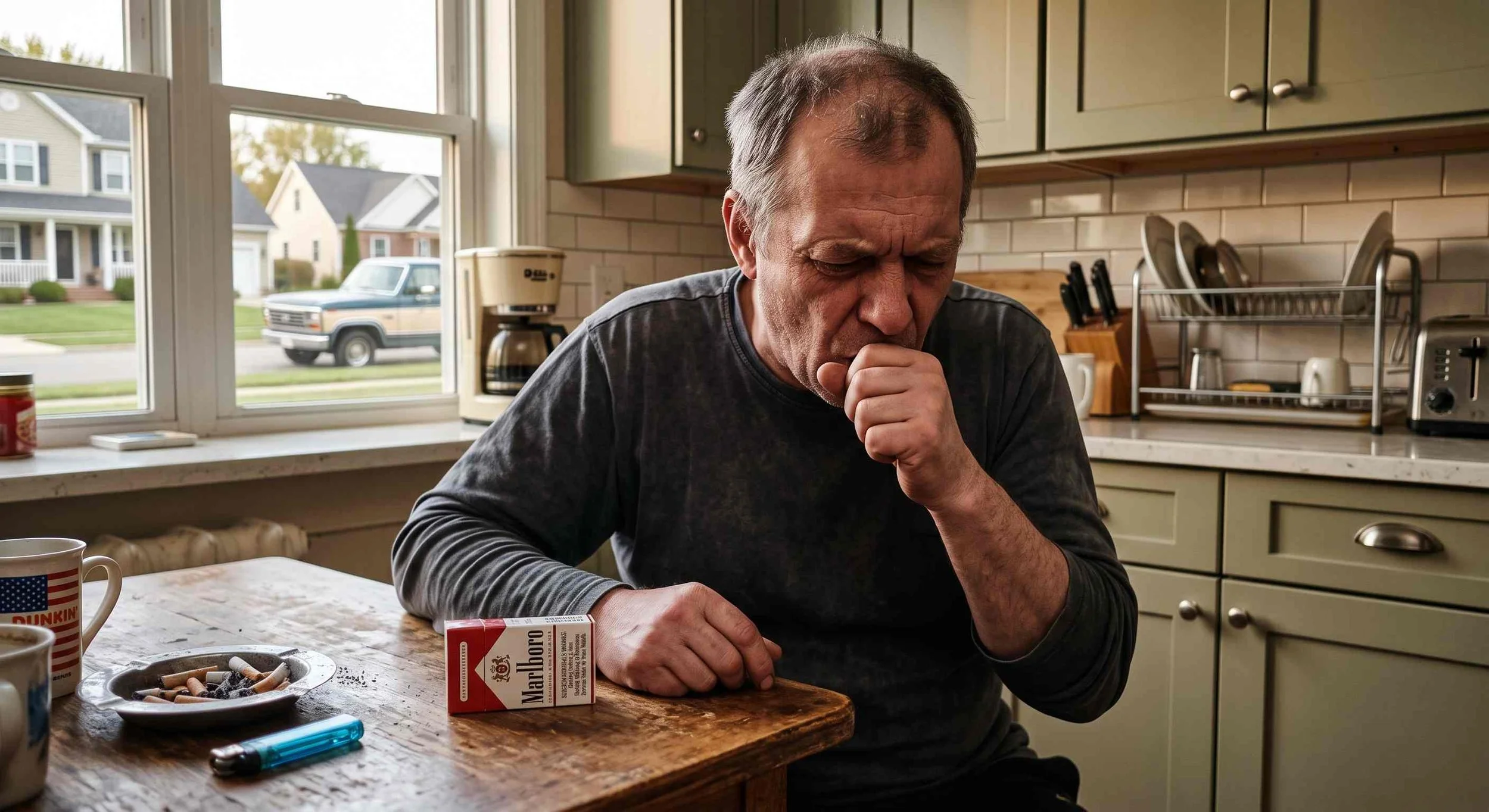
Smoking and coughing go together so often that the connection can feel almost normal. But that link is exactly the problem. The CDC reports that tobacco smoke is the main cause of COPD in the United States, and the damage from years of smoking is what drives that daily cough. A true smoker's cough is the airways reacting to constant irritation, producing extra mucus to try to clear it out.
Smoker's cough symptoms to pay attention to include a cough that sticks around for weeks or longer, mucus that you bring up most mornings, and a cough that slowly gets worse rather than better. The American Lung Association points out that a chronic cough and shortness of breath are not a normal part of getting older. It also notes that while tobacco use is the leading cause, about one in four people who develop COPD never smoked, so exposure to secondhand smoke, air pollution, and workplace dust and fumes matter too.
COPD Symptoms: Early Signs Worth Noticing
The early COPD symptoms are easy to explain away one at a time, which is why they often go unnoticed until breathing becomes a daily struggle. Recognizing the signs and symptoms of COPD as a group makes them harder to ignore.
A long-lasting cough, sometimes bringing up mucus or phlegm
Shortness of breath, especially during activity that used to feel easy
Wheezing or a whistling sound when breathing
Chest tightness
Feeling tired or low on energy
Getting chest infections such as bronchitis or pneumonia more often than usual
The National Heart, Lung, and Blood Institute notes that COPD affects more than 14 million diagnosed adults in the United States and that more than half of those diagnosed are women, a reminder that this is not only a condition of older men. If several of these symptoms sound familiar, they are worth raising with a professional rather than waiting.
When to Talk to a Doctor
It is time to check if a cough lasts more than a few weeks, if you feel short of breath doing ordinary things, or if you keep catching chest infections. Early testing is the whole point, because starting care sooner can help protect the lung function you still have. For people who find it hard to get to a clinic, seeing a doctor who can come to you at home can make that first conversation easier to arrange.
The Stages of COPD
Doctors describe COPD stages to capture how much airflow is blocked. The Cleveland Clinic explains that staging is based on a spirometry measurement called FEV1, the amount of air you can breathe out in one second. In simple terms, the four stages run from mild, where symptoms may be barely noticeable, to very severe, where breathlessness limits nearly every activity.
Stage 1, mild: airflow is only slightly reduced, and there may be a cough with little shortness of breath
Stage 2, moderate: breathlessness becomes noticeable with activity, and many people first seek help here
Stage 3, severe: airflow is significantly limited, with more fatigue and more frequent flare-ups
Stage 4, very severe: breathing is difficult even at rest, and daily life is heavily affected
One important point from the Cleveland Clinic is that the stage does not always match how a person feels. Someone can be at a higher stage and still have mild symptoms, or the reverse, so doctors look at the whole picture, including flare-ups and symptoms, when planning care.
How COPD Is Diagnosed
COPD is confirmed with spirometry, a simple breathing test that measures how much air you can move and how fast. The American Lung Association explains that a provider will order spirometry when COPD is suspected, and the results show whether the airways are blocked. A provider may also check oxygen levels with a finger sensor and use a chest X-ray to look for other causes of breathing trouble or to check the lungs during a flare-up.
For older adults or people who cannot easily travel, some of these tests can be arranged closer to home. Mobile services such as Gentry Imaging, which offers in-home X-ray and EKG, can help a care team gather the pieces they need without a trip to a hospital.
Living Well With COPD
There is no cure for COPD, but a lot can be done to breathe easier and slow the disease. The single most helpful step, according to the CDC, is to stop smoking, since quitting slows the loss of lung function no matter how long someone has smoked. From there, care often includes inhaled medicines that open the airways, pulmonary rehabilitation to build breathing strength, and a clear plan for what to do during a flare-up.
Because lung infections can trigger serious flare-ups, the World Health Organization recommends staying up to date on flu, pneumococcal pneumonia, and COVID-19 vaccines. Learning to spot a chest infection early is part of the plan too; our guide to recognizing and treating pneumonia at home can help. Some people with more advanced COPD also use supplemental oxygen, and our overview of home oxygen therapy for safe daily living explains how that works day to day.
After a hospital stay for a flare-up, recovering at home is often smoother with skilled support. A home health team such as 911 AM PM Home Health Care can provide nursing, respiratory therapy, and physical therapy in the home during that fragile stretch. Families arranging that care also find it useful to understand what home health support covers and where the gaps are, so they can line up any extra help early rather than in a rush.
Who Is at Risk for COPD
Smoking is the leading cause of COPD, but it is not the only path to the disease. The American Lung Association notes that anyone aged 40 or older with a history of tobacco use is at higher risk, yet about one in four people who develop COPD never smoked at all. That is an important reminder that a smoker's cough is only part of the story.
Other risk factors add up over a lifetime. The CDC and Cleveland Clinic point to secondhand smoke, long-term air pollution, and workplace exposure to dust, fumes, and chemicals as meaningful contributors. Cleveland Clinic also notes that risk is higher for people over 65, for women, and for those who had frequent respiratory infections in childhood. Knowing your own risk factors helps you and your provider decide whether a breathing test makes sense, even before symptoms become obvious.
Alpha-1 Antitrypsin Deficiency
A small number of people develop COPD because of a genetic condition called alpha-1 antitrypsin deficiency, which can lead to lung damage at a younger age and sometimes without a smoking history. If COPD runs in your family or appears early, a simple blood test can check for it. Identifying this cause matters because it changes how the condition is monitored and managed.
How COPD Progresses and How to Prevent Flare-Ups
COPD is a progressive condition, which means it tends to worsen slowly over years, with periods of stability broken by flare-ups, or exacerbations, when symptoms suddenly get worse. Flare-ups often follow a chest infection and can bring more breathlessness, more mucus, and more coughing. Over time they can become more frequent, which is why preventing them is a central goal of care.
A practical prevention plan usually includes taking prescribed inhalers correctly, staying current on vaccines, avoiding lung irritants, and washing hands often during cold and flu season. Just as important is having a written action plan so you know which symptoms to watch for and when to call for help. Catching a flare-up early, rather than waiting, can keep a manageable setback from turning into a hospital stay.
FAQ
-
A cough that lingers for weeks or months and brings up mucus is not a normal part of smoking or aging, and it can be an early sign of COPD. Not every long-term cough means COPD, but a cough that will not go away is a good reason to ask for a breathing test.
-
Common early COPD symptoms include an ongoing cough, more mucus or phlegm than usual, shortness of breath during everyday activity, wheezing, chest tightness, and getting tired more easily. These signs often come on slowly, which is why they are easy to brush off.
-
Both are forms of COPD. Chronic bronchitis is long-term inflammation of the airways with a cough and a lot of mucus, while emphysema is damage to the tiny air sacs deep in the lungs. Many people with COPD have features of both at the same time.
-
Doctors often describe COPD in four stages, from mild to very severe, based on a breathing test called spirometry. The stages help guide treatment, but symptoms do not always match the stage, so two people at the same stage can feel quite different.
-
There is no cure for COPD, and the lung damage does not reverse, but the condition can be managed. Quitting smoking, taking prescribed inhalers, staying active, and getting recommended vaccines can slow the decline and improve day-to-day breathing.
-
See a healthcare provider if a cough lasts more than a few weeks, if you are short of breath doing things that used to be easy, or if you keep getting chest infections. Early testing matters, because starting care sooner can protect the breathing you still have.
You May Also Like



Bedridden after an injury or surgery? See who can come to the home, how to set up care, and how to prevent pressure sores.