Sick Day Kit: What to Keep at Home When You're Sick
Table of Content
Build the kit while you feel fine. Once a fever hits and you live alone, the trip to the store is the hardest part of the whole illness.
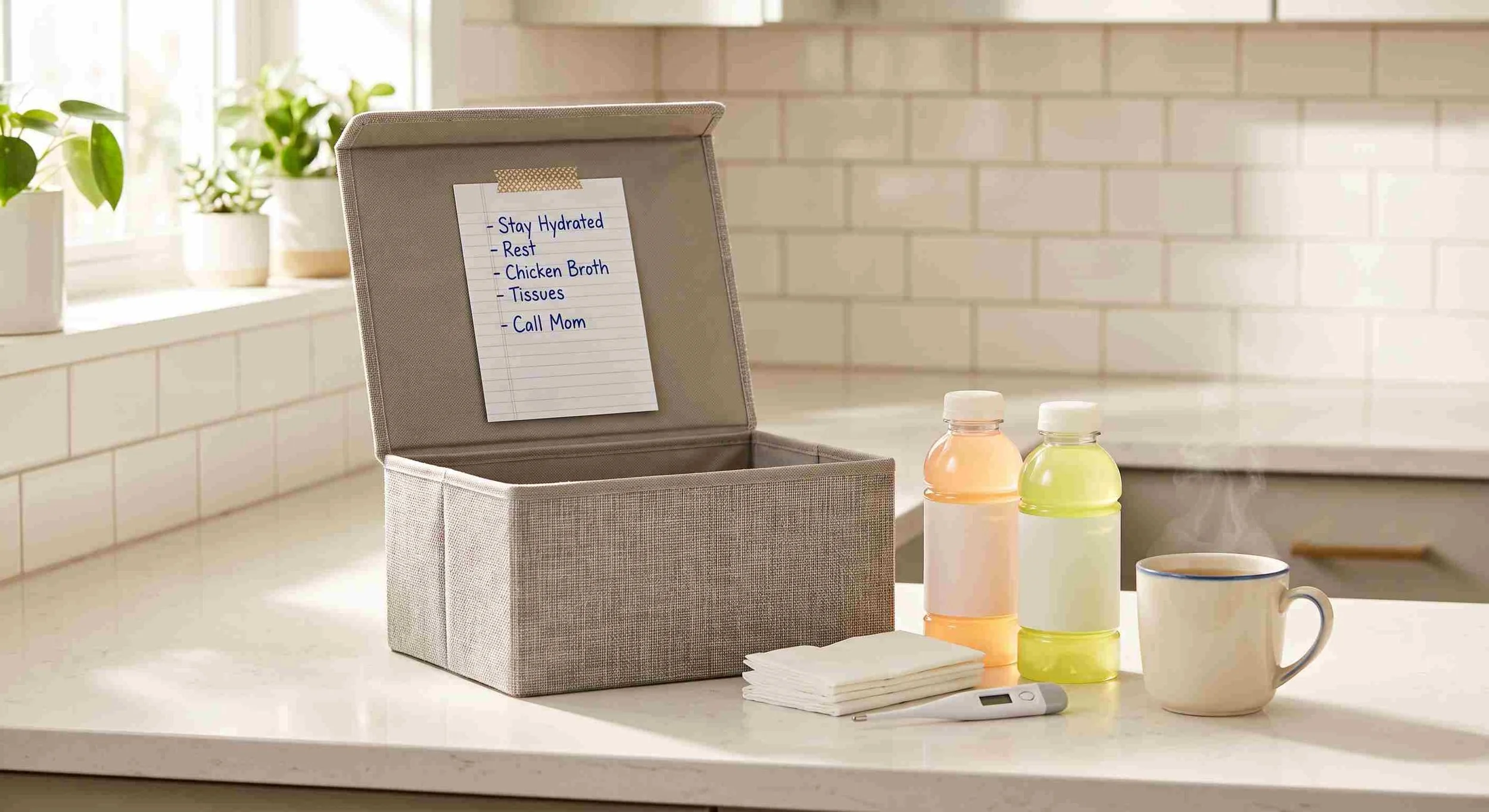
A workable sick-day kit is short: a digital thermometer, fluids with electrolytes, basic OTC cold medicine for the symptoms you actually get, tissues, something warm to eat that needs no cooking, and a written list of who to call. Everything else is optional.
What Belongs in a Sick-Day Kit?
Start with the things you cannot improvise at two in the morning. A thermometer tells you whether you have a fever at all. Fluids replace what a fever burns through. Tissues and lip balm handle the small miseries that keep you awake.
Then add the things that save a trip. Broth or canned soup, crackers, a box of herbal tea. A second set of pillowcases. A charger long enough to reach the bed. None of it is medical, and all of it is the reason a bad day stays a bad day instead of becoming a crisis.
Keep the kit in one place, not scattered across three cabinets. A single box or a low shelf you can reach from a kitchen chair works better than a top shelf you will not climb to with a temperature of 102.
The table sorts the kit into four groups. Use it as a shopping list, and cross off whatever does not apply to you.
|
Group |
What to Keep on Hand |
|---|---|
|
Measuring |
Digital thermometer for fever, a simple notebook or phone note to track temperature and symptoms |
|
Symptom relief |
OTC cold medicine matched to the symptoms you usually get, saline nasal spray, throat lozenges, lip balm |
|
Fluids and food |
Rehydration drinks or an electrolyte drink for fever, broth, canned soup, crackers, herbal tea, bottled water |
|
Comfort and basics |
Tissues, a thermometer cover, spare pillowcases, a phone charger that reaches the bed, a written list of contacts |
Which Over the Counter Cold and Flu Medicine Should You Keep?
Buy for the symptoms you actually get, not for every symptom that exists. Someone whose colds are all congestion does not need a cough product sitting unopened until it expires, and a combination product aimed at six symptoms is rarely the best match for two.
MedlinePlus, reviewed in 2025, notes that treating symptoms will not make a cold go away but will help you feel better, in its guidance on how to treat the common cold at home. Rest, fluids and warm liquids do most of the work; the medicine cabinet handles the edges.
How to Read the Label Before You Buy
The Drug Facts panel on the box lists active ingredients, uses, warnings and directions in the same order on every product in the country. Reading the active ingredients matters most, because two boxes with different names on the front often contain the same ingredient, and taking both means taking a double dose without meaning to.
Ask the pharmacist which products fit alongside what you already take. That conversation is free, takes two minutes at the counter, and is the single most useful check before anything goes into the kit.
Why Older Adults Need a Shorter Shelf
More prescriptions in the cabinet means more chances that a new over the counter cold and flu medicine collides with one of them. This overview of polypharmacy in older adults explains how those reviews work and why the list gets shorter with attention.
A geriatrics-focused clinician such as Rebecca Cook, M.D. in Scottsdale handles this kind of medication review as part of routine care, which is a reasonable time to ask what belongs in a sick-day kit and what does not.
Do You Need a Thermometer for Fever at Home?
Yes, and it is the one item worth buying first. Without a number, a fever is a guess, and the guess changes what you do next.
MedlinePlus (2024) puts an adult fever at an oral temperature above roughly 99°F to 99.5°F (37.2°C to 37.5°C) depending on the time of day, and notes in its overview of fever that normal body temperature shifts through the day and is usually highest in the evening. That evening rise is why the same person can read normal at breakfast and feverish at dinner.
A digital thermometer for fever is inexpensive and takes an oral reading in under a minute. Write down the number and the time each time you check, because the pattern over two days tells a clinician far more than a single reading does.
Keep spare batteries with it. A thermometer that will not turn on is the same as no thermometer, and the battery is never the size you have in the drawer.
Is a Pulse Oximeter Worth Buying for Home Use?
It can be useful with a lung or heart condition, and it has real limits everyone should know before relying on the number. A pulse oximeter clips onto a fingertip and estimates the oxygen saturation in your blood.
The FDA, in its 2025 consumer update on pulse oximeter basics, explains what the device measures and notes that readings can be affected by several factors, so a reading should be considered an estimate rather than an exact value.
Practically, that means a home pulse oximeter is a trend tool, not a verdict. A reading that drops steadily over a day, alongside breathlessness, is information worth calling about. A single odd reading in someone who feels fine, with cold hands or nail polish on, is often the device rather than the person.
If you are searching for the best pulse oximeter for home use, ask your own clinician whether it is worth having at all for your situation. For many healthy adults with a seasonal cold, it adds anxiety without adding information.
What About Rehydration Drinks and Electrolytes?
Fever, sweating, vomiting and diarrhea all pull fluid out faster than plain thirst replaces it. MedlinePlus, reviewed in 2025, lists fever among the causes of dehydration and notes that people who are sick often do not feel like drinking, which is exactly how mild dehydration starts.
An electrolyte drink for fever works because it replaces salts along with water. Sports drinks, oral rehydration products and broth all fit that description. Keep two or three servings in the cupboard rather than one, since a bad stretch can run several days.
Older adults are listed among the groups at higher risk, which is worth knowing if you are the person checking on a parent by phone. Asking what they have had to drink today is a more useful question than asking whether they feel thirsty.
How Should You Organize the Kit If You Live Alone?
Put everything in one container and tape a list to the lid. When you are foggy with fever, reading a list beats remembering what you bought in October. Add the date you stocked it so you know when to check expiration dates again.
Write down three phone numbers and keep them on paper: your primary care office, your pharmacy, and one person who would come by if you asked. Phones die, and the number you know by heart is rarely the one you need.
Arrange a check-in before you need it. A neighbor with a spare key, a friend who expects a text every evening, a family member who knows your building's door code. Most people who live alone do this once and never think about it again, which is the point.
A first aid kit checklist belongs in the same box: adhesive bandages in a few sizes, gauze, tape, disposable gloves, tweezers and small scissors. Illness and minor injuries tend to arrive on the same inconvenient evening.
Who Can You Call When You Are Too Sick to Go Out?
Start with your own primary care office, which can often handle a fever or a bad cough by phone or video the same day. Colds are the most common reason people reach out, and MedlinePlus (2025) notes there are over one billion colds in the United States each year, in its overview of the common cold.
When leaving the house is the obstacle rather than the illness itself, a house call doctor can examine someone at home, which matters most for people who live alone or who cannot drive while feverish.
Sorting out where to go is its own question, and this comparison of urgent care, the ER and a house-call doctor walks through which situations fit which setting. For anyone who is homebound most of the time, home-based primary care covers how regular visits at home work.
Two more things worth knowing before the season starts. Infection in an older adult does not always come with a fever, so confusion or a sudden change in behavior can be the only sign. And if a saline rinse is part of your routine, the safety rules for tap water in a neti pot are worth reading once.
Sources Used
Common cold – MedlinePlus (2025)
Dehydration – MedlinePlus (2025)
Fever – MedlinePlus (2024)
Find a clinician or care service – Doctor2me Provider Network
Home-Based Primary Care: How a House-Call Doctor Works for a Homebound Parent – Doctor2me
How to treat the common cold at home – MedlinePlus (2025)
Infection in Older Adults Doesn't Always Come With a Fever – Doctor2me
Polypharmacy in Older Adults: When Too Many Medications Becomes a Risk – Dr. Rebecca Cook, M.D.
Pulse Oximeter Basics – U.S. Food and Drug Administration (2025)
Tap Water Up the Nose and the Brain Eating Amoeba: A Calm Guide – Doctor2me
Urgent Care vs ER vs House-Call Doctor: How to Choose Where to Go – Doctor2me
FAQ
-
Check dates twice a year, at the same time you change smoke detector batteries. Liquids and nasal sprays tend to expire sooner than tablets, and an opened bottle usually has a shorter window than a sealed one.
-
It can help with dry air and a raw throat, but it needs cleaning between uses or it becomes a problem of its own. If you will not clean it, a bowl of water near the radiator does most of the job.
-
Many people find a home respiratory test useful for deciding whether to stay in, and they store easily. Check the expiration date on the box, since these often sit unused for a long stretch.
-
Warm liquid loosens mucus and makes swallowing easier, and salt and fluid together help with hydration. Whether it beats any other warm broth is less important than whether you will actually drink it.
-
Ask your own clinician for a written sick-day plan, especially with diabetes, kidney disease, heart failure or a lung condition. These plans usually cover what to check more often and when to call, and they differ enough that a general list will not do.
-
The kit is cheap insurance rather than a prediction. Most of it keeps for years, and the value shows up on the one weekend you cannot get to a store.

Written by Sofiia Puhach
September 28, 2026
You May Also Like